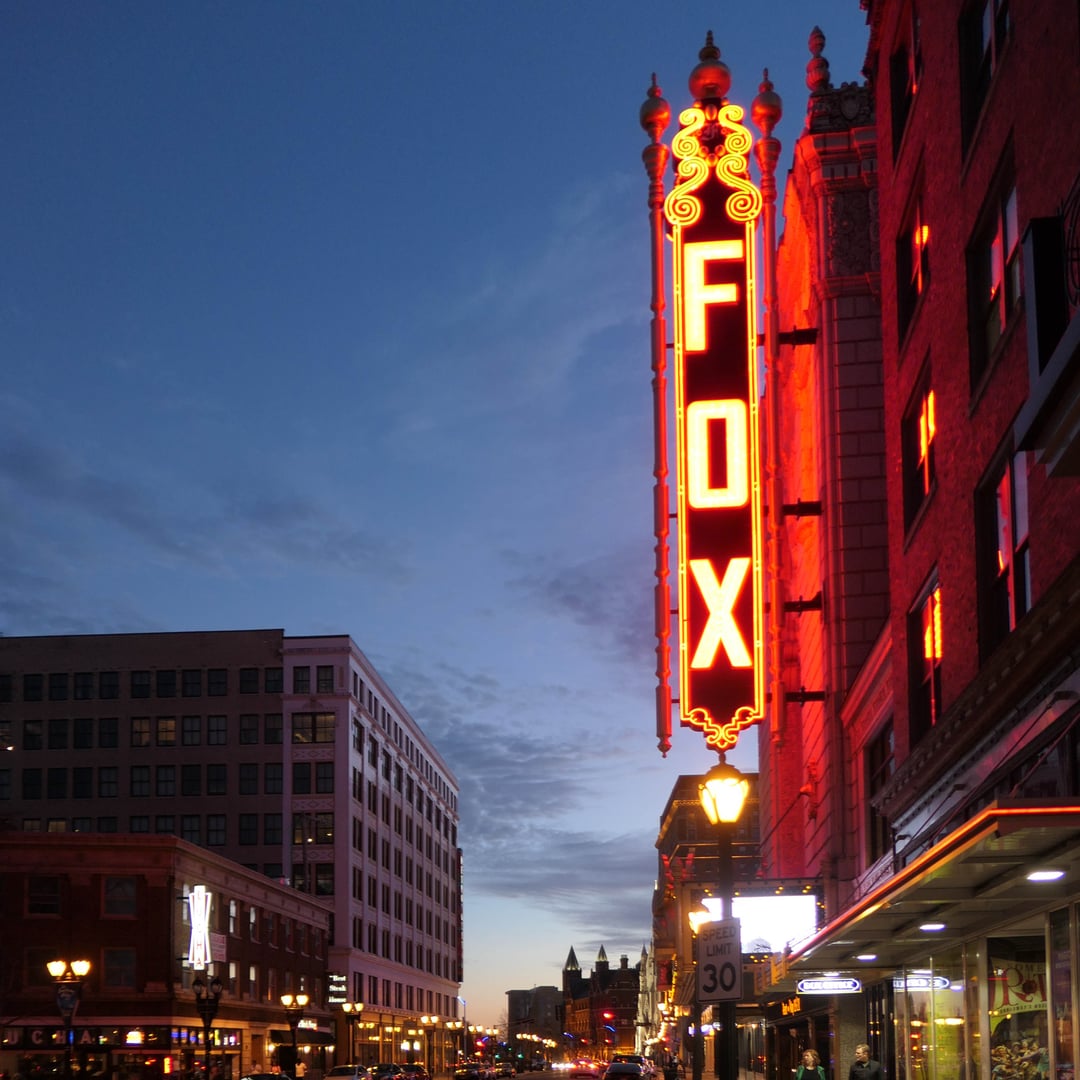
Est. 1949 · National Register of Historic Places (2001, reference 01000750) · Art Deco and Streamline Moderne architecture in Butler County, Missouri · Prominent ziggurat marquee tower on N. Broadway · Built by Poplar Bluff impresario I.W. Rodgers
I.W. Rodgers opened the theatre bearing his name in 1949 on N. Broadway in Poplar Bluff, with Dan Thompson of Poplar Bluff credited as designer alongside architects Hugo K. Graf and Stephens, Edgar & Sons. The building is a three-story brick and concrete commercial structure in Art Deco and Streamline Moderne style, distinguished by a prominent ziggurat marquee tower visible from the street.
The complex is divided into three main sections: the facade and theatre marquee, the theatre proper, and an adjacent office block. On July 19, 2001, the Rodgers Theatre Building was added to the National Register of Historic Places (reference number 01000750), recognized for its architectural significance within Butler County.
The theatre continued to operate after its 1949 opening through various configurations. Manager Shanna Eason has worked the building in recent years and has become one of its most vocal witnesses to unexplained phenomena, describing the activity with equanimity: 'I have never been scared by any of the activities because I love the history.'
Sources
- https://en.wikipedia.org/wiki/Rodgers_Theatre_Building
- https://www.americantheatre.org/2022/10/31/stage-frights-theatre-ghost-stories-vol-7/
- https://www.darnews.com/news/midwest-paranormal-seeking-ghosts-in-poplar-bluff-2457359/
Doors opening and closing on their own — recorded on security cameraDisembodied voice heard by manager while aloneUnexplained footsteps on the roof
The most documented phenomenon at the Rodgers Theatre involves its doors. Manager Shanna Eason describes needing to close the theatre doors repeatedly, only to find them open again. The theatre's own security cameras have recorded the doors opening and closing without anyone visible in the frame.
Eason also reports a personal encounter: while working alone in the building, she heard a voice speak from directly behind her. She turned and found no one. A review of security footage confirmed nothing was captured on camera. She has interpreted the experience with pragmatism rather than alarm, connecting it to the building's history rather than treating it as threatening.
Midwest Paranormal and other investigation groups have conducted formal overnight sessions at the Rodgers, deploying equipment in the theatre and office block sections. American Theatre magazine included the Rodgers in its 2022 roundup of theatre ghost accounts, placing it alongside documented activity at venues nationally. The NRHP designation and the theatre's architectural integrity have made it a draw for both preservation enthusiasts and paranormal investigators.
Media Appearances
- Stage Frights: Theatre Ghost Stories Vol. 7 (American Theatre magazine, 2022)
Where this legend is told