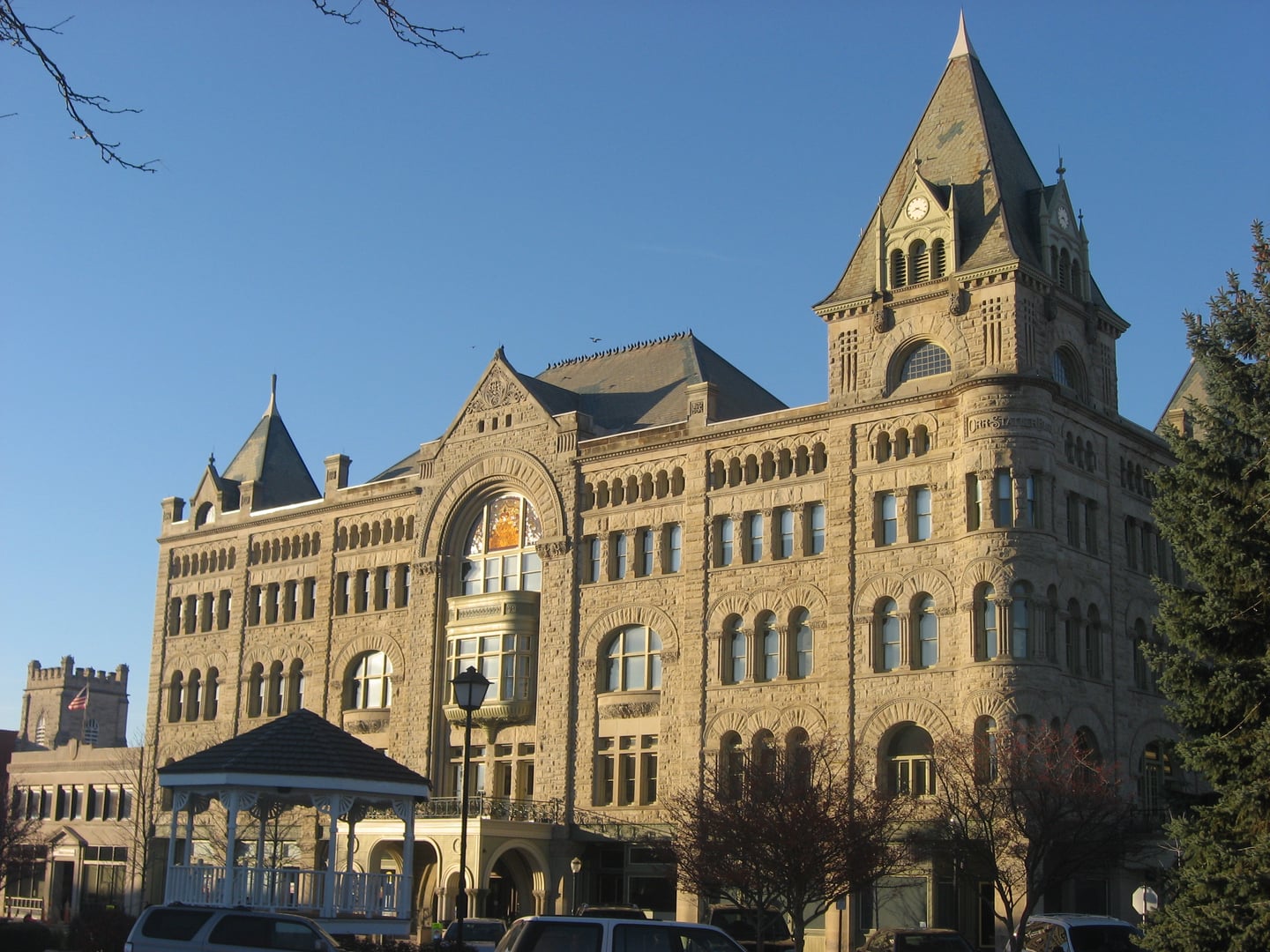
Est. 1906 · Constructed 1888-1906 in Richardsonian Romanesque style by Long and Kees · Joint home of Minneapolis city government and Hennepin County Courthouse · Site of the March 1898 hanging of John Moshik — the only execution ever at the building · 345-foot clock tower with what was the world's largest four-faced chiming clock at construction · Larkin Goldsmith Mead's 1904 marble Father of Waters sculpture in the central rotunda · Added to the National Register of Historic Places in 1974
Construction of Minneapolis City Hall began in 1888 to a design by Minneapolis firm Long and Kees in the Richardsonian Romanesque style favored for large American civic buildings of the era. The exterior is faced in rough-cut Ortonville granite, and the form is dominated by a 345-foot square clock tower whose four-faced chiming clock was the largest in the world when installed. The building was constructed in stages and was largely complete by 1906, with finishing work continuing into 1909. It has served continuously since opening as the joint home of Minneapolis city government and the Hennepin County Courthouse, an unusual shared-use arrangement that persists today.
The building's interior centers on a five-story rotunda whose floor is dominated by Larkin Goldsmith Mead's 1904 marble sculpture Father of Waters, a personification of the Mississippi River carved from a single block of Carrara marble. The Hennepin County District Court historically occupied upper-floor courtrooms, and these spaces have been the scene of major Minneapolis trials and judicial business for more than a century.
On March 18, 1898, John Moshik was hanged at City Hall after being convicted of a robbery-murder on Washington Avenue. The execution — carried out atop an iron spiral staircase in the south tower area — was botched: the drop did not break Moshik's neck and he strangled for roughly three minutes before dying. The death sparked public revulsion and was the only execution ever conducted at Minneapolis City Hall; Moshik's case is widely cited as a catalyst for Minnesota's later abolition of the death penalty in 1911.
Minneapolis City Hall was added to the National Register of Historic Places on August 1, 1974. It remains a working government building, with restoration and preservation overseen by the Minneapolis City Hall Association.
Sources
- https://en.wikipedia.org/wiki/Minneapolis_City_Hall
- https://www.startribune.com/9-crazy-facts-you-never-knew-about-the-minneapolis-city-hall-building/386336121
- https://libguides.mnhs.org/capitalpunishment/newspapers
- https://cities971.iheart.com/content/2018-10-28-haunted-minnesota-city-halls-brutal-last-hanging/
- https://deathpenaltyusa.org/usa1/date/1898.htm
Apparition of a man in 1890s clothing on the fifth floorPictures rearranging themselves on wallsDoors opening and closing in empty corridorsFlickering lights without electrical causeUnexplained voices and footstepsCold drafts and sudden temperature drops
According to Meet Minneapolis, Cities 97.1, and Minnesota Haunted Houses, the dominant ghost lore at City Hall traces back to the March 1898 hanging of John Moshik, convicted for a robbery-murder. The drop failed to break Moshik's neck; he strangled for roughly three minutes. Because of the brutality of the execution, no further hangings were ever conducted at the building, making Moshik's death the only one of its kind on site.
The paranormal accounts cluster on the fifth floor near the former courtroom where Moshik was convicted and the area where he was hanged. Staff and visitors report an apparition described as a thin man in 1890s clothing, occasionally appearing in undergarments — a detail tour narrators link to descriptions of the execution. Pictures are said to rearrange themselves on walls, doors open and close in empty corridors, lights flicker without electrical cause, and unexplained voices, footsteps, and cold drafts circulate the upper floors. Some accounts describe Moshik's mood as variable: by some retellings he merely shifts framed photographs, by others he is blamed for sudden bouts of illness among attorneys and judges working the upper floors.
Most of these accounts trace to ghost-tour aggregators and local media features rather than independent paranormal investigations. The verifiable historical anchor — Moshik's botched hanging in March 1898 — is supported by Minnesota Historical Society newspaper archives and the Star Tribune's documentation of the building's history.
Notable Entities
John Moshik — hanged March 1898 for robbery-murder at Minneapolis City Hall