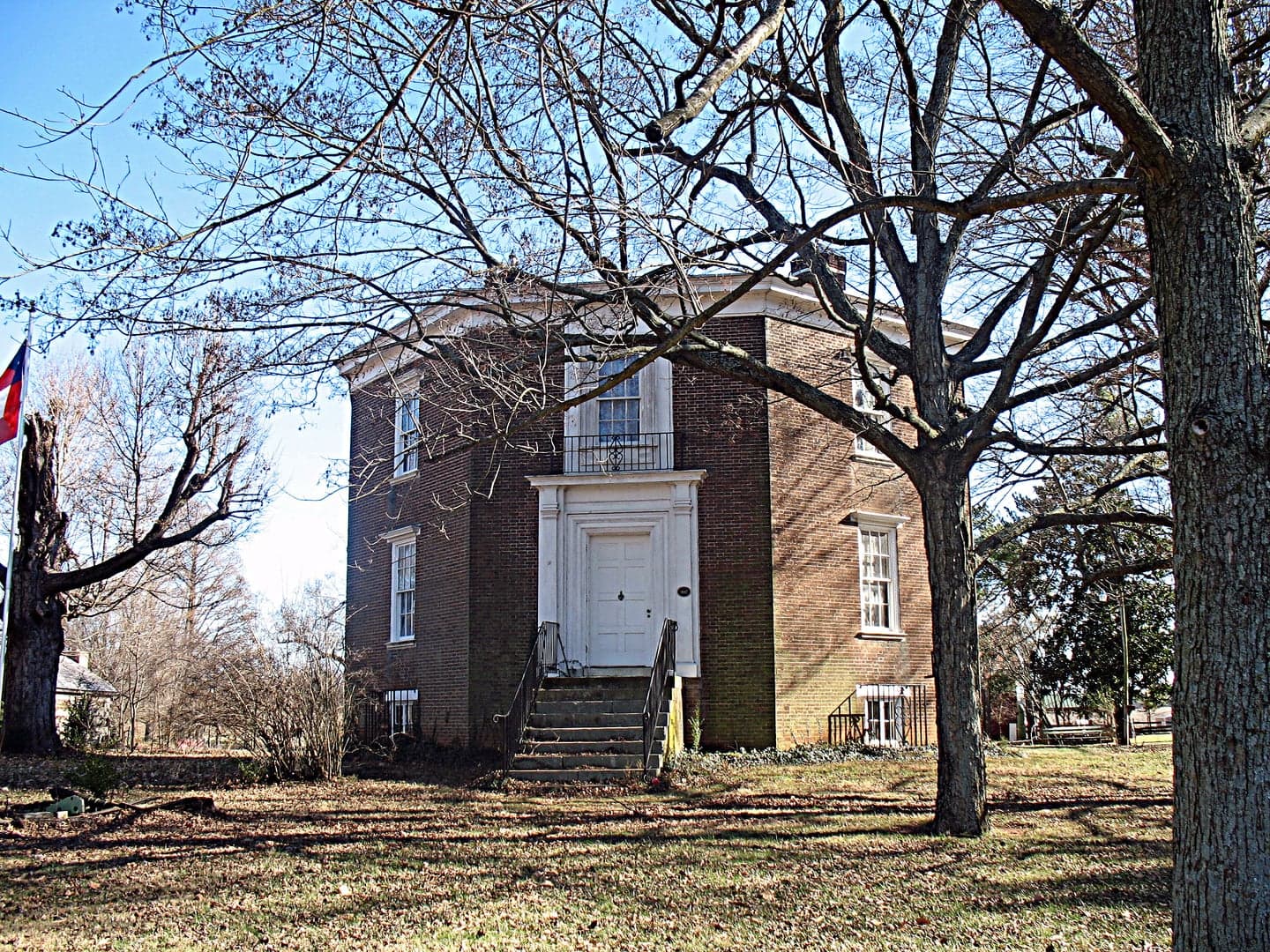
Est. 1780 · Listed on the National Register of Historic Places (1975, Ref. No. 75000866) · One of the few surviving early plantation farmhouses in Baltimore County · Stansbury family cemetery on site with burials from 1742 · Example of Federal architectural style with documented mid-19th-century addition
The land on which the Ballestone-Stansbury House stands was first granted in 1659 to William Ball of Virginia. The Stansbury family acquired the property in the following decades; the nearby Stansbury cemetery contains burials dating to 1742. Dixon Stansbury built the current structure around 1780 on Cedar Point, a peninsula between the Back and Middle Rivers in what is now Essex, Baltimore County.
The red-brick Federal-style home features Flemish bond brickwork, a white-painted facade with black shutters, and a distinctive white-pillared porch added in the 19th century. A second floor was added to a one-story wing between roughly 1870–1880, reflecting the property's continuous occupation and gradual enlargement over a century.
Due to an incorrect title search in the 1970s, the home came to be known popularly as 'Ballestone Manor,' a name that actually belongs to a separate property at Balliston Point half a mile away. The proper name, Ballestone-Stansbury House, was established in 2006. Baltimore County acquired the property in 1969 for inclusion in Rocky Point Park; after a period of deterioration in the 1970s, restoration began as a Bicentennial project and the house opened for public tours in 1977. It was listed in the National Register of Historic Places on June 18, 1975 (NRHP Ref. No. 75000866).
The Ballestone Preservation Society administers the site and furnishes the rooms to document a middle-class Maryland family across three phases of the home's architectural development.
Sources
- https://en.wikipedia.org/wiki/Ballestone_Mansion
- https://www.baltimoresun.com/news/bs-xpm-1990-09-11-1990254066-story.html
- https://www.baltimorecountymd.gov/departments/recreation/parks-directory/ballestone-stansbury-house
- https://www.visitmaryland.org/listing/visual-arts/ballestone-manor-house
Footsteps in empty roomsDoors closing without causeCreaking soundsApparitions in period-furnished roomsDisembodied voices
According to a 1990 Baltimore Sun feature on the property, as the number of museum visitors increased, Ballestone Preservation Society members noted that the home's paranormal reputation became an unexpected draw. Members described hearing creaking sounds, footsteps walking away from them in otherwise empty rooms, and doors closing without explanation.
The Maryland Haunted Houses registry documents additional visitor reports from the home: apparitions seen inside the period-furnished rooms, and disembodied voices heard in the house during quiet hours. The home's history of continuous occupation from the 1780s through the 20th century, combined with its preserved interior and on-site family cemetery, has made it a recurring subject of interest for regional paranormal enthusiasts.
The Shadowlands database submission — which described activity in 'slave's quarters in the back' — cannot be independently corroborated; no historical society, NRHP documentation, or other source specifically identifies a slave quarters structure or paranormal events associated with one. The George Washington connection cited in the Shadowlands entry is also overstated: the land was originally granted to William Ball, Washington's maternal great-grandfather, but Washington himself has no documented connection to this specific structure. The paranormal tradition at the Ballestone-Stansbury House rests on the home's documented visitor reports and the Preservation Society's own accounts.