Est. 1637 · Second-Oldest European Cemetery in the United States · Burial Site of Salem Witch Trials Magistrate John Hathorne · Mayflower Passenger Richard More Burial · National Register of Historic Places (Charter Street District)
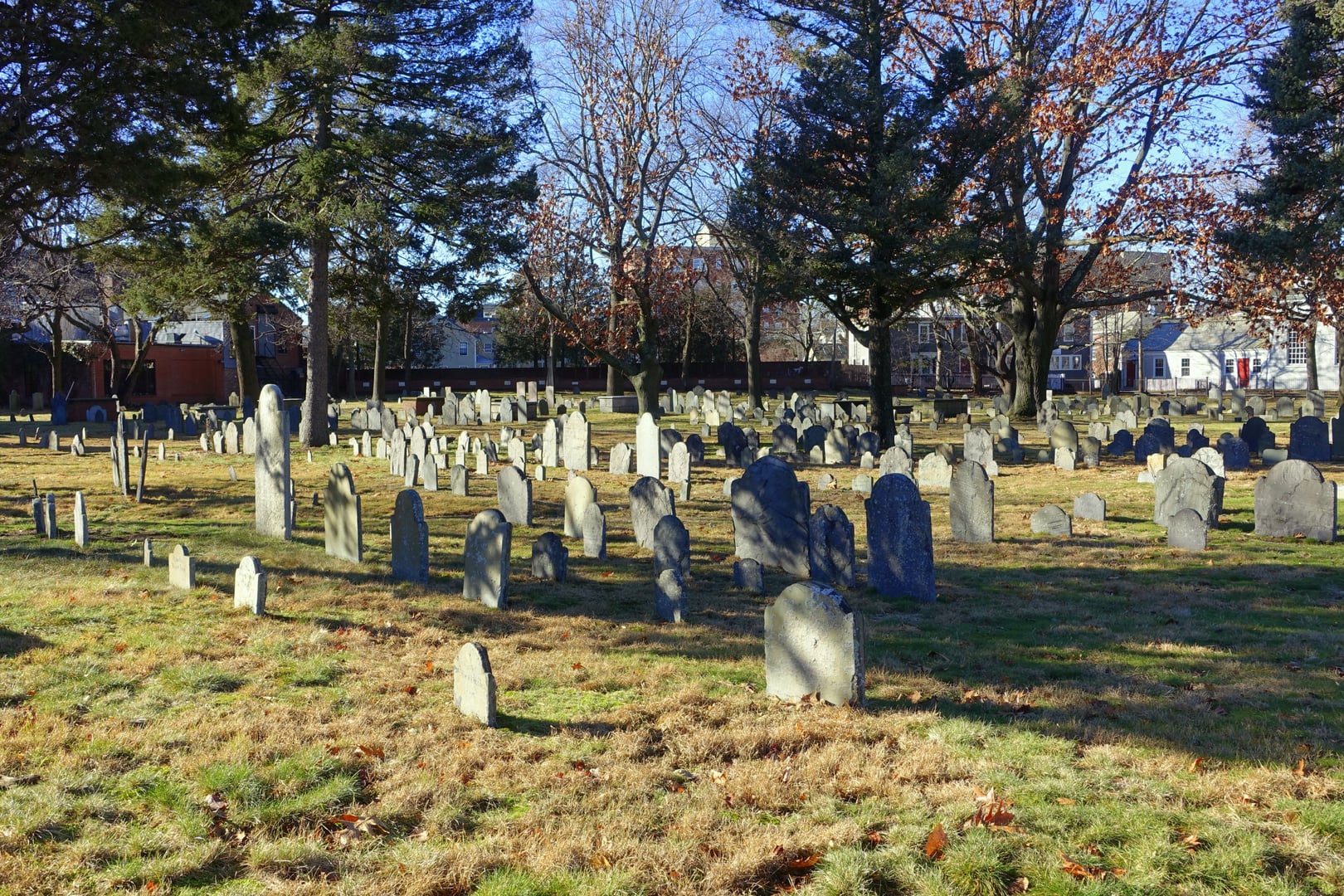
Charter Street Burial Ground, also known as Old Burying Point, was established in 1637, seven years after the founding of Salem. It is the oldest cemetery in Salem and is generally cited as the second-oldest European burying ground in what is now the United States, after the Myles Standish Burial Ground in Duxbury, Massachusetts.
The cemetery occupies 1.47 acres bounded by Charter Street, Liberty Street, and the modern Salem Witch Trials Memorial. The grounds contain roughly 700 headstones and 17 box tombs, dating from the late seventeenth through nineteenth centuries.
Notable burials include Judge John Hathorne, one of the principal magistrates of the 1692 Salem Witch Trials, who died in 1717. Hathorne is the ancestor of the novelist Nathaniel Hawthorne, who added the w to the family name in part to distance himself from the magistrate's legacy. Other significant burials include Reverend Nicholas Noyes, a clergyman associated with the trials; Bartholomew Gedney, another trial-period magistrate; and Mary Corey, said by tradition to be the wife of Giles Corey, although her exact identification is disputed by genealogists. Richard More, who arrived in New England on the Mayflower in 1620, is also buried here.
The persons executed during the Salem Witch Trials are not buried in Charter Street Cemetery. Because they were executed by the state and Puritan burial conventions did not include them, they were interred in unmarked locations, several of which have only been confirmed by modern archaeology near Proctor's Ledge in Salem.
The cemetery was restored extensively in a project completed in 2020, including the construction of the Charter Street Cemetery Welcome Center and a designed visitor path that protects the older stones. The cemetery is on the National Register of Historic Places as part of the Charter Street Historic District.
Sources
- https://www.charterstreetcemetery.com/visiting
- https://salemwitchmuseum.com/locations/old-burying-point-charter-street-cemetery/
- https://historyofmassachusetts.org/old-burying-point-cemetery-salem/
- https://salempl.org/wiki/index.php?title=Charter_Street_Burial_Ground
ApparitionsPhantom voicesShadow figuresCold spots
Charter Street Cemetery sits at the center of Salem's dark-tourism geography, immediately adjacent to the Salem Witch Trials Memorial and a short walk from the Peabody Essex Museum's historic Salem Witch Museum. The cemetery's atmosphere is heavily mediated by the trials, even though the executed of 1692 are not buried here.
Visitor accounts collected by Salem Ghosts, Ghost City Tours, and similar operators describe a consistent vocabulary of reports: unexplained voices among the older box tombs, fragmentary phrases that read as Puritan diction, shadow movement at the periphery of vision at dusk, and a heaviness of atmosphere near the cluster of stones associated with trial-era magistrates and clergy.
A recurring tradition identifies an apparition near the cluster of graves containing Hathorne, Noyes, and Gedney; descriptions cast the figure as a Puritan-era man in dark clothing. The accounts are folk in character and have not been corroborated by named historical events beyond the cemetery's documented links to the trials.
The Salem Witch Museum, which provides interpretation for the cemetery, treats the trials with archival neutrality and discourages framing the executed of 1692 as supernatural agents. Visitors who pair the cemetery with the adjacent Memorial and the Proctor's Ledge execution site can build a coherent picture of the trials' geography across one afternoon.