Est. 1659 · Boston's Second-Oldest Cemetery (1659) · Colonial Free Black Community Burials — Prince Hall Section · Cotton Mather and Increase Mather Burial Site · British Artillery Position — Battle of Bunker Hill (1775) · Daniel Malcolm's Bullet-Riddled Headstone · Freedom Trail Stop
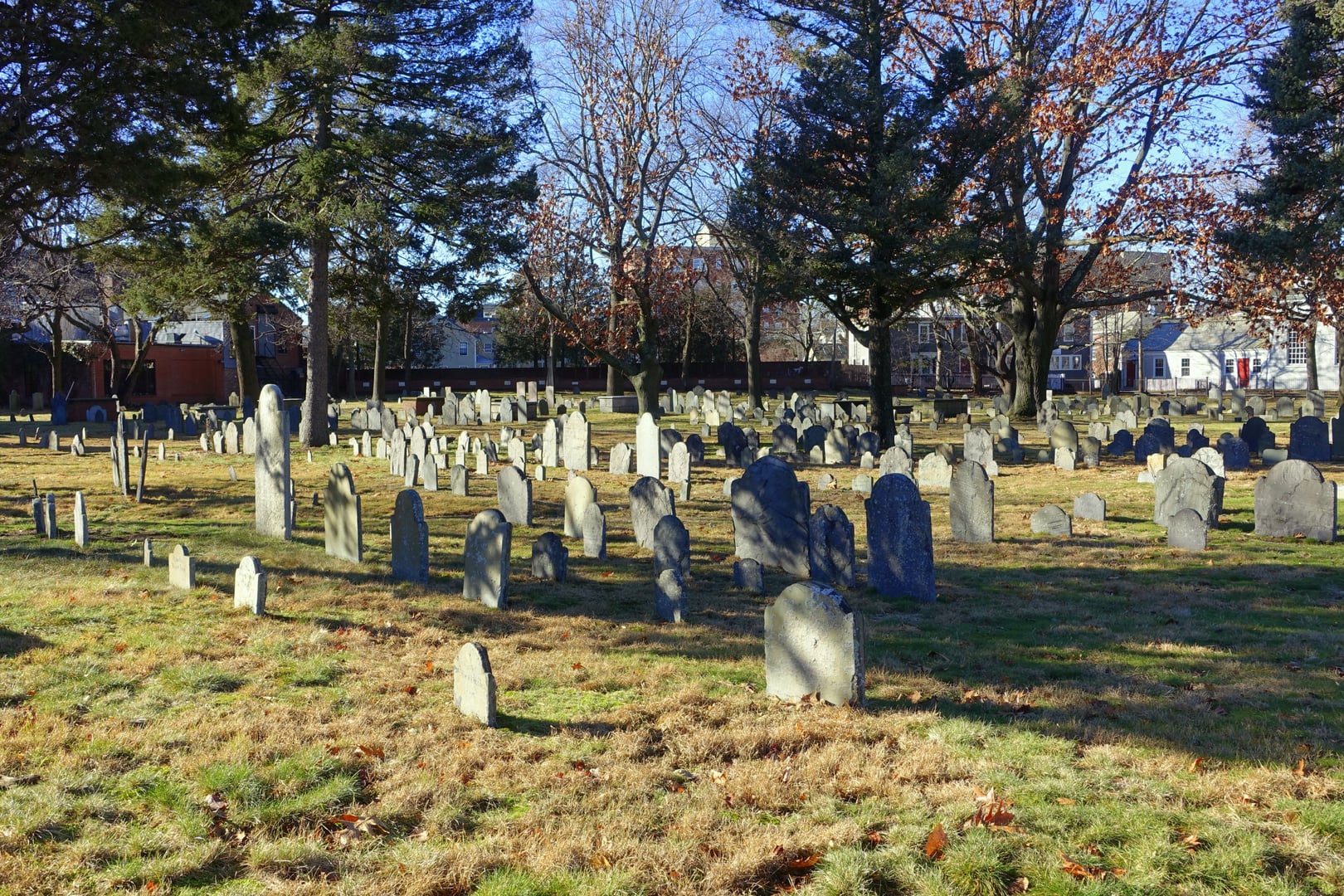
Copp's Hill Burying Ground was established in 1659 on a hillside overlooking Boston Harbor in the North End, making it the city's second-oldest cemetery after the King's Chapel Burying Ground (1630). The site takes its name from William Copp, an early cobbler who owned land on the hill.
The cemetery served as the principal burial ground for North End residents across several social strata. Among the most historically significant sections are the graves of Puritan ministers Increase Mather and Cotton Mather, two of the most influential clergymen of colonial New England. The Prince Hall section contains more than 1,000 graves of Boston's colonial-era free Black community, including members of the Snowden family whose headstones are among the earliest documented African American grave markers in New England.
Robert Newman, who hung Paul Revere's lantern signal in the steeple of Old North Church on the night of April 18, 1775 — "one if by land, two if by sea" — is buried at Copp's Hill.
During the Siege of Boston, British troops occupied the hill and used it as an artillery battery, firing on Charlestown during the Battle of Bunker Hill on June 17, 1775, when they burned much of the town. Daniel Malcolm's headstone — Malcolm was a Boston merchant and a member of the Sons of Liberty whose stone inscription proclaimed him an 'Enemy to Oppression' — was used by British soldiers as a target for musket practice. The bullet holes that resulted are still clearly visible on the stone today.
Copp's Hill is a stop on Boston's official Freedom Trail and is managed by the City of Boston Parks and Recreation Department. It appears on the National Register of Historic Places.
Sources
- https://en.wikipedia.org/wiki/Copp%27s_Hill_Burying_Ground
- https://www.boston.gov/cemeteries/copps-hill
- https://revolutionarywarjournal.com/best-ghost-stories-of-the-american-revolution/
EVP recordingsShadow figures between headstonesSudden temperature dropsAtmosphere of agitation near desecrated graves
Copp's Hill's haunting reputation is anchored in a specific documented history: British soldiers using the graves of Boston patriots and community members for target practice during the siege, and the broader desecration of a sacred space for military purposes. Ghost City Tours and Ghosts and Gravestones, two of Boston's principal paranormal tour operators, include Copp's Hill on their routes and have documented the site in detail.
Paranormal investigators working the site have reported EVP (electronic voice phenomenon) recordings in the older sections near the Malcolm and Mather graves. Shadow figures moving between headstones have been reported by multiple independent visitors, and tour participants describe sudden and localized temperature drops — the kind of cold spot that paranormal tradition associates with entity activity rather than drafts in an open urban space.
A persistent atmospheric quality reported across multiple sources is a sense of anger or agitation, which accounts link to the desecration of the graves by British troops. Whether this represents a genuine reportable phenomenon or a projection by visitors who know the history is not something any published investigation has resolved.
The site's reputation draws enough visitor interest that Boston's major ghost tour operators make it a standard stop. The Revolutionary War Journal's coverage of American Revolution ghost stories cites Copp's Hill as one of the most reliably reported paranormal sites from the period, alongside documented historical trauma rather than invented lore.
Notable Entities
Daniel Malcolm (Sons of Liberty merchant, buried here)
Where this legend is told