Est. 1836 · U.S. Army Ordnance Depot and Powder Storage (1836–1861) · Confederate Seizure (January 1861) · Battle of Baton Rouge (August 5, 1862) · National Register of Historic Places (1973) · One of Two Surviving Arsenal Structures
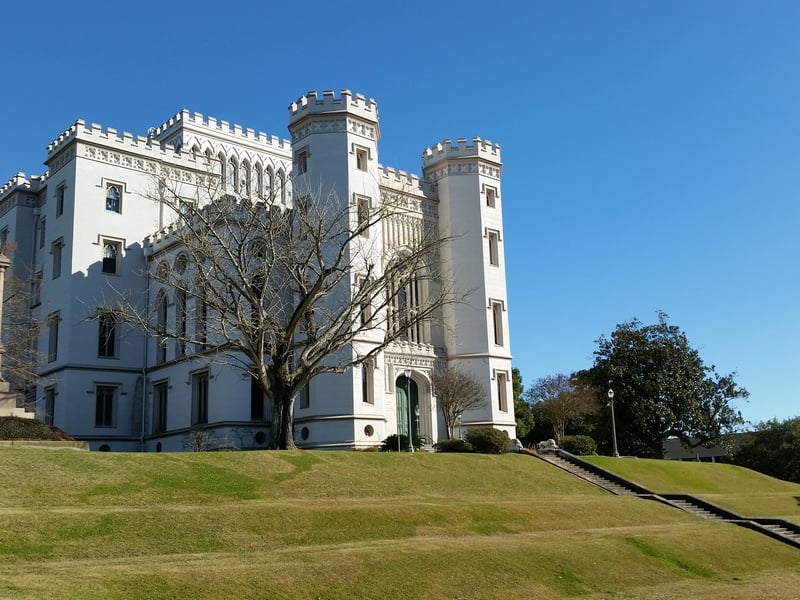
The Old Arsenal Powder Magazine was constructed by the U.S. Army between 1836 and 1838 adjacent to the main Baton Rouge Arsenal and Ordnance Depot on what is now the Louisiana State Capitol grounds. The thick-walled stone structure was designed to store explosive powder safely, with a capacity of approximately 3,000 barrels. It is one of only two surviving structures from the original arsenal complex.
When Louisiana seceded in January 1861, Confederate forces seized the arsenal and its stores. Union troops retook Baton Rouge in May 1862 after the fall of New Orleans. On August 5, 1862, Confederate forces under General John C. Breckinridge launched an assault on the city — the Battle of Baton Rouge. The powder magazine absorbed artillery fire during the engagement and survived structurally intact, a fact the museum's exhibits still document.
The building was listed on the National Register of Historic Places on June 14, 1973, the same designation cycle that covered the adjacent Pentagon Barracks. It was subsequently restored and converted to its current use as the Old Arsenal Museum, operated by the Louisiana Secretary of State's office. The museum interprets the military and political history of the arsenal, the 1862 battle, and Louisiana's Civil War experience.
The site is also notable for its proximity to an undisturbed Native American ceremonial mound within the Capitol grounds, adding an additional layer of historical depth to the property.
Sources
- https://www.brproud.com/news/local-news/baton-rouge/baton-rouges-old-arsenal-museum-former-powder-magazine-listed-in-national-register-of-historic-places/
- https://64parishes.org/entry/old-arsenal-museum
- https://www.exploresouthernhistory.com/powdermagazine.html
Full-body apparitionsInteraction with visitors (questioning figures)Unexplained presence in museum interiorApparitions in adjacent Arsenal Park
The most specifically named figure associated with the Old Arsenal Museum is called Billy Boy Blue by those who have encountered him — described as a uniformed soldier, apparently from the Civil War era, who appears in the museum's interior. Accounts characterize him as a presence connected to a wrongful death, though the historical basis for this claim has not been independently documented.
A second reported figure is notable for its interactive quality: witnesses describe being approached by a figure in period dress who asks questions about ordinary modern objects — a watch, a phone, a piece of clothing — as if genuinely unfamiliar with them, before disappearing without warning. Both accounts come from staff and visitors rather than from published paranormal investigations.
The adjacent Arsenal Park has separately generated reports of soldier figures moving through the oak trees on the grounds, a phenomenon described in local journalism. The proximity to a Native American ceremonial mound within the Capitol grounds has led some accounts to layer additional narratives onto the site, though these remain undocumented at the primary source level.
Notable Entities
Billy Boy Blue