Est. 1940 · National Register of Historic Places · New Deal Architecture · Louisiana Tech Campus History
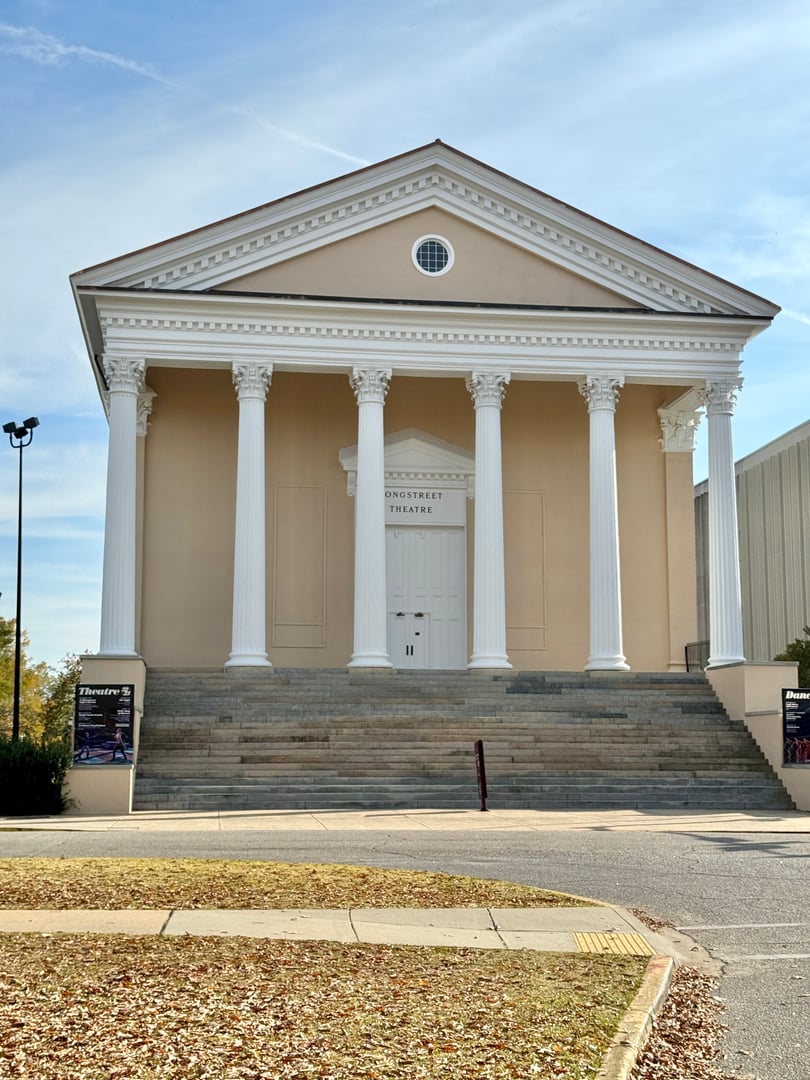
Howard Auditorium was designed by Shreveport architect Edward F. Neild as part of a group of seven buildings completed at Louisiana Tech during the late New Deal era, at a combined cost of $2,054,270. Construction ran from 1938 to 1940. The building was named for Harry Howard, the university's first graduate, who also served as the institution's treasurer for four decades.
Neild's Streamline Moderne design was distinctive on the campus, departing from the Georgian Revival style found in Louisiana Tech's earlier buildings. The auditorium was constructed as a combined performance and academic facility — the Howard Auditorium and Fine Arts Building — and remains one of the architecturally significant structures on the central quad.
The building is listed on the National Register of Historic Places, recognized for its architectural significance within the context of Louisiana Tech's 1930s-1940s campus development. Today the auditorium continues to function as an active performance venue at the center of campus, surrounded by the Student Center, Prescott Memorial Library, and other quad-facing buildings.
Vera Alice Paul, a former speech and English professor at Louisiana Tech during the early and middle twentieth century, retired from the university in 1952 and moved to Iowa, where she died in a nursing home in 1962. She has been associated with Howard Auditorium in campus tradition, though the specific legend of her death in the building is factually incorrect.
Sources
- http://hauntednation.blogspot.com/2016/10/la-tech-jack-howard-auditorium-ruston.html
- https://en.wikipedia.org/wiki/History_of_Louisiana_Tech_University
- https://www.stoppingpoints.com/louisiana/Lincoln/Howard+Auditorium,+Louisiana+Tech+University.html
- https://haunttracker.com/haunted-places/louisiana/ruston/louisiana-tech-university/
- https://peachtown.org/ruston-theater/
ApparitionsObject movementIntelligent haunting
The simplest and most-repeated account from Howard Auditorium involves the theater's seating. The seats are spring-loaded and return to the upright position when unoccupied. When staff or students enter the empty auditorium, one seat is reliably found in the down position — as though someone has just been sitting there. Pushing it up resolves the situation temporarily; returning later, another seat, or the same one, will be found down again.
Students working in the theater during late hours have reported seeing the figure of a woman seated in the auditorium, watching them. The figure vanishes when observed directly or approached.
The presence is attributed in campus tradition to Vera Alice Paul, a professor of speech and English who taught at Louisiana Tech through the mid-twentieth century and was known for her dedication to the theater program. A Louisiana Tech theater professor, addressing the legend in online comments, clarified that Paul retired in 1952 and died in an Iowa nursing home in 1962 — the story of her suicide in the auditorium is not factually accurate. The same professor noted that Paul is still honored by the School of Theatre through an annual award in her name, and that the department considers her presence a protective one rather than a troubling one.
The spring-loaded seat phenomenon has no mechanical explanation from facilities staff that has been documented in public sources.
Notable Entities
Vera Alice Paul