National Historic Landmark · French Colonial Architecture · LGBTQ+ Cultural History · Tennessee Williams Heritage
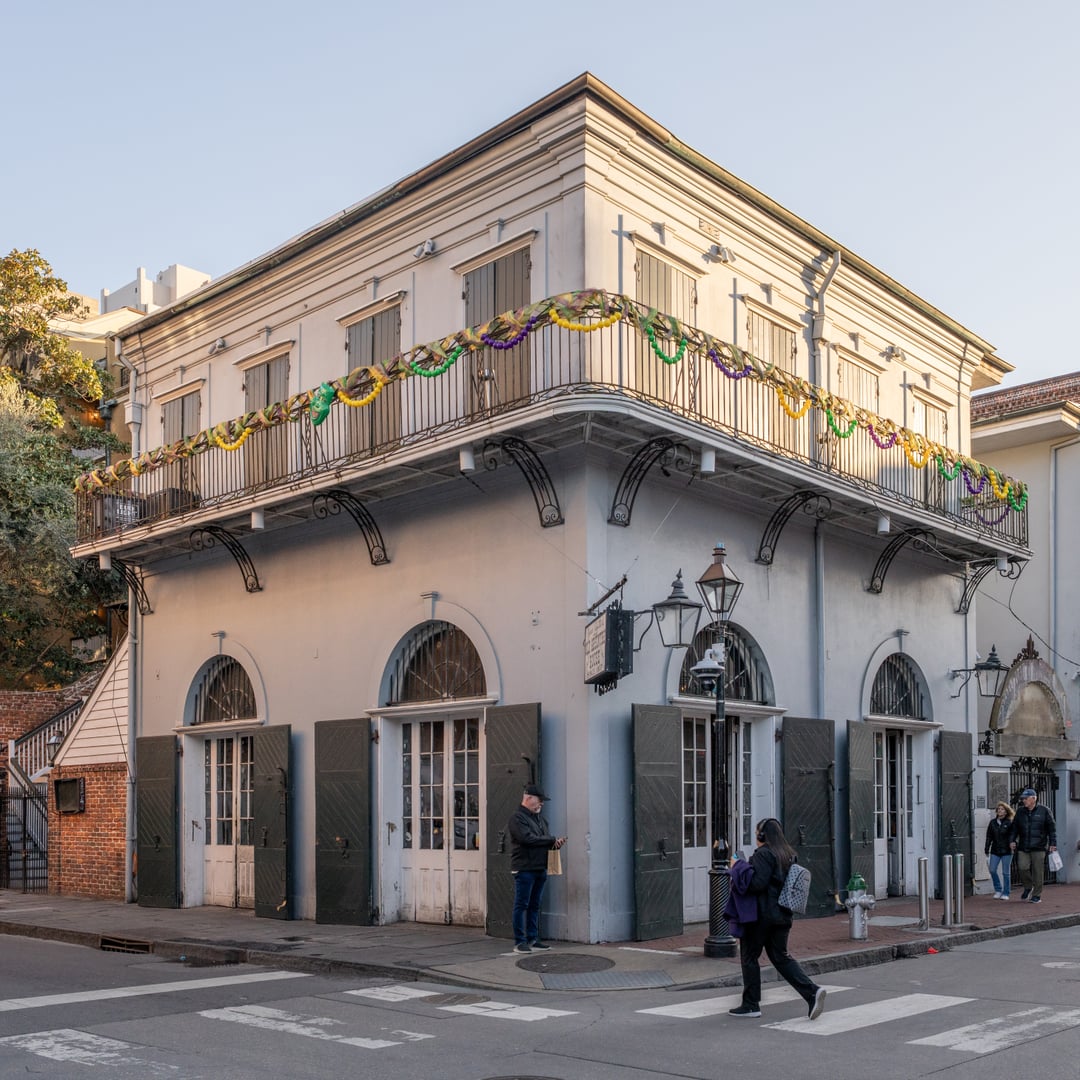
The building at the corner of Bourbon and St. Philip Streets is a French Colonial cottage that the Vieux Carré Survey says most likely dates from the 1770s. The walls use briquette-entre-poteaux construction - soft Spanish-period bricks set between heavy cypress posts and beams - and the original double-pitched hipped roof remains in place. The structure survived both of the late-eighteenth-century French Quarter fires that destroyed much of the surrounding building stock. It was designated a National Historic Landmark in 1970.
The building's name derives from a romantic association with the Lafitte brothers, Jean and Pierre, who operated the Barataria smuggling network in southern Louisiana in the early nineteenth century. Local tradition holds that the brothers used the building as a base for their New Orleans operations. The National Park Service states that no evidence confirms the Lafitte blacksmith-shop legend. The Lafitte name appears to have been attached to the building in the mid-twentieth century as bar branding.
The building has had multiple uses across its 250-year history. In the mid-1940s, Roger 'Tom' Caplinger renovated the long-abandoned ground floor and opened Cafe Lafitte. The bar quickly became a fixture in the bohemian and gay subcultures of postwar New Orleans, with regulars including Tennessee Williams and Noel Coward. Cafe Lafitte's later split into the current Lafitte's Blacksmith Shop and the separate Cafe Lafitte in Exile a few blocks away on Bourbon Street. The Blacksmith Shop has operated continuously as a bar in its current configuration since the 1950s.
Sources
- https://en.wikipedia.org/wiki/Lafitte's_Blacksmith_Shop
- https://www.lafittesblacksmithshop.com/AboutUs.html
- https://neworleanshistorical.org/items/show/616
- https://www.nola.com/entertainment_life/home_garden/lafittes-blacksmith-shop-intrigues-even-without-the-fiction/article_dc8d8b46-beb5-11ee-8a48-6b98dda4813d.html
- https://urbanlegendsmysteryandmyth.com/2026/01/haunted-roadtrips-lafittes-blacksmith.html
- https://americanghoststories.com/haunted-blacksmiths-shop-lafittes-orleans-la/
ApparitionsPhantom footstepsPhantom smellsObject movement
The bar's haunted reputation rests largely on the strength of its building and its association with the Lafitte legend. Patrons and staff have for decades reported a recurring figure in eighteenth-century dress observed near the central fireplace, often identified by tour guides as Jean Lafitte. The figure is most often described as bearded and dark-eyed; some accounts describe a pair of glowing red eyes observed from within the fireplace itself after closing hours.
Other regular reports include the smell of pipe tobacco in unoccupied corners, the sound of footsteps overhead when the upstairs is unoccupied, drinks moved or knocked over without contact, and figures observed in the windows from Bourbon Street after the bar has closed. The dim candlelit interior and the building's structural irregularities - sloping floors, uneven walls, and the deep shadows cast by the central fireplace - contribute to the atmospheric weight independent of any specific incident.
Ghost Adventures, the Travel Channel, and multiple French Quarter walking-tour operators have covered Lafitte's Blacksmith Shop as a haunted location. The bar itself does not actively program around the ghost stories. Visitors who order a drink and spend an evening at the back fireplace get the full effect of the building without needing the supernatural framing to make sense of why the place is unsettling.
Notable Entities
The Figure in the Fireplace