Est. 1848 · National Register of Historic Places · Greek Revival Architecture · Slavery in Antebellum Kentucky · Daniel Boone Family Connection
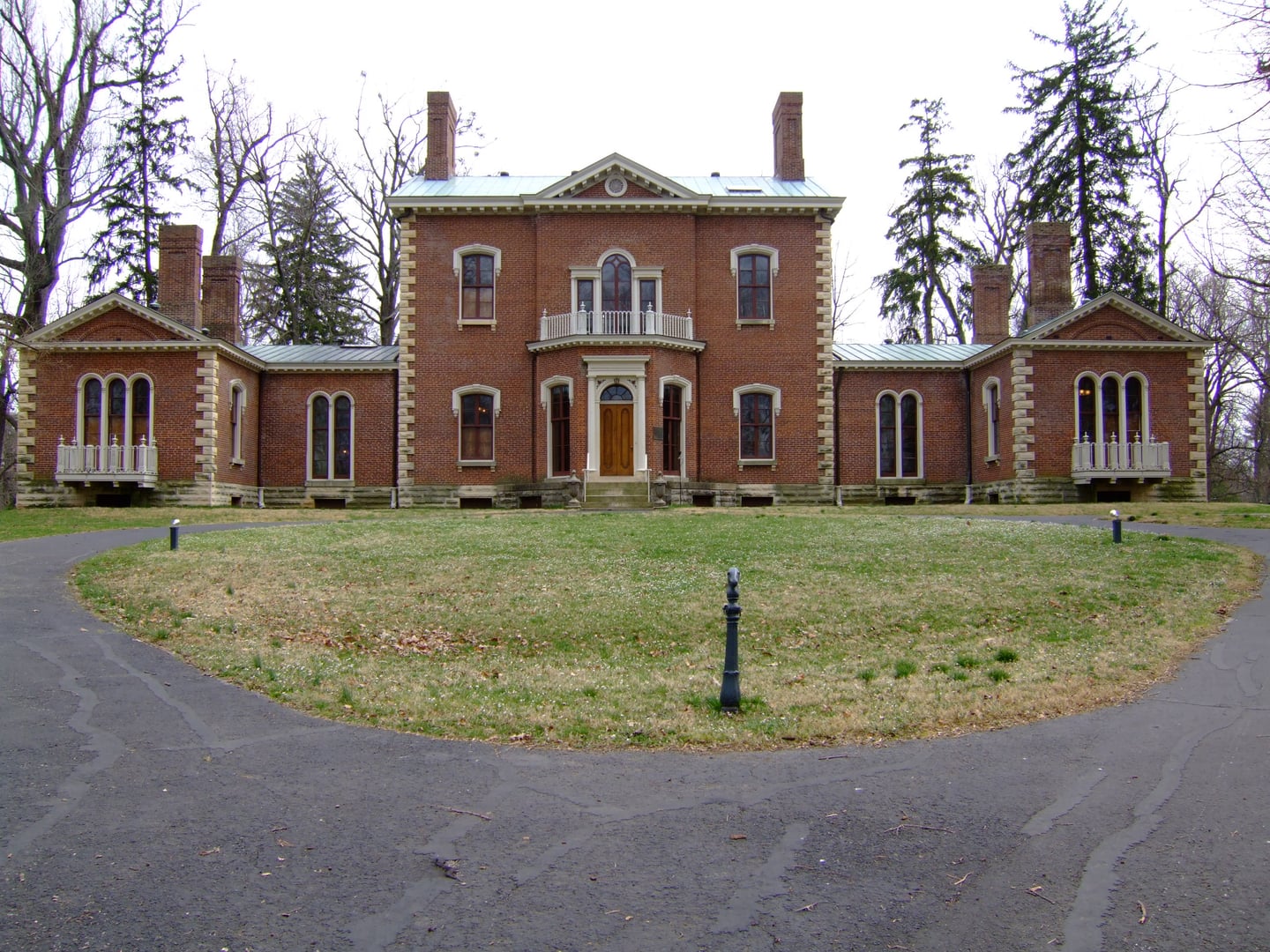
The land at Waveland was first surveyed by Daniel Boone in 1779. Daniel Boone Bryan, Boone's nephew, settled the property and ran a gun-and-paper-making operation. The land passed to his son Joseph Bryan, who completed the present Greek Revival mansion in 1848 — a substantial three-story brick house with a portico of Ionic columns and double parlors. The Bryan family ran Waveland as a working hemp, livestock, and Thoroughbred operation, and the estate at its height encompassed roughly 2,000 acres.
Waveland was a slaveholding plantation. The site retains original outbuildings tied directly to the labor of the enslaved people who sustained the estate: the duplex slave quarters, the smokehouse, and the ice house. Kentucky State Parks interprets these structures alongside the mansion as integral to the property's full history, not as ancillary buildings. Documentation on the enslaved residents is uneven — common across most antebellum sites — but state-park programming attempts to recover and present what is known.
The Bryan family sold Waveland in 1894. The property changed hands several times before the Commonwealth of Kentucky acquired it in 1956. The University of Kentucky operated it as an agricultural museum into the 1970s, after which Kentucky State Parks took over full operation. The site was added to the National Register of Historic Places in 1971.
Waveland today is a 10-acre interpretive site offering scheduled house tours, school programs, and seasonal events including the annual candlelight ghost tour. The mansion retains many original architectural features — interior woodwork, plaster cornices, and the central staircase — and is furnished with period pieces, some original to the Bryan family.
Sources
- https://en.wikipedia.org/wiki/Waveland_State_Historic_Site
- https://parks.ky.gov/explore/waveland-state-historic-site-7805
- https://www.visitlex.com/listing/waveland-state-historic-site/5915/
Object manipulationSensed presenceFootsteps
Waveland's reputation as a haunted site has been institutionally cultivated rather than left to oral tradition alone. The Kentucky State Parks site runs an annual candlelight ghost tour — covered by Kentucky Monthly and Kentucky Living — in which the historical interpreters present the reported phenomena alongside the property's documented history. The tour itself, more than any single witness account, is the central paranormal artifact attached to Waveland.
Reported phenomena at the site, according to published accounts, include staff finding cabinets and drawers opened without human intervention during morning setup — one named-staff account describes turning on kitchen lights to find the kitchen rearranged. Visitors on candlelight tours have described cold spots and a sensed presence in the upper floors of the main house. The slave quarters, smokehouse, and ice house are part of the tour route and figure into the reported activity, though the staff frames discussion of those buildings around the documented lives of the enslaved residents rather than around generic 'plantation ghost' tropes.
Waveland has been featured in paranormal television productions covering Kentucky sites, as documented by the Kentucky Kernel's coverage of a paranormal show premiere centered on the property. The activity reported on those programs tracks with the staff accounts: opened drawers, footsteps in unoccupied rooms, and a generalized sensed presence on the second floor. Visitors interested in the paranormal lore should consider that most of the published activity originates from on-site staff during tour-prep hours and from formal investigations rather than from casual day visitors.
Notable Entities
Bryan family
Media Appearances
- Paranormal television feature reported by Kentucky Kernel