Est. 1902 · National Register of Historic Places Historic District · Illinois Psychiatric History · Cottage System Architecture · Dr. George Zeller Legacy
The 1895 Illinois General Assembly authorized a new institution for the 'incurably insane' after the existing facilities in the state were chronically overcrowded. A commission appointed by Governor John Altgeld selected land near Peoria in Bartonville, and construction began. The first main building, completed by 1897, was never used — engineers found it either structurally compromised by abandoned mine shafts beneath the site or simply out of step with evolving institutional design philosophy. The entire structure was demolished and rebuilt.
The reconstructed facility opened February 10, 1902 under the direction of Dr. George Zeller. Zeller was a significant figure in American psychiatric history: he ran the institution according to therapeutic rather than purely custodial principles, cultivated public interest in mental health care by inviting journalists and community members to visit, and documented his experiences in an autobiography published in the 1920s. He served two tenures as superintendent — 1902 to 1913 and 1921 to 1935.
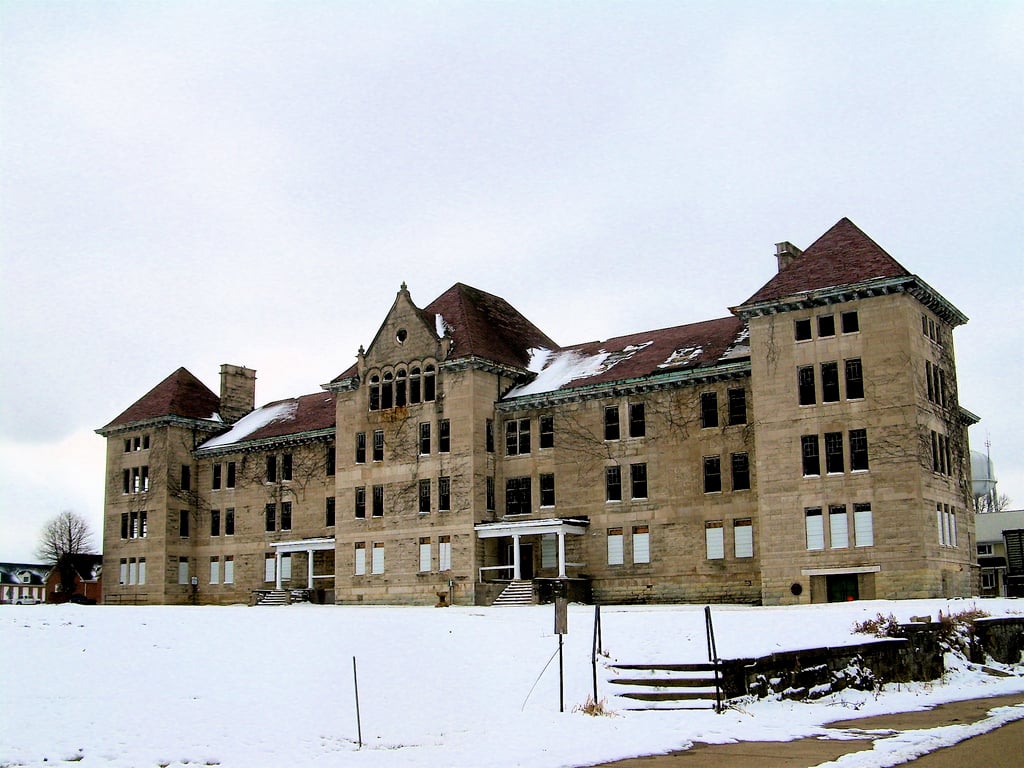
The campus Zeller built was a genuine architectural achievement. The cottage system design — 33 residential buildings for patient housing spread across 215.5 acres, supplemented by staff quarters, a power station, bakery, farm infrastructure, and eventually a nursing school opened in 1906 — created a self-contained community rather than a warehouse. The buildings combined Prairie, Mission, Classical Revival, and Georgian Revival architectural styles.
Patient population grew steadily: 13,510 cumulative admissions by 1927, reaching approximately 2,800 patients at peak in the 1950s. The institution underwent repeated name changes as state mental health policy evolved: Illinois Hospital for the Incurable Insane (1902), Illinois General Hospital for the Insane (1907), Peoria State Hospital (1909).
Declining census in the 1960s and early 1970s led to closure in 1973. The subsequent auction of buildings — and the bankruptcy of the primary buyer — resulted in widespread demolition. Of the 63 original structures, 13 survived into the 21st century. The site was listed on the National Register of Historic Places in 1982 as a historic district. The Peoria State Hospital Museum, housed in the original firehouse, continues to operate on the grounds.
Sources
- https://en.wikipedia.org/wiki/Peoria_State_Hospital
- https://www.atlasobscura.com/places/peoria-state-hospital
- https://www.bumpinthenight.net/peoria
ApparitionsPhantom voicesResidual hauntingEVP
Manuel A. Bookbinder was a patient who had been assigned to the burial crew, the team responsible for interring the hospital's dead in the asylum cemetery. He earned the nickname 'Old Book' from staff. At each burial he worked, witnesses described him weeping inconsolably, moaning beneath a large elm tree near the cemetery — a tree that came to be called the Graveyard Elm.
When Old Book himself died and his funeral was held, the mourners around the grave reportedly saw something that Superintendent Dr. George Zeller documented formally: the figure of Old Book, weeping and moaning at the Graveyard Elm, precisely as he had appeared at every other funeral. At the same time, his body lay in the open casket in full view. The wailing stopped when attendants, convinced something was wrong, removed the casket lid. Old Book was found in calm repose.
Within weeks, according to accounts published in Zeller's autobiography Befriending the Bereft, the Graveyard Elm began to wither. It died.
The Atlantic Paranormal Society (TAPS) investigated the claims from Zeller's account for the Ghost Hunters television program. Ghost Adventures also conducted an investigation of the Peoria State Hospital, featuring the Bartonville campus in one of their episodes.
American Hauntings, operating since 1993, includes the Peoria State Hospital cemeteries in their investigation events — emphasizing that participants access areas described as 'secret parts of the former cottage-style asylum, as well as into the eerie cemeteries.' The physical specificity of the Old Book account — a named patient, a documented superintendent's firsthand account, a physical tree that subsequently died — gives it a different quality from most institutional ghost legends.
Notable Entities
Old Book (Manuel Bookbinder)
Media Appearances
- Ghost Adventures
- Ghost Hunters (TAPS investigation)