Est. 1849 · Greek Revival Architecture · Cotton Trade Era Savannah · Founding Site of Girl Scouts of USA · National Historic Landmark
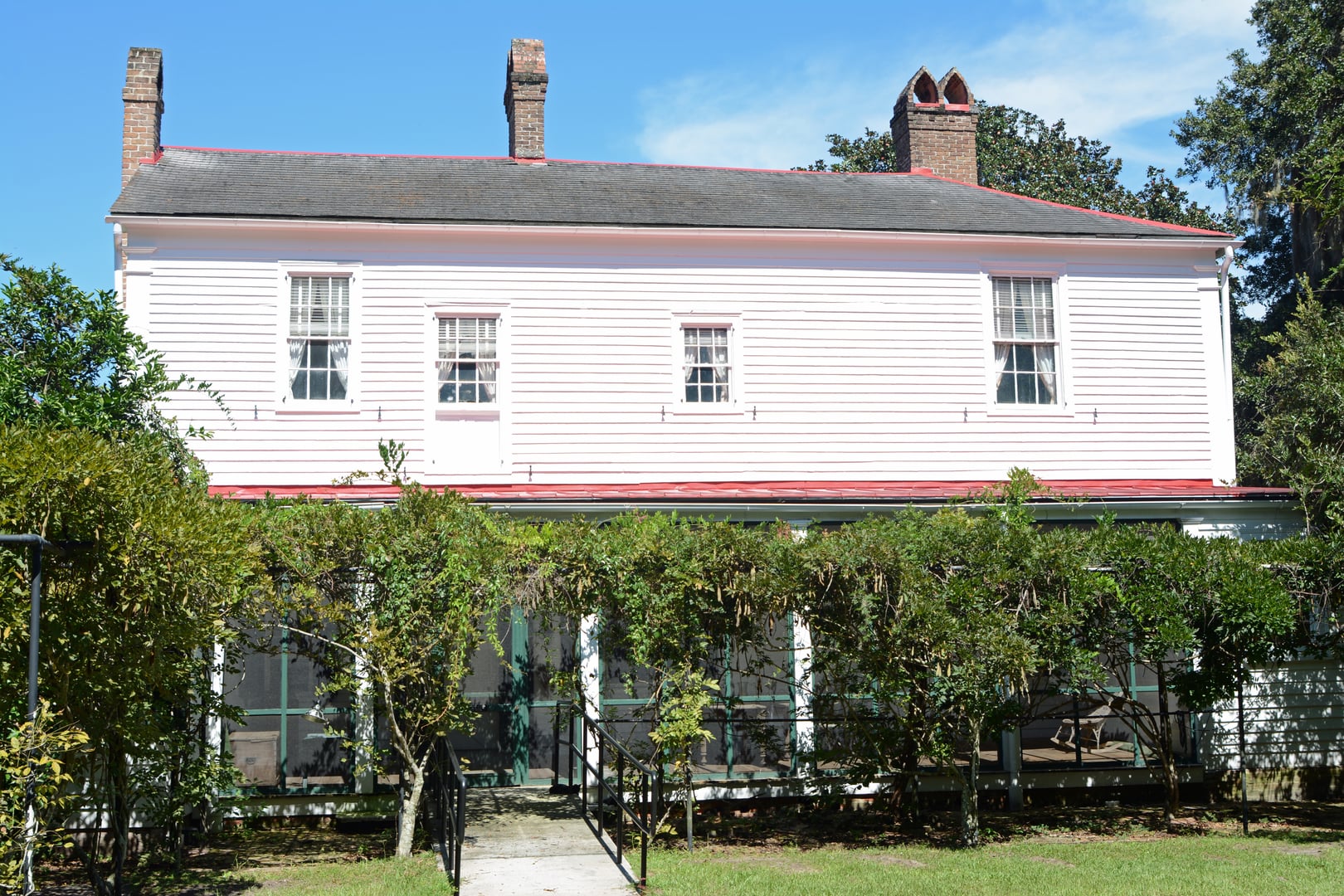
The Andrew Low House occupies a full block of Lafayette Square in Savannah's historic district. Construction was completed in 1849 for Andrew Low (1812 to 1886), a Scottish immigrant who arrived in Savannah as a teenager and built one of the largest cotton-export firms of the antebellum South, operating a fleet of cargo ships running cotton to Liverpool. By the 1850s, Low was widely regarded as the wealthiest man in Savannah.
The house was designed by John Norris, a New York architect responsible for several of Savannah's most distinguished antebellum residences. The exterior is restrained Greek Revival with stuccoed brick and cast-iron balconies; the interior is more elaborate, with carved plasterwork and original heart-pine floors. The garden behind the house, also restored, is one of the few surviving documented examples of an antebellum private garden in Savannah.
William Makepeace Thackeray stayed at the Low House during his American lecture tours in 1853 and 1856, and recorded his impressions in correspondence later published. Following the Civil War, Robert E. Lee visited Savannah in April 1870 — his final extended journey before his death later that year — and was hosted at the Andrew Low House.
Andrew Low's son William married Juliette 'Daisy' Gordon in 1886. Juliette Gordon Low (1860 to 1927) inherited the house after Andrew Low's death and resided there during the years she developed the Girl Scout movement. On March 12, 1912, after meeting Robert Baden-Powell of the British Boy Scouts and Agnes Baden-Powell of the Girl Guides, Low convened the first meeting of what she called Girl Guides at the Andrew Low House. The organization renamed itself Girl Scouts the following year. The Andrew Low Carriage House, separately preserved at 330 Drayton Street, served as the first dedicated Girl Scout headquarters.
Following Juliette Gordon Low's death in 1927, the Andrew Low House was purchased in 1928 by the Georgia State Society of the Colonial Dames of America, who continue to operate it as a house museum. The museum opened to the public in 1952 and is part of the Juliette Gordon Low Historic District, which also includes Juliette Gordon Low's birthplace at 10 East Oglethorpe Avenue.
The house is listed on the National Register of Historic Places and is a National Historic Landmark.
Sources
- https://www.andrewlowhouse.com/
- https://en.wikipedia.org/wiki/Juliette_Gordon_Low_Historic_District
- https://savingplaces.org/places/andrew-low-house-museum
- https://exploregeorgia.org/savannah/general/historic-sites-trails-tours/andrew-low-house
- https://genteelandbard.com/savannah-ghost-stories/2022/11/21/the-ghostly-residents-of-savannahs-andrew-low-house
ApparitionsObject movementPhantom smellsPhantom voicesResidual haunting
The Andrew Low House occupies a quieter position in Savannah's paranormal literature than some of its better-known neighbors. The Colonial Dames have approached the house's reputation with measured discretion, integrating occasional after-hours programming during October without making paranormal claims central to interpretation.
Visitor and docent accounts collected through Savannah ghost-walk operators and regional paranormal investigators describe several recurring phenomena. A male figure in mid-19th century dress has been reported in the upper hallway and at the head of the front staircase, sometimes interpreted as Andrew Low himself and sometimes as a visiting gentleman whose identity remains unclear. The most-told account places the figure briefly in the doorway of the bedroom where Robert E. Lee stayed in 1870.
Staff have reported finding portraits and small objects slightly rearranged on returning to closed rooms, particularly in the rooms most associated with Juliette Gordon Low. The scent of pipe tobacco has been reported in the rear parlor, where William Makepeace Thackeray is documented to have smoked during his 1856 visit.
A recurring report from museum staff and visitors describes the sound of children's voices in the carriage house and along the rear garden wall — areas associated with early Girl Scout meetings and activities. These accounts are gentle in character and have been embraced by some Girl Scout heritage programming as part of the museum's emotional connection to its founding history.
No formal published paranormal investigation has produced documentation that has entered the major American paranormal literature, and the museum administration treats the building primarily as a historic site and Girl Scout heritage destination. The house's reputation is enough to justify inclusion in Savannah ghost-tour itineraries but is not the primary frame through which the institution presents itself.
Notable Entities
Andrew LowMid-19th Century Gentleman