Est. 1801 · National Historic Landmark · Treaty of Ghent Ratification Site · Early Federal Architecture · American Institute of Architects Headquarters
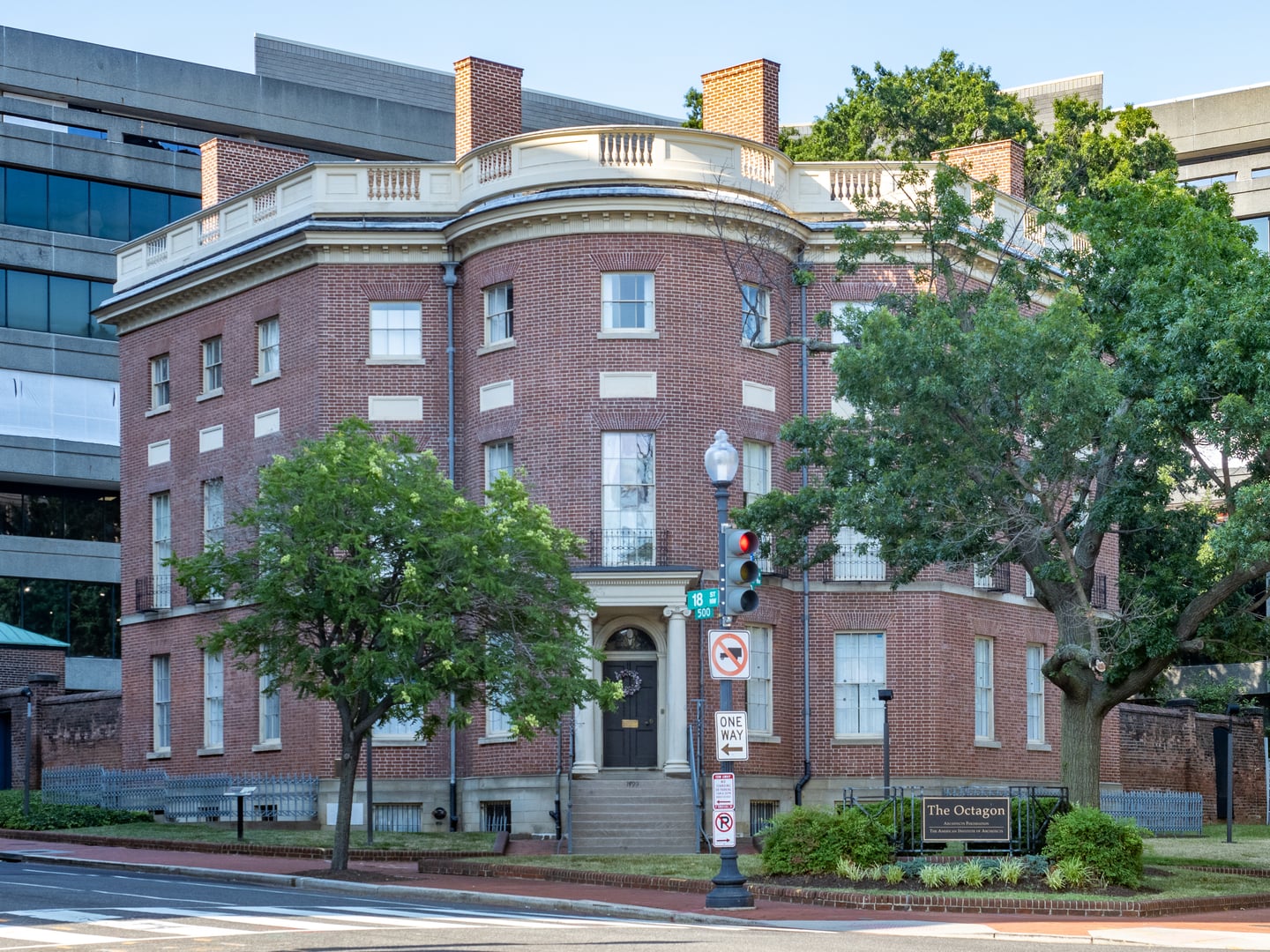
Colonel John Tayloe III, of Mount Airy plantation in Virginia, was among the wealthiest landowners in the early Republic. President George Washington personally encouraged Tayloe to construct a winter town residence in the new federal city, and Tayloe selected a wedge-shaped lot at the intersection of New York Avenue and Eighteenth Street. He commissioned William Thornton, then serving as the first architect of the United States Capitol, to design the house. Construction proceeded from 1798 through 1801.
Thornton's design responded to the unusual lot geometry by joining a curved entry rotunda with two principal wings, producing a six-sided plan that contemporaries called the Octagon. The interior includes a central oval staircase, a domed circular drawing room, and a series of formal rooms that supported the Tayloe family's program of political entertainment.
During the War of 1812, British forces burned the White House on August 24, 1814. Tayloe loaned the Octagon to President James Madison and First Lady Dolley Madison, who occupied the property as the executive residence from September 1814 through March 1815. On February 17, 1815, Madison ratified the Treaty of Ghent in the upstairs study, formally ending the war. The desk used for the signing remains on display.
The Tayloe family retained the property through the nineteenth century. The American Institute of Architects, founded in 1857 in New York and incorporated in Washington in 1898, selected the Octagon as its national headquarters and purchased the property outright in 1902. The AIA professional staff moved to a new headquarters building behind the Octagon in the 1970s, and the historic house was opened as a museum. The Architects Foundation, the AIA's affiliated nonprofit, currently operates the property.
The Octagon is a National Historic Landmark and is listed on the National Register of Historic Places.
Sources
- https://en.wikipedia.org/wiki/The_Octagon_House
- https://architectsfoundation.org/the-octagon/
- https://www.nps.gov/articles/the-octagon-of-washington-d-c-the-house-that-helped-build-a-capital-teaching-with-historic-places.htm
- https://historicsites.dcpreservation.org/items/show/436
- https://www.justshortofcrazy.com/history-ghost-hunting-octagon-mansion/
- https://www.cbsnews.com/news/a-look-inside-the-octagon-one-of-washington-d-c-s-oldest-and-most-haunted-homes/
- https://www.fox5dc.com/news/dc-most-haunted-house-octagon-museum-history
ApparitionsPhantom smellsDoors opening/closingLights flickeringEquipment malfunctionPhantom footsteps
The Octagon's most-frequently cited paranormal narrative concerns First Lady Dolley Madison, who lived at the property during the seven months that the Madisons used it as a temporary executive residence. Local tradition holds that ghostly receptions continue to be held in the front hall and drawing room, accompanied by the scent of lilacs that Dolley reportedly favored.
A second strand of reports concerns the central oval staircase. Tradition attaches at least two earlier nineteenth-century deaths to the staircase, including the death of one of Tayloe's daughters who reportedly fell from the upper landing. Subsequent reports describe the figure of a young woman observed in the staircase well and the sound of footsteps on the upper landing when the building is closed.
Foundation staff have reported a recurring pattern of security-system anomalies, with motion sensors triggering in empty rooms during overnight hours, doors found unlocked the morning after secure closing, and lights flickering in the principal Tayloe rooms. The staff handle these reports with archival rather than dramatic framing; the building's security history is consistent enough that some staff members refer to it as part of the property's working character.
The Architects Foundation does not market the building as a haunted attraction. The paranormal narrative is present in published Washington ghost-tour materials and in the standard repertoire of regional folklore writers, but the foundation's institutional focus is on architectural history, Federal-era interpretation, and War of 1812 commemoration.
Notable Entities
Dolley Madison
Media Appearances
- CBS News feature on the Octagon's ghost stories