Est. 1801 · National Historic Landmark · Designed by William Thornton (First Capitol Architect) · Temporary Executive Mansion 1814-1815 · Site of Treaty of Ghent Signing
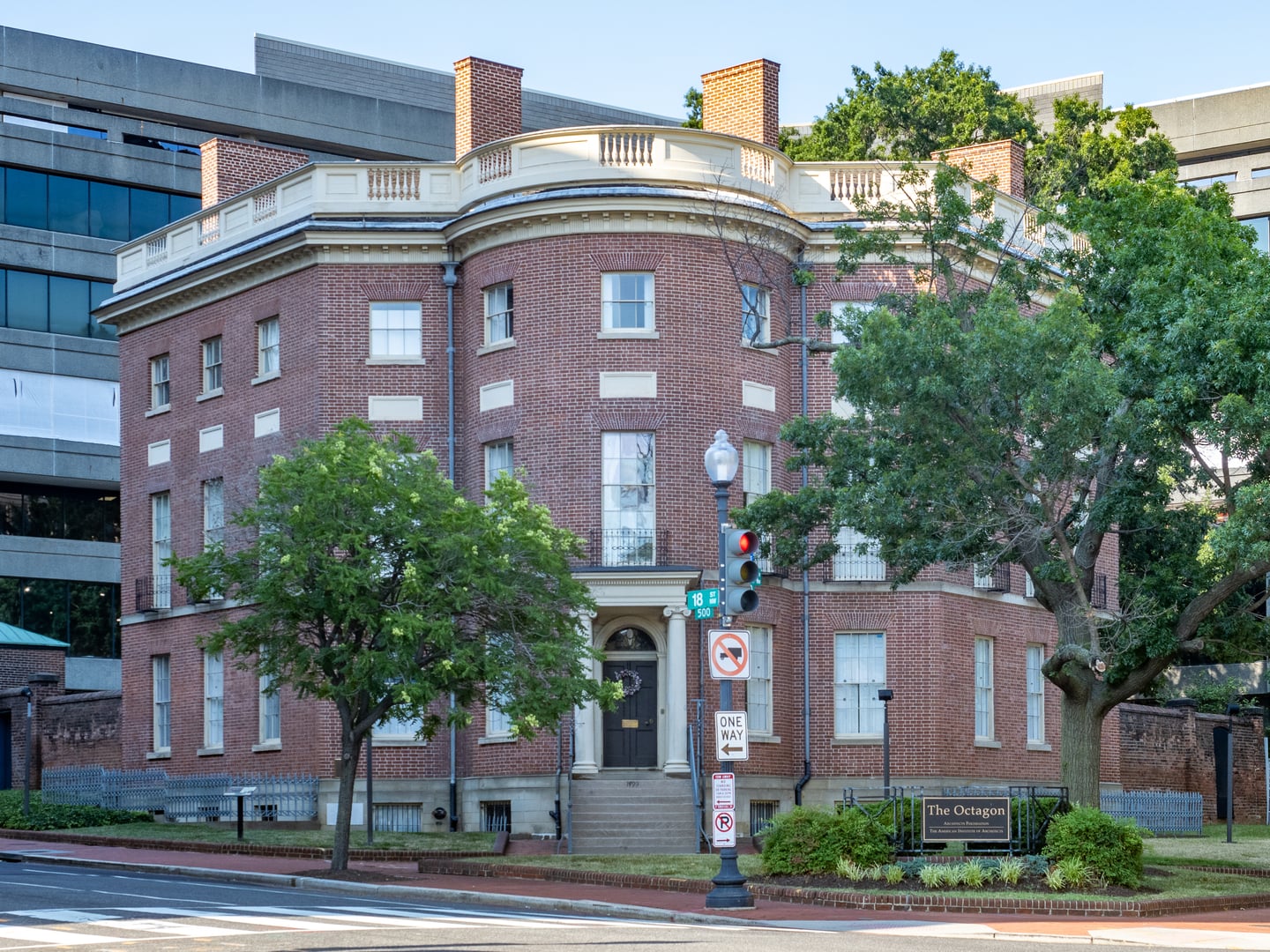
The Octagon was built between 1799 and 1801 for Colonel John Tayloe III, then one of the wealthiest planters in the United States, on a triangular lot at the intersection of New York Avenue and Eighteenth Street NW. The design is attributed to William Thornton, the first architect of the United States Capitol. Despite the name, the floor plan is not a regular octagon; it incorporates a circular entrance hall, a rectangular wing, and several angled rooms that responded to the awkward shape of the lot.
The house is one of the earliest substantial private residences in the new federal city. The Tayloe family used the mansion as a winter home, returning each spring to their Mount Airy plantation in Richmond County, Virginia.
In August 1814, during the War of 1812, British forces burned the White House and other public buildings. President James Madison and First Lady Dolley Madison required a substitute Executive Mansion. Tayloe offered the Octagon, and the Madisons lived and worked there from September 1814 through March 1815. On February 17, 1815, Madison signed the Treaty of Ghent in the second-floor study of the Octagon, formally ending the War of 1812.
The Tayloe family retained the house through the nineteenth century. The American Institute of Architects acquired the property in 1902 and made it the AIA's national headquarters. Today the house is operated as the Octagon Museum by the American Architectural Foundation, focused on the history of American architecture, decorative arts, and the early federal city. It was designated a National Historic Landmark in 1960.
Sources
- https://en.wikipedia.org/wiki/The_Octagon_House
- https://boundarystones.weta.org/2014/07/16/octagon-houses-tales-grave
- https://www.cbsnews.com/news/a-look-inside-the-octagon-one-of-washington-d-c-s-oldest-and-most-haunted-homes/
- https://www.fox5dc.com/news/dc-most-haunted-house-octagon-museum-history
ApparitionsPhantom footstepsPhantom smellsDoors opening/closing
The Octagon's reputation as a haunted house developed gradually through the late nineteenth and early twentieth centuries, with the most familiar legends not appearing in print until around 1908. The dominant tradition concerns the central spiral staircase. According to several variants, one of John Tayloe III's daughters quarreled with him on the second-floor landing over her relationship with a British officer. The argument is said to have ended with her fall down the staircase to her death. A second variant adds a second Tayloe daughter who suffered a similar fall after a separate dispute.
Research published by Boundary Stones, the public history site of WETA, has shown that no Tayloe daughter died at the Octagon. The genealogical record indicates that Rebecca Plater Tayloe, the daughter most often associated with the legend, died in 1815 at age 18, but at that time the Octagon was occupied by President and Mrs. Madison, and the Tayloe family was at their Mount Airy plantation in Virginia. The legend's earliest appearance, around 1908, places it firmly in the period when ghost stories about prominent old houses became a feature of Washington society writing.
A second tradition holds that the Octagon retains the presence of Dolley Madison. Visitors have reported the scent of lilacs, which is associated in regional lore with Dolley, particularly in the rooms used by the Madisons during their 1814-1815 residency. Reports of footsteps on the staircase and of doors closing without explanation are also documented in twentieth-century museum staff accounts.
The Octagon has been featured on Travel Channel programming and in CBS News and Fox 5 DC reporting on Washington's historic-house traditions. The AIA Foundation acknowledges the lore as a cultural artifact while emphasizing the documentary architectural and political history of the house.
Notable Entities
Dolley Madison