Est. 1854 · DC Inventory of Historic Sites · First For-Profit Cemetery in DC · Notable Nineteenth-Century Burials
The Glenwood site was originally part of an early-nineteenth-century estate called Clover Hill, assembled by Dr. Phineas Bradley after he acquired the land from John Dixon in 1809. In June 1852, Joseph B. Close, William S. Humphreys, Randolph S. Evans, and George Clendenin purchased the ninety-acre Clover Hill tract with the intent of establishing a secular, non-sectarian burying ground.
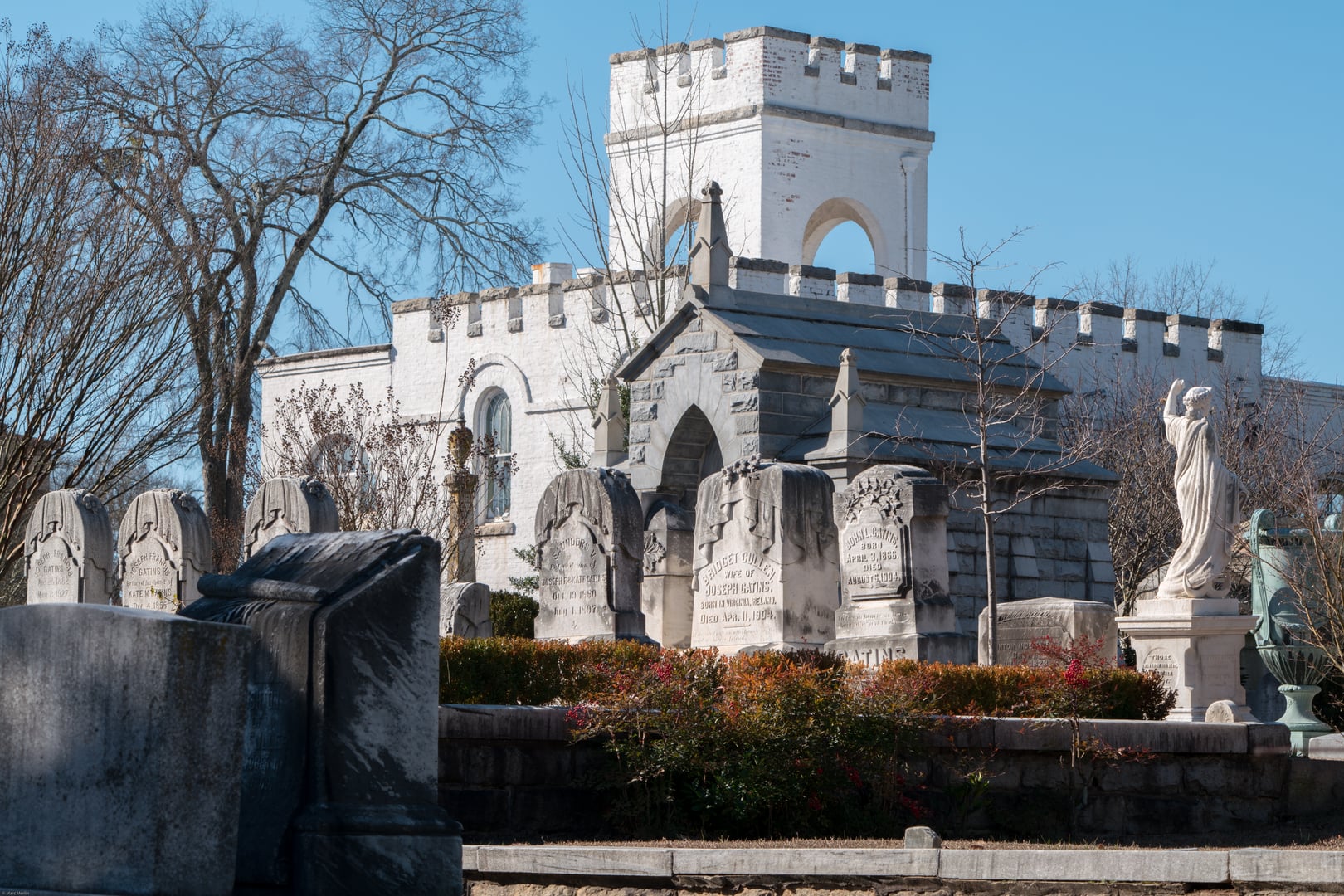
Congress chartered Glenwood Cemetery in 1852, making it the first for-profit cemetery in the District of Columbia and among the earliest commercial cemeteries in the country. The grounds were dedicated on August 2, 1854. The design followed the rural-cemetery model popularized by Boston's Mount Auburn — winding drives, planted hillsides, and elaborate family monuments — providing a green pastoral counterpoint to the increasingly crowded urban capital.
Glenwood's notable burials reflect the cultural and political life of nineteenth-century Washington. Emanuel Leutze, painter of the iconic Washington Crossing the Delaware, was interred at Glenwood in 1868. Clark Mills, who cast Thomas Crawford's Statue of Freedom for the Capitol dome and sculpted the Andrew Jackson equestrian statue in Lafayette Square, is buried on the grounds. Constantino Brumidi, the Italian-born painter responsible for the Capitol's interior frescoes including The Apotheosis of Washington, was interred at Glenwood in 1880 in what was for nearly seventy years an unmarked grave. Amos Kendall, postmaster general under Andrew Jackson and a founder of what became Gallaudet University, is buried at the cemetery.
Long-standing cemetery tradition holds that George Atzerodt — one of four conspirators hanged in July 1865 for the Lincoln assassination plot, having failed in his assignment to kill Vice President Andrew Johnson — was secretly reinterred at Glenwood in an unmarked grave. Cemetery records do not name him publicly; the claim is supported by family-history reporting but not by a marked headstone.
Glenwood was added to the District of Columbia Inventory of Historic Sites in 2010 and remains an active burial ground.
Sources
- https://en.wikipedia.org/wiki/Glenwood_Cemetery_(Washington,_D.C.)
- https://www.theglenwoodcemetery.com/notables/
- https://historicsites.dcpreservation.org/items/show/883
Cold spots
Glenwood is best understood as a historically significant cemetery rather than a paranormal hotspot. Major paranormal television series have not produced featured episodes from the property, and organized ghost-tour programming in DC tends to focus on Congressional Cemetery and Rock Creek Park rather than Glenwood.
The most-discussed dark-tourism element at Glenwood is the persistent tradition of George Atzerodt's unmarked grave. Atzerodt was assigned by John Wilkes Booth to assassinate Vice President Andrew Johnson on the night of the Lincoln assassination; he abandoned the attempt, was captured, and was hanged at the Old Arsenal Penitentiary on July 7, 1865. Like the other conspirators, he was initially buried at the Arsenal and later released to family. Family tradition and cemetery accounts indicate that he was reinterred at Glenwood in an unmarked plot; the cemetery does not publicly identify the grave. Visitors interested in Civil War true-crime history sometimes seek the site, though the lack of a marker makes it more pilgrimage than tour stop.
Quiet visitor reports of cold spots near older Victorian monuments and the impression of being observed at dusk circulate in regional ghost-tour social media, but they are not anchored to specific named accounts.
Notable Entities
George Atzerodt (unmarked grave, by tradition)