Est. 1926 · Founded 1871 as California School of Design - among oldest art schools west of the Mississippi · Spanish Colonial Revival campus by Bakewell & Brown (1926) · Diego Rivera mural painted 1931 · Closed July 2022; bankruptcy April 2023; acquired by CASA February 2024
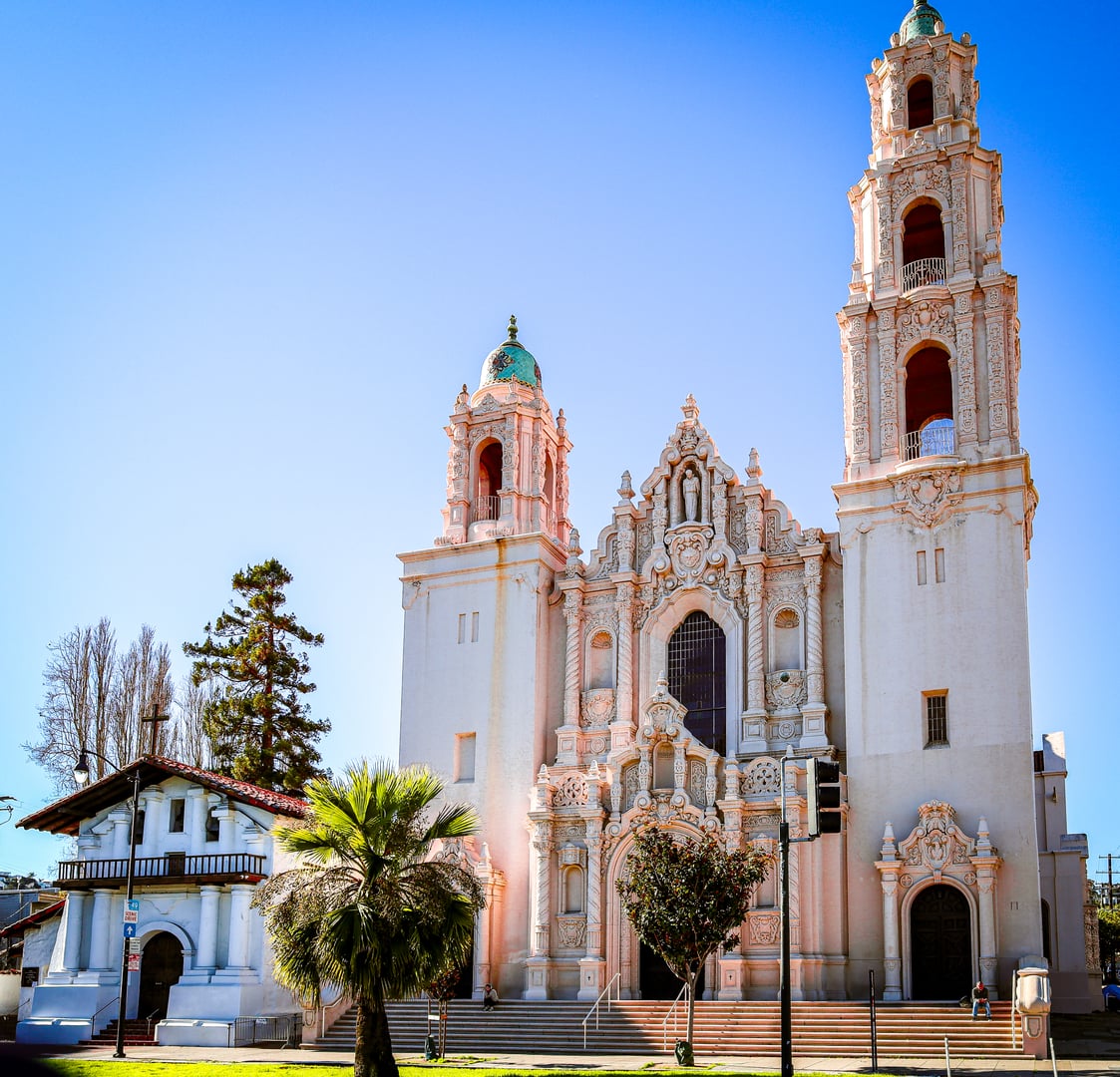
The San Francisco Art Institute traces its origin to 1871 as the California School of Design, making it one of the oldest art schools west of the Mississippi. Its long-time home at 800 Chestnut Street on Russian Hill was designed by Bakewell & Brown, built in 1926 and dedicated on January 15, 1927, replacing earlier downtown facilities. The Spanish Colonial Revival campus is best known for its central bell tower, its inner courtyard, and the Diego Rivera mural ('The Making of a Fresco Showing the Building of a City') painted for the school in 1931.
Financial pressure had been building on SFAI for over a decade by the time of its closure. The school ceased all course and degree programs and held its final commencement and graduation ceremony on July 12, 2022. SFAI filed for Chapter 7 liquidation in April 2023.
In late February 2024, a nonprofit corporation endowed by Laurene Powell Jobs (through the Emerson Collective) acquired the campus, including the Diego Rivera mural, for approximately $30 million. The new entity is the California Academy of Studio Arts (CASA), which plans to offer free one-year study residencies to roughly 30 emerging visual artists. The campus is closed to the public during the transition.
Sources
- https://en.wikipedia.org/wiki/San_Francisco_Art_Institute
- https://www.foundsf.org/Haunted_Tower_Spooks_Wannabe_Artists
- https://news.artnet.com/art-world/san-francisco-art-institute-casa-arts-center-2653645
- http://www.weirdca.com/location.php?location=13
Phantom footstepsDoors opening and closingTools and lights activating on their ownSense of being watched in stairwells
The Haunted Tower tradition at SFAI is unusually well-documented in print compared to most American campus ghost stories. The earliest published account collected in the FoundSF archive describes Bill Morehouse, an art student employed as the institute's night watchman in 1947, who reportedly experienced footsteps in the empty bell tower on his first night sleeping there and saw doors open and close on their own. Morehouse's account was repeated in print and helped establish the bell tower as the central locus of the building's lore.
The 1960s added a darker layer. According to FoundSF, students working night shifts on a 1968 construction project experienced a cluster of misfortunes — a motorcycle accident, a polio case, a family tragedy — that came to be associated with the tower. A séance held during this period reportedly found only frustrated spirits, and one medium spoke of a lost graveyard.
A persistent secondary claim in haunted-history features holds that the campus sits over a portion of the former Russian Hill cemetery, with graves displaced after the 1906 earthquake. This claim does not appear in the Wikipedia article for SFAI or in available historical surveys of the Russian Hill block, and should be treated as folk-history rather than documented fact unless and until primary records surface.
A recurring story among former students describes a deceased janitor who lingers in the lower stairwells.
With the campus closed and CASA's program not yet operational, no current institutional sponsor exists to confirm or update the lore.
Notable Entities
Bell tower presenceDeceased janitor (folkloric)
Media Appearances
- FoundSF 'Haunted Tower Spooks Wannabe Artists'
- Antoinette May, Haunted Houses of California
- SF Ghosts profile
Where this legend is told