Est. 1776 · Oldest building in San Francisco · Only intact original chapel of California's 21 missions · Burial site of approximately 5,000 Ohlone, Miwok, and First Californian people · Founded October 9, 1776 · National Historic Landmark · Filming location for Alfred Hitchcock's 'Vertigo' (1958)
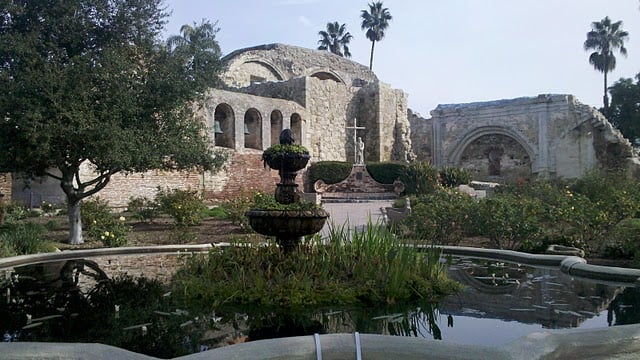
Mission San Francisco de Asís was founded on October 9, 1776 — five days before the United States Continental Army's Battle of Brooklyn — by Spanish Franciscan friars dispatched as part of the Spanish colonial occupation of Alta California. The mission was named for St. Francis of Assisi and was commonly called 'Mission Dolores' from a nearby seasonal creek the Spanish named Arroyo de los Dolores ('Creek of Sorrows'). The surviving adobe mission chapel, built between 1782 and 1791 by Ohlone and other Native Californian forced laborers under Franciscan supervision, is the oldest building in San Francisco and the only intact original chapel among the 21 California missions.
The mission's founding-era population was overwhelmingly Ohlone (Yelamu and other local groups) and Coast Miwok people, who were drawn or coerced into the mission system through a combination of disease pressure, Spanish military presence, and Franciscan religious mission. The historical record is now unambiguous that the California mission system functioned as a coercive labor and religious system that broke up indigenous families, suppressed indigenous languages and religious practices, and produced devastating mortality. According to documentation cited by Atlas Obscura and the California missions historical record, Mission Dolores had one of the highest death rates of Spain's 21 California missions — thousands of Native Californian people died of European diseases (especially measles and smallpox epidemics), overwork, and the destruction of their pre-contact lifeways.
Approximately 5,000 Ohlone, Miwok, and other First Californian people are interred in the mission cemetery. The cemetery as it exists today is far smaller than the original burial ground; thousands of additional graves were displaced over the 19th and 20th centuries when surrounding land was converted to park, school, and street use, with remains relocated to the Catholic cemetery in Colma south of the city.
The larger basilica adjacent to the old mission was completed in 1918 after the original parish church was severely damaged in the 1906 earthquake. The basilica was elevated to its current status as a minor basilica by Pope Pius XII in 1952. The complex hosts an active Catholic parish, public visitation of the old mission and cemetery, and exhibits interpreting the mission's history.
Mission Dolores is a National Historic Landmark and is also notable as a filming location — Alfred Hitchcock's 1958 'Vertigo' used the mission cemetery for one of its central scenes.
Sources
- https://en.wikipedia.org/wiki/Mission_San_Francisco_de_As%C3%ADs
- https://www.missiondolores.org/old-mission
- https://www.atlasobscura.com/places/mission-dolores-cemetery
- https://cemeterytravel.com/2011/04/27/cemetery-of-the-week-13-mission-dolores-cemetery/
Voices and faint chanting in the cemeteryShadowy figures wandering among headstonesUnearthly knocking from beneath certain markersSensed presence in the older burial section
Mission Dolores's paranormal record is unusual in two respects. First, it is unusually old — paranormal accounts at the mission appear in the published San Francisco press as early as an 1891 San Francisco Morning Call article cited in Mission Local's 'corpse roads' feature, in which a city police officer described a recurring shadow figure observed during night patrols of the burial ground. This makes Mission Dolores one of the earliest documented haunted sites in California's written record.
Second, the paranormal activity must be understood in the context of the catastrophic and well-documented mortality of Mission Dolores's Native Californian residents. According to Atlas Obscura, the mission's official site, and the broader California missions historical record, thousands of Ohlone, Miwok, and other First Californian people died at the mission — primarily of European diseases, overwork, and the destruction of their indigenous lifeways under the Franciscan mission system. The cemetery as it exists today contains approximately 5,000 burials, and thousands of additional indigenous graves were displaced when surrounding ground was converted to park, school, and street uses across the 19th and 20th centuries, with remains relocated to Colma.
Reported phenomena consistently include voices and faint chanting in the cemetery, shadowy figures wandering among the headstones (most frequently reported at dusk and at night), and what Mission Local and Atlas Obscura describe as 'unearthly knocking' from beneath certain markers. Many of these reports cluster in the older indigenous-grave section of the cemetery, where the displacement and grave-disturbance history is most extensive.
The responsible framing for visitors interested in the paranormal reputation of Mission Dolores is that this is a site of severe indigenous loss and forced labor, and accounts of unsettled activity here speak to historically documented violence and mortality rather than to a generic 'ancient burial ground' trope. The mission's own interpretive program is now explicit about acknowledging the lives and deaths of Ohlone and Miwok people at the site, and any reflective visit benefits from approaching the cemetery as a place of memorial first and paranormal interest second.
Notable Entities
Ohlone, Miwok, and First Californian dead of the mission period