Est. 1834 · National Historic Landmark · Third System Coastal Fort · Battle of Mobile Bay · Alabama Historical Commission Property
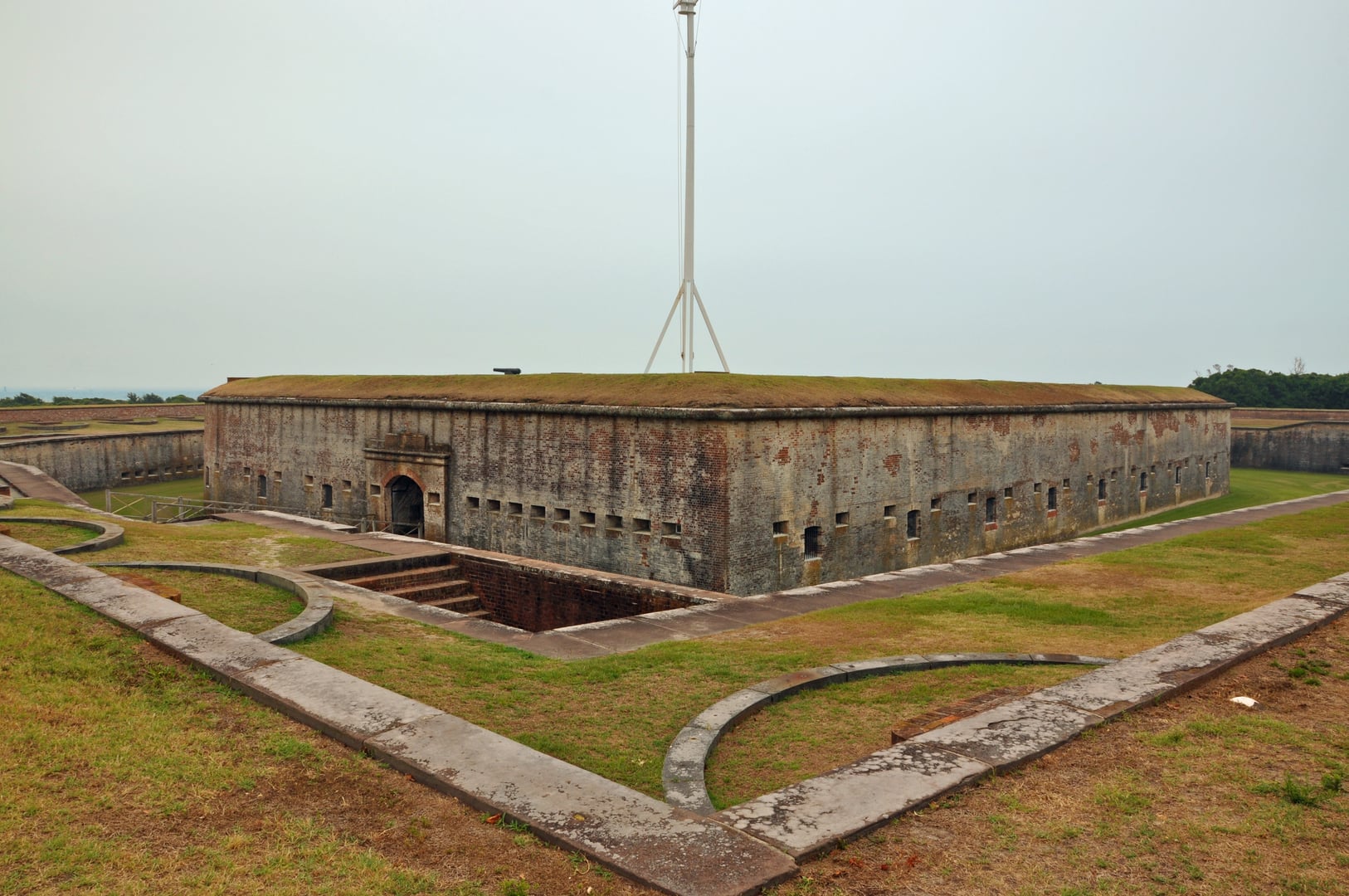
Fort Morgan was built on Mobile Point, the eastern point at the mouth of Mobile Bay, on the site of the earlier Fort Bowyer, an earthen-and-stockade fortification involved in the final land battles of the War of 1812. Construction of the present masonry fort began in 1819 and was completed in 1834. The pentagonal design followed the Third System pattern of brick-and-masonry coastal fortifications.
The fort was named for Revolutionary War hero Daniel Morgan. Scholars consider Fort Morgan one of the finest examples of military architecture in the New World, with substantial original brickwork still intact.
The most historically significant engagement at the site was the Battle of Mobile Bay on August 5, 1864. Admiral David Farragut led a Union fleet through the mined channel under fire from Fort Morgan's batteries. The phrase 'Damn the torpedoes, full speed ahead,' attributed to Farragut during this battle, became one of the most-quoted military aphorisms in American history. Confederate General Richard L. Page held Fort Morgan for an additional two weeks of bombardment before surrendering on August 23, 1864. The fort's brickwork still bears the impact damage of the Union bombardment.
Fort Morgan was used in five subsequent conflicts, including World Wars I and II. Control transferred from the federal government to the Alabama Historical Commission in 1977. The site is a National Historic Landmark and one of Alabama's most-visited historic properties.
Sources
- https://en.wikipedia.org/wiki/Fort_Morgan_(Alabama)
- https://ahc.alabama.gov/properties/ftmorgan/ftmorgan.aspx
- https://www.nps.gov/articles/fort-morgan-and-the-battle-of-mobile-bay-teaching-with-historic-places.htm
- https://encyclopediaofalabama.org/article/fort-morgan-museum-and-state-historic-site/
- https://www.wkrg.com/haunted-history/spirits-bring-haunted-life-back-to-fort-morgan/
- https://www.liquidlifevacationrentals.com/blog/haunted-spots-orange-beach-gulf-shores
- https://alabamaliving.coop/articles/ghosts-spirits-said-to-wander-the-grounds-at-fort-morgan/
Phantom footstepsPhantom voicesCold spotsApparitions
Coastal forts that experienced sustained bombardment but limited prisoner population typically accumulate less paranormal lore than prison sites like Fort Delaware or Fort Pulaski. Fort Morgan follows this pattern. Reports collected by regional ghost-tour writers in Gulf Coast Alabama describe phantom footsteps in the brick casemates, indistinct voices on the parade ground, and atmospheric heaviness in the corner casemates.
No named entities dominate the lore. The most-cited locations are the casemates damaged by the 1864 Union bombardment and the parade ground itself. Civil War casualties at Fort Morgan were relatively modest by mid-war standards, and the site's enduring significance lies more in its architecture and in the broader story of the Battle of Mobile Bay than in any specific haunting account.
Visitors interested in atmospheric coastal-fort visits will find Fort Morgan an excellent companion site to Fort Pickens (Florida) and Fort Gaines (also at the mouth of Mobile Bay, on Dauphin Island).