National Historic Site · National Register of Historic Places · Oregon Trail Site · Treaty Council Site
Fort William was established in 1834 by William Sublette and Robert Campbell as a private fur-trading post on the Laramie River near its confluence with the North Platte. The American Fur Company acquired the post and rebuilt it as Fort John in the early 1840s. The U.S. Army purchased the site in 1849, renaming it Fort Laramie and converting it into the principal military post on the Northern Plains.
For four decades Fort Laramie sat at the center of westward migration, fur trade, and U.S.-Plains Native relations. Tens of thousands of emigrants on the Oregon, California, and Mormon trails passed through. Two foundational treaty councils between the U.S. government and Plains nations took place at Fort Laramie: the 1851 Treaty of Fort Laramie, which defined the territory of the Lakota, Cheyenne, Arapaho, Crow, Shoshone, and other nations, and the 1868 Treaty of Fort Laramie, which established the Great Sioux Reservation. The 1868 treaty remains the legal basis for ongoing Lakota land claims, including the Black Hills.
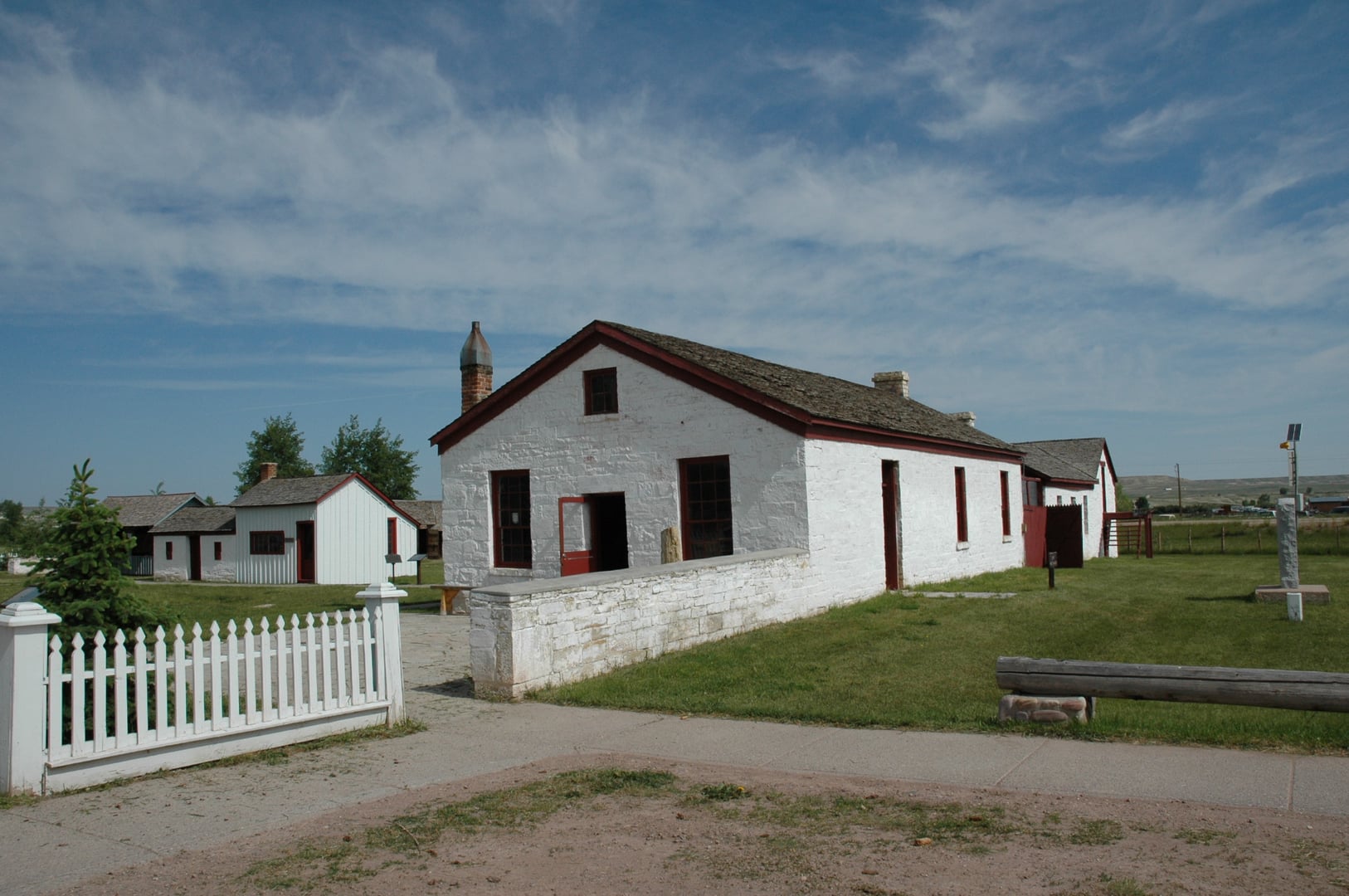
The army abandoned the fort in 1890 as the frontier system that supported it dissolved. Many of the buildings were sold and dismantled for materials. Fort Laramie became a National Monument in 1938 and was redesignated a National Historic Site in 1960. Twelve original buildings have been restored or stabilized, including Old Bedlam, the 1849 bachelor officers' quarters that is the oldest military building in Wyoming.
Fort Laramie's interpretive program is developed in active consultation with descendant communities. Visitors should approach the site as both an American military landmark and a place of unfinished business between the federal government and Plains nations.
Sources
- https://en.wikipedia.org/wiki/Fort_Laramie_National_Historic_Site
- https://www.nps.gov/fola/
- https://www.wyohistory.org/encyclopedia/fort-laramie
- https://www.legendsofamerica.com/wy-fortlaramiehauntings/
- https://cowboystatedaily.com/2022/09/26/ghosts-of-fort-laramie-haunt-wyoming-historic-site/
- https://cowboystatedaily.com/2023/11/02/did-this-guy-get-photos-of-ghosts-at-fort-laramie-on-halloween-you-be-the-judge/
- https://rawhidestudios.com/fort-laramie-ghost-story/
ApparitionsPhantom footstepsDoors opening/closingLights flickeringPhantom voices
Fort Laramie's paranormal reputation is unusually well organized by named entities. The Captain's Quarters has a long-standing reputation among staff for unexplained activity, with the resident presence affectionately called George. Reports include doors opening, footsteps in empty rooms, and unexplained interior lights despite the building having no electrical service.
Old Bedlam, the 1849 bachelor officers' quarters and Wyoming's oldest military building, is the second major focal point. Visitors have described an apparition of a young cavalry officer who reportedly tells loud guests to be quiet, and accounts of a surgeon's figure in a blood-stained uniform. The post hospital and the surgeon's quarters have their own discrete tradition.
The most folkloric of the Fort Laramie figures is the Lady in Green. Local tradition holds that she was the daughter of the agent in charge of the post during its 1840s Fort John phase, and that she set off on a black stallion and disappeared. The legend, repeated in Legends of America and regional Wyoming sources, holds that her apparition reappears east of Fort Laramie every seven years. Verification in primary sources is not available; the story circulates as oral tradition tied to the fort's pre-army period.
National Park Service interpreters present these stories as folkloric tradition rather than as confirmed phenomena, and the site's interpretive priority remains the documented military and treaty history.
Notable Entities
George (Captain's Quarters)Cavalry Officer (Old Bedlam)Lady in Green