Est. 1823 · Second-Oldest Operating U.S. Lighthouse · National Register of Historic Places · Cape Hatteras National Seashore · 1718 Death-of-Blackbeard Site (regional)
The Ocracoke Light Station was authorized by Congress in 1822 and completed in 1823 on Ocracoke Island, an Outer Banks barrier island in Hyde County, North Carolina. The contract went to Massachusetts builder Noah Porter, who completed the project for $11,359.35, including the keeper's quarters. The lighthouse replaced an earlier 1798 wooden tower on nearby Shell Castle Island that had been destroyed by lightning.
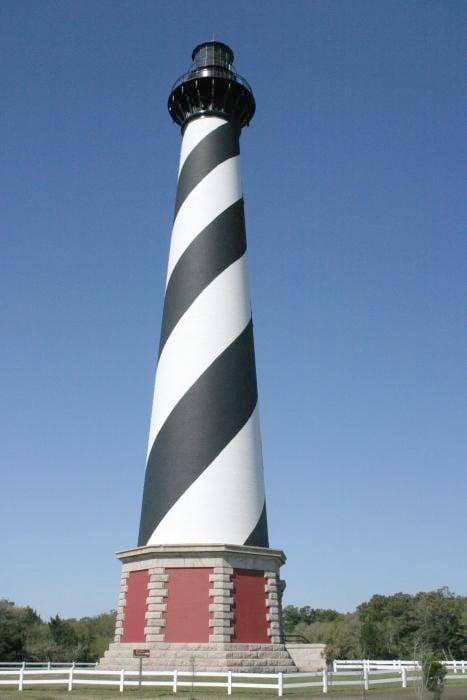
The tower stands 75 feet tall with a brick base 25 feet in diameter narrowing to 12 feet at the lantern. The whitewashed exterior is maintained by the National Park Service. The fixed white light shines at 8,000 candlepower and is visible up to 14 nautical miles offshore.
During the Civil War, Confederate forces dismantled the lighthouse's fourth-order Fresnel lens in 1861 to deny the light to Union shipping. Federal forces recovered and reinstalled the lens after taking the island. The light was automated in 1955, and the last resident keeper of the station died in 1951. Since that year, the Cape Hatteras National Seashore division of the National Park Service has administered the tower and keeper's quarters.
The lighthouse is the second-oldest operating light station in the United States; the Sandy Hook Light in New Jersey, built in 1764, is the oldest. Tower climbing is not permitted, but the grounds are open daily.
Ocracoke Island is also closely associated with the death of Edward Teach (Blackbeard). On November 22, 1718, a Royal Navy boarding party under Lieutenant Robert Maynard attacked Teach's vessel in the cove now known by local tradition as Teach's Hole, just south of the present-day lighthouse. Teach was killed in the action and beheaded.
Sources
- https://en.wikipedia.org/wiki/Ocracoke_Light
- https://www.nps.gov/places/000/ocracoke-lighthouse.htm
- https://www.history.uscg.mil/Browse-by-Topic/Assets/Land/All/Article/1969233/ocracoke-lighthouse/
- https://uslhs.org/resources/keepers-log/select-articles/ocracoke-lighthouse-history-north-carolinas-oldest
- https://lighthousefriends.com/light.asp?ID=355
ApparitionsPhantom soundsOrbs
Outer Banks folklore concerning Ocracoke Island is dominated by Edward Teach (Blackbeard) rather than by the lighthouse alone. Multiple generations of Ocracoke residents have described a phenomenon called Teach's Light, a luminous flicker that appears intermittently over the water in the cove called Teach's Hole, just south of the present lighthouse. Some accounts describe the light as a slowly moving orb at the height of a torch; others describe a brief brightening of the water surface.
Local tradition holds that the figure of Teach himself, holding a lantern and missing his head, is occasionally seen along the shoreline of Springer's Point near Teach's Hole. Teach was beheaded during the 1718 boarding action by Lieutenant Robert Maynard's party; his head was hung from the bowsprit of Maynard's vessel as a warning. The decapitation is the documented historical basis for the headless-apparition tradition.
Reports specifically attached to the lighthouse itself are sparser and concern keeper-era unexplained light activations and occasional resident reports of a figure visible at the lantern gallery after the 1955 automation. The National Park Service does not publicly document or interpret these reports.
The Ocracoke Working Watermen's Association and several Outer Banks tourism publications collect and republish versions of the Teach's Light tradition each fall.
Notable Entities
Blackbeard / Edward Teach