Est. 1914 · Designed by Kirtland Cutter, Spokane's most prominent Gilded Age architect · Listed on the National Register of Historic Places · One of the earliest U.S. hotels with central air conditioning (1914) · Saved from demolition by 2002 Worthy restoration following 17-year vacancy
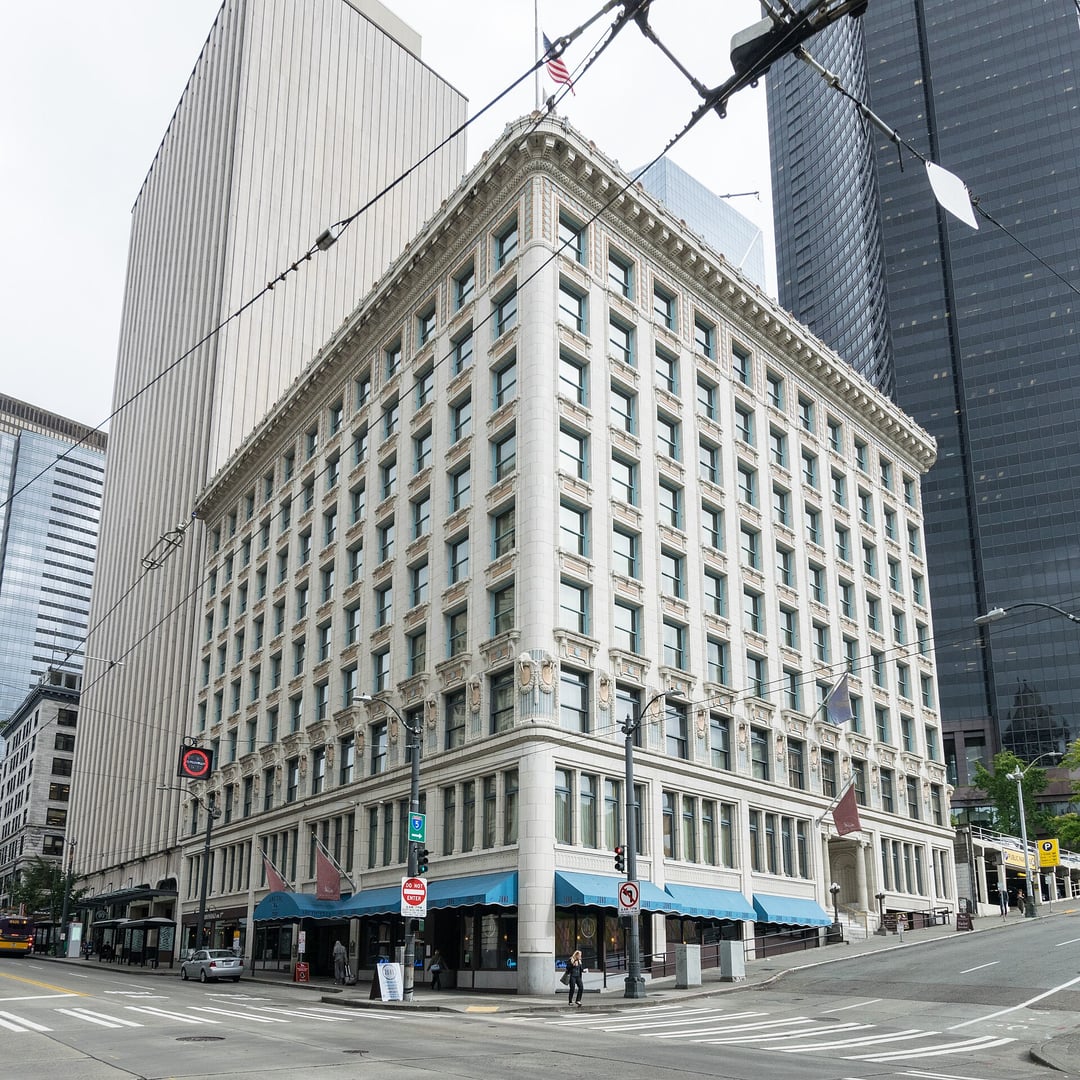
The Historic Davenport Hotel was built in 1913-14 for Spokane restaurateur Louis M. Davenport, who had operated the celebrated Davenport's Restaurant on the same block. Architect Kirtland Cutter, working with associate Karl Malmgren, produced a hotel whose interiors blended elements from Italy, France, England, Spain, and Imperial Russia. The building cost $2 million (roughly $64 million in 2025 dollars) and went up in eight months in 1913 using horse carts, steam jacks, and hand tools, with no worker fatalities — unusual for the period.
The hotel opened in 1914. At opening it offered amenities considered remarkable for the era: central air conditioning, a central vacuum system, dividing doors in the ballrooms, and a pipe organ in the lobby. Cutter himself lit the first fire in the lobby fireplace, beginning the hotel's tradition that the fire would always burn as a symbol of hospitality.
Louis Davenport lived in a personal suite at the hotel and died there in 1951; his widow Verus died in the same suite in 1967. The hotel changed hands several times after Davenport's death and ultimately closed in 1985, then sat vacant and deteriorating for 17 years. In 2002, Spokane developers Walt and Karen Worthy bought the building for $6.5 million and undertook a $38 million restoration; the hotel reopened on July 15, 2002.
The Davenport is listed on the National Register of Historic Places and is now part of Marriott's Autograph Collection. It anchors what is now branded as the Historic Davenport District in downtown Spokane.
Sources
- https://en.wikipedia.org/wiki/The_Davenport_Hotel_(Spokane,_Washington)
- https://www.historylink.org/File/8280
- https://www.historylink.org/file/7545
- https://properties.historicspokane.org/property/?PropertyID=1775
- https://www.davenporthotelcollection.com/history/
- https://www.onlyinyourstate.com/stays/washington/haunted-historic-davenport-hotel-wa
- https://www.spokesman.com/stories/2005/aug/18/davenport-ghost-has-roots-in-fact/
- https://929thebull.com/haunted-hotel-spokane/
- https://www.inlander.com/news/haunted-hotel-2178532
Apparition of a woman in 1920s dress peering over the mezzanine railingFigure in bathrobe and slippers reported by night-shift staff on guest floorsSense of being watched in lobby and mezzanine areas
The Davenport's most-corroborated ghost story is Ellen McNamara, a 68-year-old wealthy widow from New York who was touring the West with her sister and cousins in August 1920. According to a Spokesman-Review historical investigation, while her party went to dinner in the Isabella Room, McNamara walked onto the third-floor cement walkway, then passed through a door into the pagoda structure that covered the lobby skylight. She fell through the Tiffany skylight to the marble lobby floor. Per the hotel's records cited by the Spokesman-Review, she was briefly conscious and asked 'Where did I go?' before becoming insensible; she died hours later. Guests and staff have since reported a woman in 1920s clothing peering over the mezzanine railing toward the lobby below, as if looking for her party.
The second narrative belongs to Louis M. Davenport himself. According to KREM, KXLY, and Inlander coverage, Davenport lived in Suite 1103 until his death in 1951 and reportedly said in life, 'I never want to leave here.' His wife Verus died in the same suite in 1967. Night-shift staff have reported a figure in a bathrobe and slippers walking the hallways, matching Davenport's documented habit of late-night walks through his hotel.
Local coverage also references a 1973 employee homicide (Archie Gonia) and additional miscellaneous sightings, though these are less widely reported. The Spokesman-Review's 2005 'Davenport ghost has roots in fact' feature is notable in the genre because it confirmed McNamara's death through period newspaper accounts before relating the modern lore — a level of documentary anchoring uncommon for hotel ghost stories.
Notable Entities
Ellen McNamara (d. August 1920)Louis M. Davenport (d. 1951)