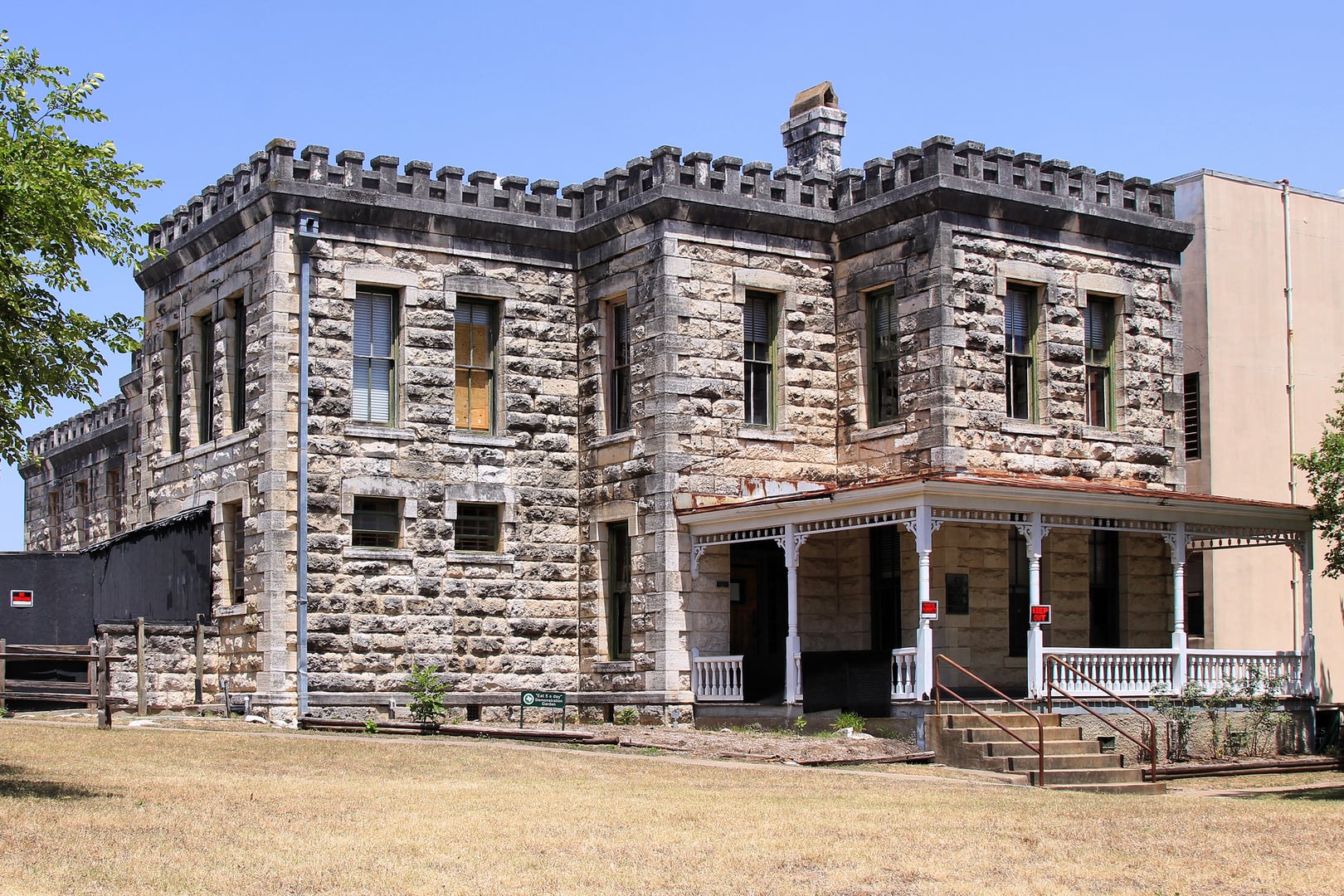
Est. 1892 · National Register of Historic Places — Bastrop County Courthouse and Jail Complex · Active county jail 1892–1974 · Second-floor gallows with at least three documented executions · Original hanging hook preserved in converted office space
The Bastrop County Courthouse and Jail Complex was developed in the late nineteenth century as Bastrop County's primary civic and law-enforcement campus. The jail portion was constructed in 1892 in a two-tone brick design — tan and red — that made it architecturally distinctive on Main Street. The building is part of the Bastrop County Courthouse and Jail Complex, which is listed on the National Register of Historic Places.
The jail operated as the county detention facility for more than eight decades, from 1892 through 1974. During that span its second-floor gallows were used for at least three documented executions. One of those condemned was described in local accounts as an outlaw who had killed thirteen men, though the specific name and case are not definitively documented in sources accessible during this build.
After the county moved to a new detention facility in 1974, the 1892 building was repurposed rather than demolished. It was converted into offices for the Bastrop Area Chamber of Commerce. According to accounts of the building's interior, the original hanging hook from the second-floor gallows was left in place during the conversion and reportedly remains visible today.
The building sits one block from Maxine's Café at 905 Main — another structure on Bastrop's Main Street with a documented dark history — making the block an unusual concentration of locally acknowledged paranormal sites in a small Central Texas city.
Sources
- https://en.wikipedia.org/wiki/Bastrop_County_Courthouse_and_Jail_Complex
- https://www.texasescapes.com/Jails/Bastrop-Texas-Bastrop-County-Jail.htm
Presence sensed on upper floor (former gallows level)General unease reported by building occupants
The 1892 Bastrop County Jail served as the site of at least three executions on its second-floor gallows. One of the condemned was locally characterized as an outlaw with thirteen killings to his name — a detail that has circulated in Bastrop oral history even as the specific case has not been definitively identified in accessible historical archives.
The original hanging hook was left in the building when it was converted to Chamber of Commerce offices in the years following 1974. The hardware's presence in a now-ordinary office environment — where staff conduct routine civic business beneath the physical apparatus of the gallows — gives the building an uncanny quality that goes beyond typical haunted-building aesthetics.
Paranormal accounts for the building describe presences associated with those who died there, with the concentrated lore attached to the upper floor where the gallows stood. Specific incidents in the documented record are limited; the building's haunted reputation rests substantially on the physical evidence of its execution history — the hook, the architecture, the documented deaths — rather than a catalog of witnessed events.
Where this legend is told