Drive-By
True-Crime Site Visit
View the Main Street site of the former Richards Mansion, scene of the unsolved 1940 Oliver Springs triple murder, now occupied by Harvey's Furniture.
- Duration:
- 30 min
HauntBound archive · catalog record
Reported phenomena, as catalogued
A furniture store on Main Street in Oliver Springs, Tennessee, built on the site of the Richards Mansion where an unsolved 1940 triple murder occurred, now reported to be haunted by a woman in 1940s-style dress.
200 Main Street, Oliver Springs, TN 37840
Research updated May 2026
Age
All Ages
Cost
Free
Active retail furniture store; the site's history is best appreciated from public areas. No admission fee.
Access
Wheelchair OK
Paved downtown sidewalk and store entrance
Equipment
Photos OK
Est. 1940 · Site of the unsolved 1940 Oliver Springs triple murder of the Richards sisters and Leonard 'Powder' Brown · Featured in WBIR-TV's 'Appalachian Unsolved' series · Leonard Brown officially cleared of suspicion in 2001; case remains open
On February 5, 1940, one of the most notorious unsolved crimes in East Tennessee history took place at the Richards Mansion in Oliver Springs. Margaret Richards, 46, a secretary at the Oliver Springs Brick Yard, was found shot twice, in the head and the throat, on the stairwell. Her sister Ann Richards, 48, a bank teller at the Oliver Springs Bank, was found shot in the head in the kitchen. Also killed was Leonard 'Powder' Brown, a 16-year-old African American errand boy the sisters had befriended and employed, who was found near the second-floor banister with a .38 pistol nearby.
Investigators initially theorized that Brown had killed the sisters and then himself, but the evidence did not support it: there were no fingerprints on the gun, Brown was described as timid and afraid of firearms, and the shootings showed accurate marksmanship. Cigarette butts were found throughout the house even though the Richards family did not smoke, and it was later noted that convicts recently released from nearby Brushy Mountain State Penitentiary had been seen in the area. On February 13, 1940, a coroner's jury concluded that all three had been killed by 'persons unknown,' though the local sheriff maintained his belief in Brown's guilt.
Leonard Brown was officially cleared in 2001, after a witness came forward with information about two men seen watching the house the day before the killings. The case remains officially open and unsolved to this day, and is featured in WBIR-TV's 'Appalachian Unsolved' investigative series.
The Richards Mansion was later destroyed by fire, and Harvey's Furniture was built on the site at 200 Main Street, where it operates today as a downtown Oliver Springs business.
Sources
Because the store occupies the ground where the Richards Mansion once stood, the unsolved 1940 murders have given Harvey's Furniture a haunted reputation in local lore. Employees and customers have, over the years, reported seeing the apparition of a woman dressed in 1940s-style clothing moving through the building, along with hearing voices of unknown origin echoing through the store. These accounts are typically tied to the Richards sisters, whose deaths were never explained.
The paranormal reports are documented in regional accounts of the Oliver Springs mystery, including local histories of the case. They should be understood as folklore that grew up around a genuine and well-documented tragedy rather than as verified phenomena.
Out of respect for the victims, it is worth emphasizing the historical record: Leonard 'Powder' Brown, the teenage errand boy, was a victim of the crime and was officially cleared of any wrongdoing in 2001. Earlier and now-discredited accounts that cast suspicion on him do not reflect the established facts of the case, and the haunting tradition is best framed around the lasting mystery of who killed three people in that house.
Notable Entities
Media Appearances
View the Main Street site of the former Richards Mansion, scene of the unsolved 1940 Oliver Springs triple murder, now occupied by Harvey's Furniture.
Some links on this page may earn HauntBound a small commission when you book, at no extra cost to you. Our editorial picks are independent. Full disclosure
Every HauntBound history is researched from documented sources. We clearly separate verified historical fact from paranormal folklore.
Free Guide
11 verified stops, rated for families, mapped in order. Free.
One email to confirm, then the guide link. Unsubscribe anytime.
Bellingham, WA
The Redlight Bar at 1017 N State Street occupies the site of the old Palace Meat Market, where butcher Frederick L. Dames was killed in a shack behind the shop on the night of April 11-12, 1905. The case was never officially solved.
Elfrida, AZ
The property operated as the Cochise Guest Lodge and Ranch, a dude ranch in Arizona's remote Sulphur Springs Valley. On December 3, 1977, ranch hand James Dean Clark killed four people — ranch owners Charles and Mildred Thumm and two fellow wranglers, Gerald McFerron and George Martin — in a spree that ended with his arrest in El Paso. Clark was convicted of four counts of first-degree murder in 1978 and executed by the State of Arizona on April 14, 1993. The property was subsequently acquired by VisionQuest National, a youth rehabilitation organization founded in 1973, which operates it as a residential program to this day.
La Porte, IN
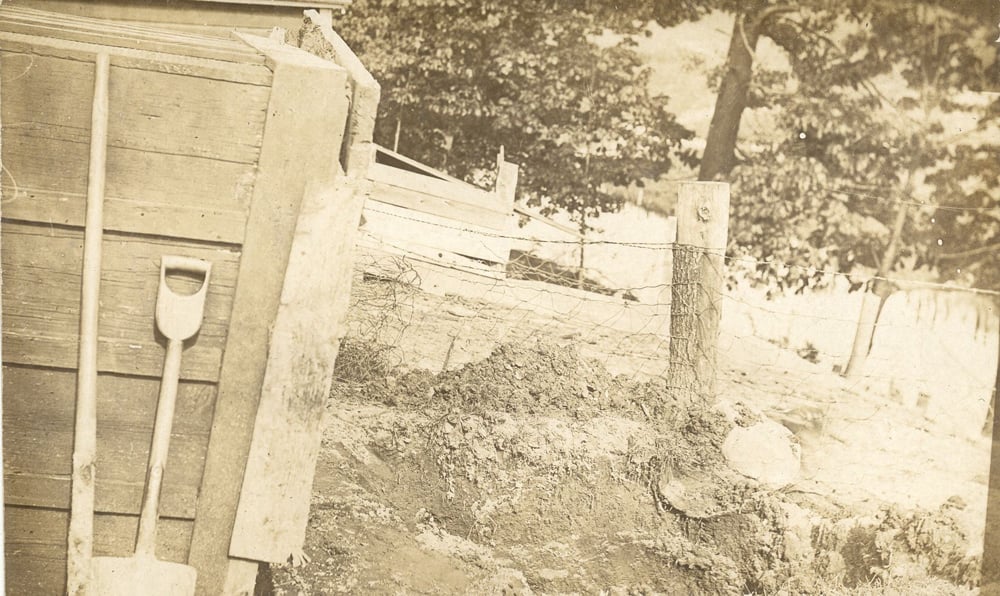
Between 1896 and 1908, Belle Gunness used her 48-acre farm northwest of La Porte to murder an estimated 40 or more people, including at least two husbands, her own children, and a series of suitors lured by matrimonial advertisements in Norwegian-language newspapers. The farmhouse burned on April 28, 1908, and the case was never fully resolved — Gunness was never captured.