Est. 1909 · Civil War History · General William P. Sanders · Union Hospital · 19th Century Hotel Architecture
The land at 803 South Gay Street changed hands in 1801 when developer Thomas Humes began planning a hotel. Construction began in 1815 and was completed in 1817, producing a building with thirteen guest rooms, a ballroom, a bar, and a dining room — a substantial civic anchor for the growing town of Knoxville.
By the time the Civil War reached East Tennessee in late 1863, the building was operating as the Lamar House Hotel. Under Union occupation, the Lamar House served for a time as a hospital, and Generals William Sherman and Phil Sheridan made it their headquarters. On November 18, 1863, Union General William P. Sanders was struck by a Confederate sharpshooter — believed to have been positioned in the tower of Bleak House — while leading cavalry on Kingston Road delaying the Confederate advance. He was carried back to the Lamar House and died in the bridal suite on November 19. He was 30 years old.
In the weeks following Sanders' death, the hotel served as a makeshift hospital for Union wounded. Hundreds of Confederate casualties from the failed assault on Fort Sanders — the earthwork named in the general's honor — were also treated in the building's rooms and corridors.
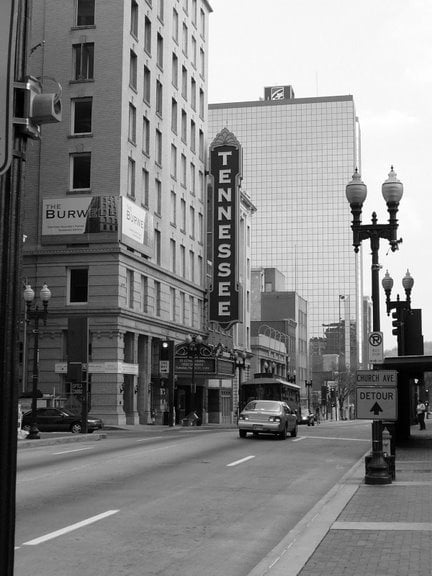
The Bijou Theatre opened on March 8, 1909, as part of the Lamar House Hotel. The hotel closed in 1969 after being declared a public health hazard, while the theater continued to operate. The theater itself closed in 1975, reopened in 1977, shut down again in May 2004 and reopened in 2006. The New York Times has described it as 'one of the best sounding rooms in the country.' It now hosts approximately 39 concerts and events annually on a calendar that runs from national touring acts to regional performers. The venue is in the heart of downtown Knoxville, walking distance from Market Square and the Tennessee Theatre.
Sources
- https://knoxbijou.org/
- https://en.wikipedia.org/wiki/Bijou_Theatre_(Knoxville,_Tennessee)
- https://insideofknoxville.com/2023/10/inside-the-haunted-200-year-old-bijou-theatre-do-you-believe/
- https://www.wbir.com/article/news/history/knoxvilles-haunted-history/51-4e9f4bb3-71ce-4124-8c45-50c950ee580e
- https://spookfinder.com/place/bijou-theatre
ApparitionsPhantom footstepsDoors opening/closingObject movementCold spots
The figure on the stairs is described the same way across independent accounts: a man with a beard, in uniform, moving through the second-floor corridor or standing near the box seats. He is observed directly, not peripherally, and disappears when approached or when the observer looks away and back. Staff have reported him during setup hours before performances, when the building has few people in it.
General Sanders died in the room that was then the bridal suite, on November 19, 1863, from a sniper wound taken during the siege. He was the Union officer after whom Fort Sanders was named — the earthwork fortification whose defense against Longstreet's assault became one of the pivotal moments of the campaign. His body was in the hotel when the final Confederate assault was repulsed.
A second figure associated with the building is described as a boy, reported primarily in the area of a second-floor bathroom. The reports involve things being knocked over, fixtures running on their own, and a presence that retreats when confronted. No historical identity has been attached to this figure.
The building's history as a hospital — hundreds of wounded men in the rooms over several weeks in late 1863 and early 1864 — provides the broader context that investigators note. The Bijou is not just the site of one death; it is the site of a period of concentrated suffering that occurred in the specific rooms where modern visitors now sit and hear music.
Notable Entities
Union General William P. SandersMischievous boy