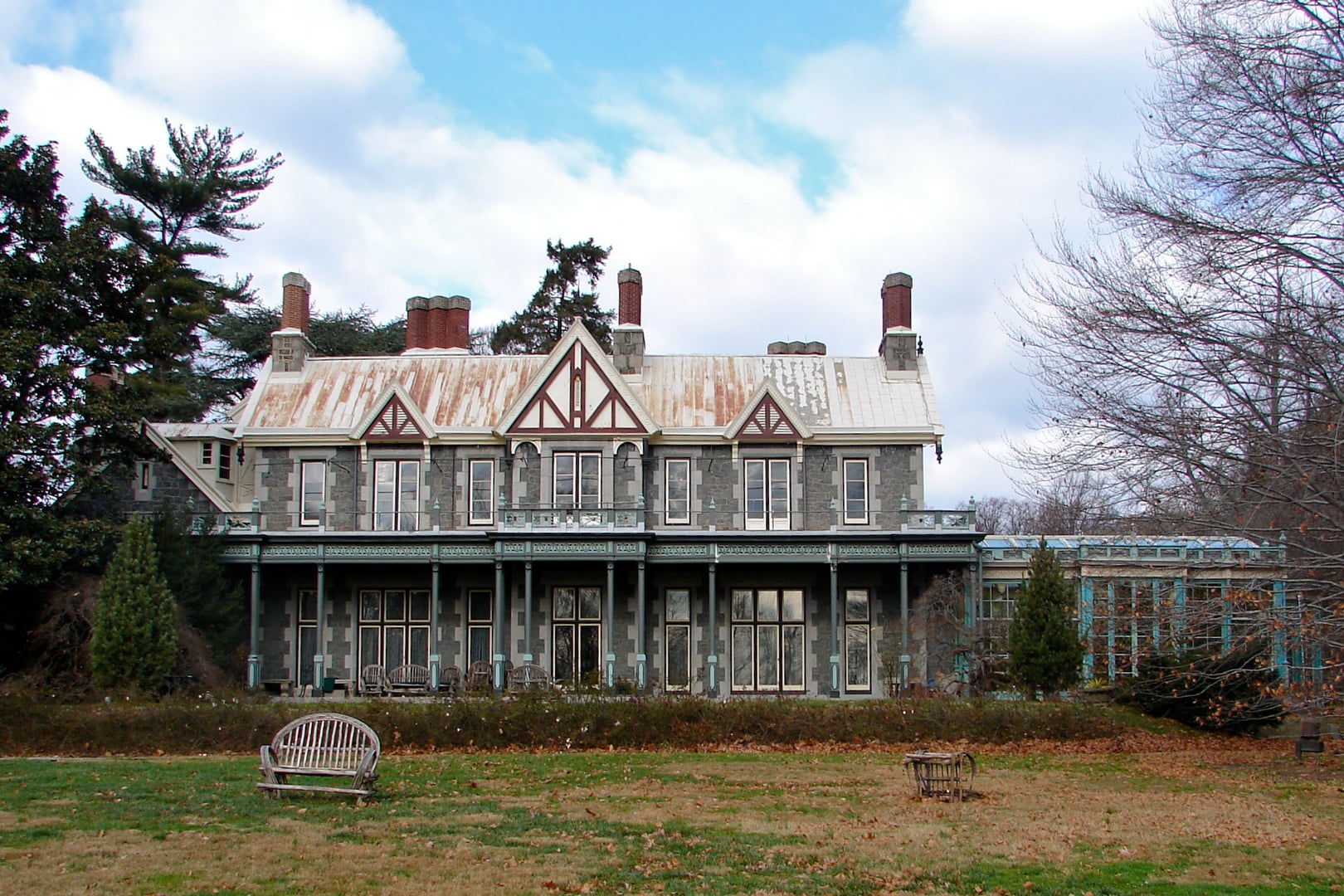
Est. 1892 · Queen Anne Architecture · Black Hills Gold Rush · Deadwood Historic District · Sealed-and-Preserved House Museum
The Adams House stands on Van Buren Street in Deadwood's residential upper terrace, a Queen Anne Victorian completed in 1892 for Harris Franklin, a Polish-Jewish immigrant who built one of the largest fortunes of the Black Hills gold rush. Franklin commissioned the home from architects working in the high-style Queen Anne idiom popular in the upper Midwest at the turn of the century, with asymmetrical massing, a corner tower, ornate spindlework, and stained-glass transoms.
Franklin's son Nathan died in 1903, and the family eventually left Deadwood. In 1920, William E. Adams — owner of the Adams Brothers wholesale grocery, a dominant regional firm — purchased the home for his second wife Mary and their daughters. W.E. Adams suffered a stroke on June 7, 1934, and died on June 16. Mary Adams continued to live in the house for two years. According to family accounts, she heard her late husband's footsteps walking the second floor on a regular basis and closed the house in 1936, moving to California.
The house remained sealed for more than half a century. Mary Adams did not sell or rent the property; instead, she simply locked the doors and left the contents in place. When Deadwood Historic Preservation acquired the house in 1992, restoration teams found original furnishings, clothing, china, and personal effects largely undisturbed since the 1930s. The home opened as a museum in 2000 under Deadwood History, Inc.
More than 80% of the museum's current furnishings are documented as having belonged to the Adams family — an unusually high preservation rate for a 19th-century American house museum, attributable directly to Mary's decision to close rather than dispose of the home. The museum is listed on the National Register of Historic Places as part of the Deadwood Historic District, designated a National Historic Landmark in 1961.
Sources
- https://www.deadwoodhistory.com/about-us/properties/historic-adams-house/
- https://www.cityofdeadwood.com/historic-preservation/page/historic-adams-house
- https://www.kotatv.com/content/news/Historic-Adams-House-combines-history-paranormal-activity-496636011.html
- https://www.bhparanormal.com/historic-adams-house-investigation/
Object movementPhantom smellsPhantom footstepsEVPEMF anomaliesShadow figuresResidual haunting
The Adams House's paranormal reputation rests on a relatively well-documented body of staff observations and recorded investigator findings — unusual for a small Western house museum.
The most frequently cited phenomenon is the movement of Mary Adams's rocking chair, located in an upstairs sitting room. Staff arriving in the morning have reported finding the chair rocking gently with no one in the room. The motion has been observed by multiple docents independently over the years the museum has been open.
The second persistent report involves the smell of cigar smoke. W.E. Adams was a documented cigar smoker, and the scent is reported most often in his former study and along the second-floor hallway he is said to have paced after the 1934 stroke. The house has been smoke-free since reopening as a museum in 2000.
Black Hills Paranormal Investigations, a regional group that has conducted multiple sessions at the home, has published audio of an EVP in which a woman's voice clearly exclaims 'fire.' Investigators have associated this with the 1895 Deadwood fire that destroyed much of the town but stopped short of Van Buren Street, sparing the Adams (then Franklin) home. Other recorded phenomena include REM-pod activations, parascope readings consistent with directional responses, and shadow figures captured in laser-grid photographs along the second-floor landing.
Deadwood History, Inc. has approached the paranormal narrative with notable restraint, integrating it into evening event programming without making it the primary interpretive frame for the home. The daytime tour focuses on Franklin and Adams family history, Black Hills mercantile economy, and the preservation story.
The most poignant reported phenomenon is the footsteps Mary Adams herself described in 1934-36 — the experience that caused her to close the home and depart for California, and that returned to the building only after eighty years of silence when paranormal investigators began documenting nighttime activity in the same upstairs hallway.
Notable Entities
W.E. AdamsMary Adams

.jpg)