Est. 1901 · Early American Tuberculosis Sanatorium · Lawrence Flick Public Health Legacy · Former Pennhurst State School Annex · Pierre du Pont Philanthropy
The White Haven Sanatorium opened during the first week of August 1901 with a superintendent, a cook, and three patients. The property was situated on a level stretch of ground halfway up a mountainside, on what had been a working farm. The original buildings consisted of a converted farmhouse for kitchen, dining, and staff quarters, and a barn converted into a forty-bed pavilion for patients.
The sanatorium expanded rapidly under Dr. Lawrence F. Flick, a Pennsylvania physician central to the early-twentieth-century American campaign against tuberculosis. The property was selected for its cold, dry mountain climate and for its isolation, both important factors in the prevailing approach to TB treatment. The property was easily reached by train from New York City but distant enough to limit contagion.
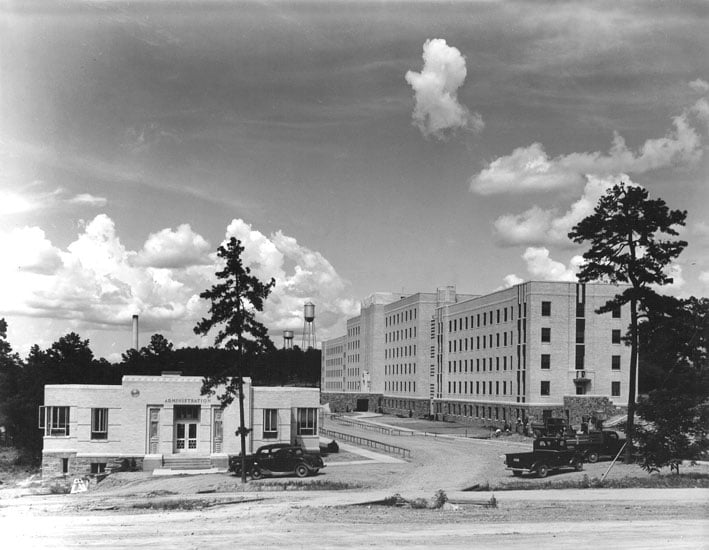
From 1901 to 1941 the sanatorium treated 25,335 patients, an annual average of 617. In 1907 the sanatorium established one of the first nurse-training schools in the country dedicated to teaching recovered TB patients a livelihood; from 1909 to 1942 the school graduated 275 nurses. The complex grew to include multiple ward buildings, residential staff housing, agricultural operations, a chapel, and a cemetery.
A dedicated coal-to-steam power plant was constructed to meet rising electrical demand. In 1938, industrialist Pierre du Pont donated $125,000 to expand the power plant, funding a new dining room and a state-of-the-art kitchen. This expanded power plant is the building now operating as the Powerhouse Eatery.
In 1946, Jefferson Medical College accepted the sanatorium as a gift, operating it until March 1, 1956, when the diminishing tuberculosis caseload forced its closure. The Commonwealth of Pennsylvania purchased the complex on March 5, 1956 to operate it as Pennhurst State School Annex #2, providing care for residents with developmental disabilities. By 1976 the entire former sanatorium complex was vacant. In 1989 the power plant was renovated as the Powerhouse Eatery, while the surrounding sanatorium buildings remain in their decommissioned state.
Sources
- https://www.angelfire.com/biz/AFSCME2334/hist.html
- https://www.powerhouseeatery.co/history
- https://www.asylumprojects.org/index.php/White_Haven_State_School_and_Hospital
- https://jamanetwork.com/journals/jamainternalmedicine/fullarticle/563621
Phantom smells
The Shadowlands Haunted Places Index entry for the site is brief, noting only that ghostly mist has been reported. Given the property's history as a tuberculosis sanatorium that treated tens of thousands of patients across roughly half a century, with associated mortality, regional folklore around the abandoned wards has accumulated organically. Such reports are typical of long-decommissioned medical facilities and are not specific to confirmed phenomena.
Independent published sources, including the Powerhouse Eatery's own history page and academic histories of Lawrence Flick's tuberculosis work, document the medical and architectural history of the sanatorium without substantive paranormal claims. The Powerhouse Eatery, the restored 1938 power plant, does not market itself as a haunted location.
The surrounding sanatorium buildings remain inaccessible to the public, and ongoing investigation activity at the ruins is not publicly documented. The site should be approached as a heritage and architectural destination via the operating restaurant rather than as a ghost-tour stop.