Est. 1836 · National Historic Landmark · Rural Cemetery Movement · John Notman Landscape Architecture · Civil War Burials
John Jay Smith, a Philadelphia Quaker librarian, founded Laurel Hill Cemetery in 1836 after the difficult experience of trying to find his deceased daughter's grave in a crowded Philadelphia churchyard. Smith partnered with Nathan Dunn, Benjamin W. Richards, and Frederick Brown to acquire a 78-acre Schuylkill River bluff property and establish a new model of American burial ground modeled on Boston's Mount Auburn Cemetery, which had opened in 1831.
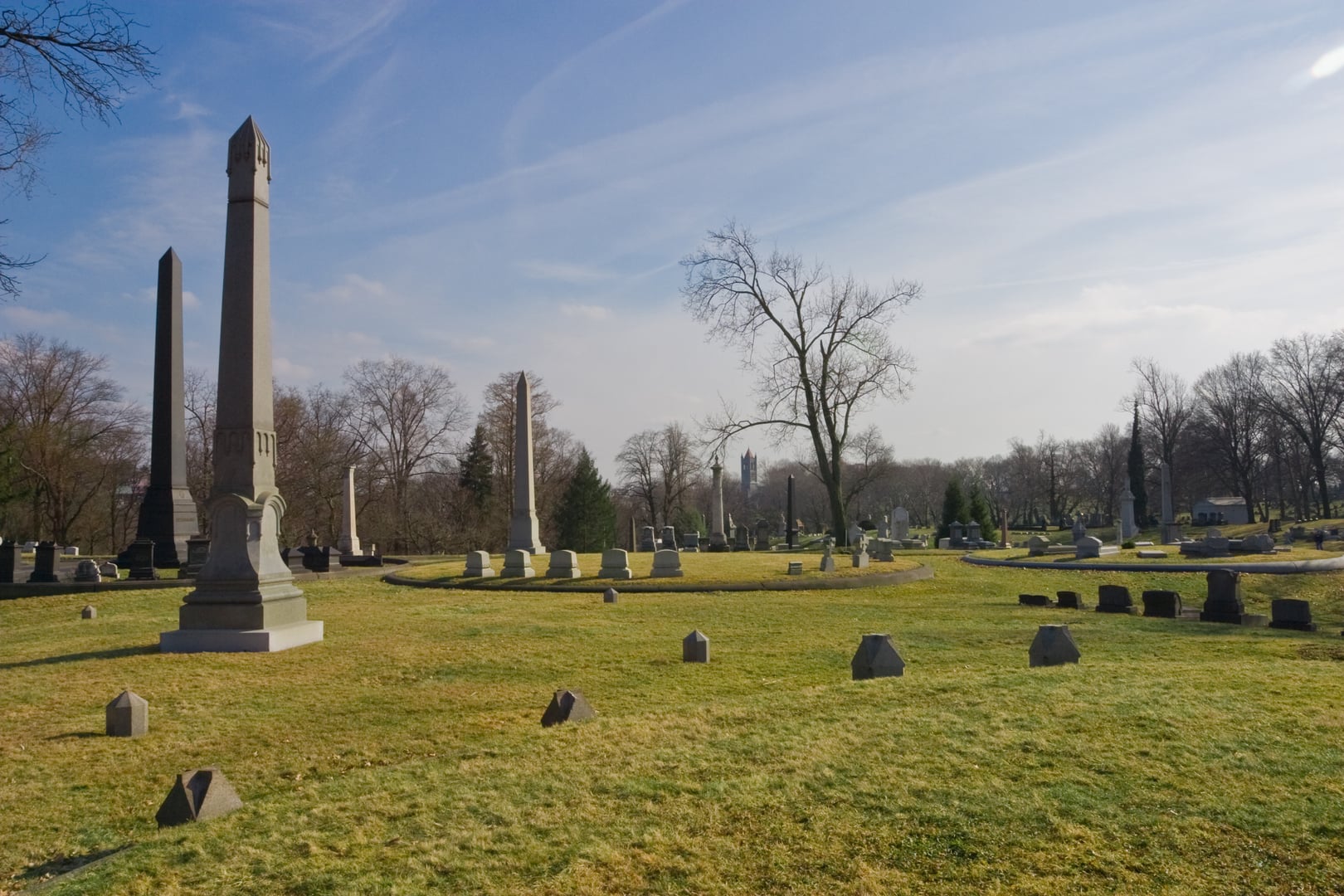
An informal design competition selected Scottish-born architect John Notman to lay out the cemetery. Notman's plan organized the property as an amphitheater stepping down to the Schuylkill, with curving carriage roads following the topography rather than imposing a grid. He designed the Roman Doric gatehouse on Ridge Avenue, completed in 1837, which still defines the cemetery's primary entrance. Notman went on to design the Philadelphia Athenaeum and St. Mark's Church in Philadelphia.
Laurel Hill was an immediate civic success. By 1848, nearly thirty thousand visitors had entered the gates between April and December alone, drawn by the landscape, the Schuylkill views, and the unfolding Victorian funerary program of monuments and family lots. The cemetery preceded Central Park by more than two decades and helped shape the American public-park movement; Philadelphia's Fairmount Park, established in 1855, drew on Laurel Hill's example.
The cemetery's burial roster includes thirty-nine generals of the Civil War, six Mayflower passengers' descendants, multiple signers of the Declaration of Independence's families, and a dense layer of nineteenth-century Philadelphia industrial, financial, and cultural figures. Laurel Hill was designated a National Historic Landmark in 1998. It is operated today as a public-facing nonprofit with an active program of tours, public events, and conservation work.
Sources
- https://thelaurelhillcemetery.org/about/history
- https://en.wikipedia.org/wiki/Laurel_Hill_Cemetery
- https://philadelphiaencyclopedia.org/essays/laurel-hill-cemetery/
- https://sah-archipedia.org/buildings/PA-02-PH134
ApparitionsPhantom footstepsShadow figures
Laurel Hill's haunted reputation is unusual among American cemeteries in that the cemetery itself actively programs around it. The cemetery's events calendar includes regular evening tours and seasonal investigations, all conducted with archival respect for the burials and with educational content that frames the paranormal accounts as cultural history rather than confirmed supernatural incident.
Reports collected over the cemetery's nearly 200-year history include figures observed in period dress walking between the mausoleums, footsteps on the carriage roads when no one is visible, and recurring activity at specific monuments. The William Warner monument, a Greek Revival temple with reclining figures, is among the most-cited locations. The Ardrossan Hill section, with its concentration of large family mausoleums, generates additional accounts.
Laurel Hill's value as a destination does not depend on the ghost framing. The Notman landscape design, the density of significant Victorian sculpture, the Schuylkill River views, and the educational programming all reward visitors who come for the cultural history rather than the paranormal hook. Visitors interested specifically in the haunted tradition should attend one of the cemetery's organized evening programs rather than approach the property casually after hours.