Est. 1969 · Site of 1758 Battle of Grant's Hill (French and Indian War) · Site of British Fort Pitt (1759–1792) · Senator John Heinz History Center affiliate · Smithsonian Affiliate
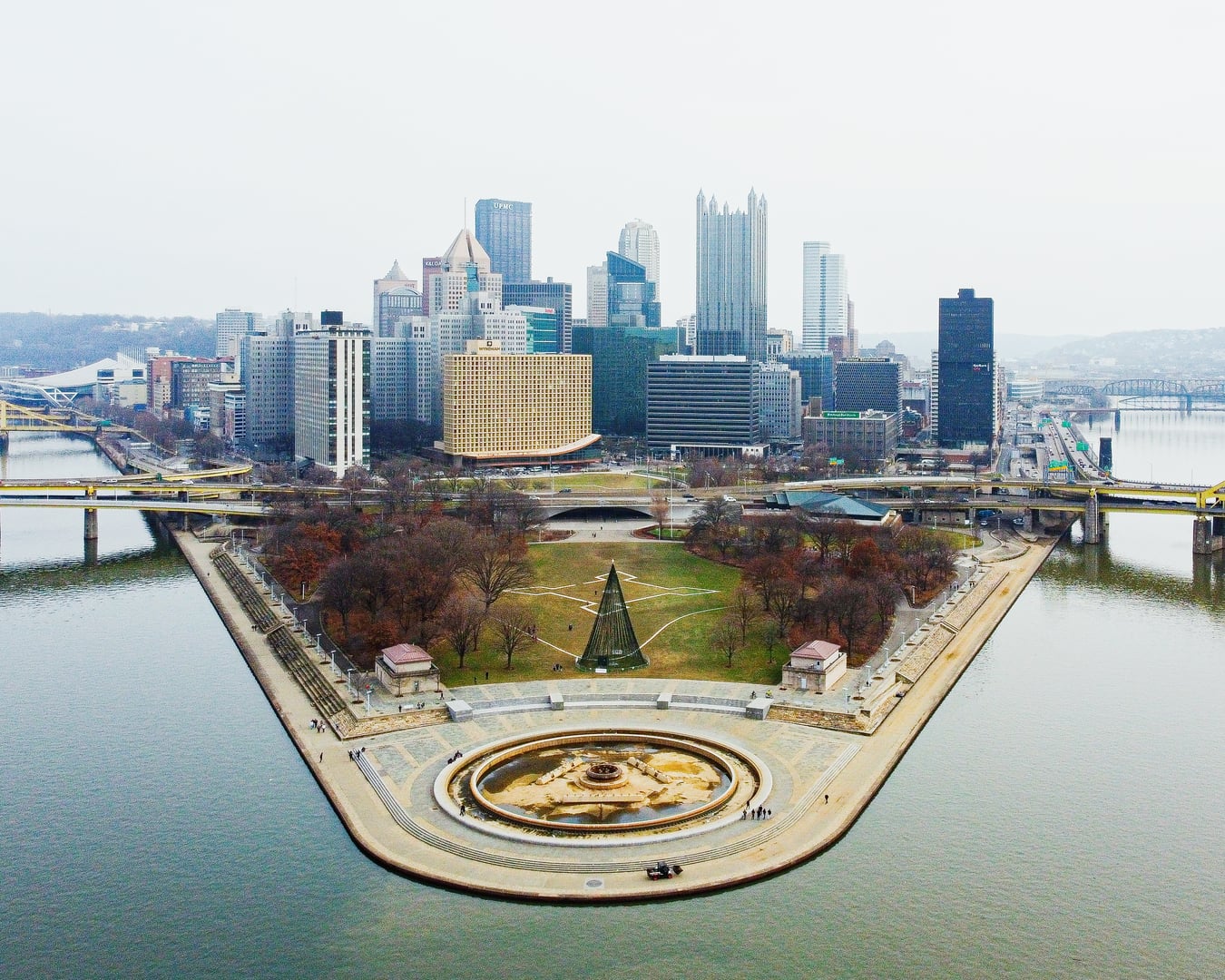
The point of land at the confluence of the Allegheny and Monongahela rivers — the 'Forks of the Ohio' — was strategically critical to control of the Ohio Valley. The French built Fort Duquesne on the point in 1754. On September 14, 1758, a British force under Major James Grant of the 77th Highlanders advanced on the fort and was ambushed and routed on the rising ground above; the engagement is known as the Battle of Grant's Hill and resulted in the deaths of approximately 300 British and provincial troops. Grant himself was captured. The French abandoned and burned Fort Duquesne in November 1758 under pressure from the larger Forbes Expedition.
The British constructed the larger Fort Pitt on the same site between 1759 and 1761. Fort Pitt was the British center of operations for Pontiac's War (1763–1766) and for the early western theater of the American Revolution. Most of the fort was demolished after 1792, with only the 1764 Fort Pitt Block House surviving.
The Commonwealth of Pennsylvania designated the site Point State Park in 1945. Construction of the park and the Fort Pitt Museum, located on the foundations of the original Monongahela bastion, was completed in 1969. The museum has been operated by the Senator John Heinz History Center, an affiliate of the Smithsonian Institution, since 2010.
Grant's Hill itself, originally a 70-foot rise immediately north of the fort, was leveled to street grade in 1912 as part of downtown Pittsburgh's regrading.
Sources
- https://en.wikipedia.org/wiki/Fort_Pitt_Museum
- https://www.heinzhistorycenter.org/visit/fort-pitt/
- https://en.wikipedia.org/wiki/Point_State_Park
- https://www.wesa.fm/arts-sports-culture/2023-03-20/what-happened-to-grants-hill-in-downtown-pittsburgh
Figures appearing on security monitors with no physical presenceSmall artifacts relocated overnightSmell of black-powder smoke near the Block HousePeriod-dressed figures reported on park paths
Pittsburgh paranormal accounts collected on the city's regional ghost-tour circuit and by local writers describe two recurring patterns at the Fort Pitt Museum. Security staff have reported seeing figures on the museum's surveillance monitors — most often described as a man in colonial-era dress in the eighteenth-century gallery — that are not visible when the corresponding area is physically checked. Small artifacts have occasionally been found relocated overnight, though the museum has not endorsed the reports. CBS Pittsburgh's 'Best Pittsburgh Haunts' feature documents the security-monitor and disappearing-objects pattern, and the Paranormal in Pennsylvania podcast devoted a 'Haunting Histories' episode to the museum's reports.
Local tradition references a re-enactor's death at the site in the early 1970s, but no contemporary newspaper account has been definitively identified in the public record; the detail should be considered folklore rather than documented history until corroborated.
Point State Park itself, as the site of the 1758 Battle of Grant's Hill and the larger Forbes Expedition campaign, has accumulated separate accounts: visitors to the surviving Fort Pitt Block House occasionally report the smell of black-powder smoke, and joggers on the lower park paths near the river have described seeing groups of period-dressed figures that disappear when approached.
Media Appearances
- Paranormal in Pennsylvania podcast — Fort Pitt Museum Haunting Histories
- CBS Pittsburgh — Best Pittsburgh Haunts
Where this legend is told