Est. 1910 · Built 1910 for John Teele Pratt; Charles A. Platt architect · Home of Ruth Baker Pratt — first woman elected to Congress from New York (1928) · One of five surviving Pratt family mansions in Glen Cove · One of the first conference center hotels in the United States (1967)
The Manor was built in 1910 at 200 Dosoris Lane in Glen Cove, designed by architect Charles A. Platt for John Teele Pratt and his wife Ruth Baker Pratt. John Pratt was the son of Charles Pratt, whose oil company was absorbed into Standard Oil, making the Pratt family among the wealthiest on Long Island. The Manor stands as one of five surviving mansions built for sons of Charles Pratt, alongside The Braes (now Webb Institute), Welwyn (Holocaust Memorial and Tolerance Center of Nassau County), Poplar Hill (Glengariff Healthcare), and Killenworth (now the Russian UN delegation's retreat).
Ruth Baker Pratt (1877–1965) was a significant political figure. She became New York City's first female Alderman and in 1928 was elected to the U.S. House of Representatives — the first woman elected to Congress from New York State. She served two terms in Congress and remained a prominent figure in New York Republican politics until her death. She died at The Manor in 1965.
After Ruth Pratt's death the estate was converted into use as a conference hotel in 1967, reportedly one of the first such facilities in the United States. The property operated as Harrison House until 1985 and has since been branded as the Glen Cove Mansion Hotel and Conference Center or The Mansion at Glen Cove.
Sources
- https://en.wikipedia.org/wiki/The_Manor_(Glen_Cove,_New_York)
- https://patch.com/new-york/glencove/is-glen-cove-mansion-haunted
- https://www.lihauntedhouses.com/real-haunt/glen-cove-mansion.html
Man in brown suit (identified as John Pratt) in main hallwayJukebox changing selections without input (Pub 1910)Television turning on by itself (Pub 1910)Persistent fog pattern on window in Mrs. Pratt's former studyComputer monitors shaking simultaneouslyFemale apparition — smiling older woman seated in corner
The Manor's haunting accounts center on its original owners, both of whom are documented as having died in or closely connected to the property. Ruth Baker Pratt died at the mansion in 1965 after decades of residence; accounts of her presence date to the years following her death.
Front desk receptionist Kim Flammia described seeing apparitions and watching computer monitors shake simultaneously for about 30 seconds — a detail notable for its specificity. A man in a brown suit, identified by staff as John Pratt based on period photographs, has been seen walking the main hallway before disappearing. The figure's appearance in a formal garment matches descriptions across multiple staff accounts.
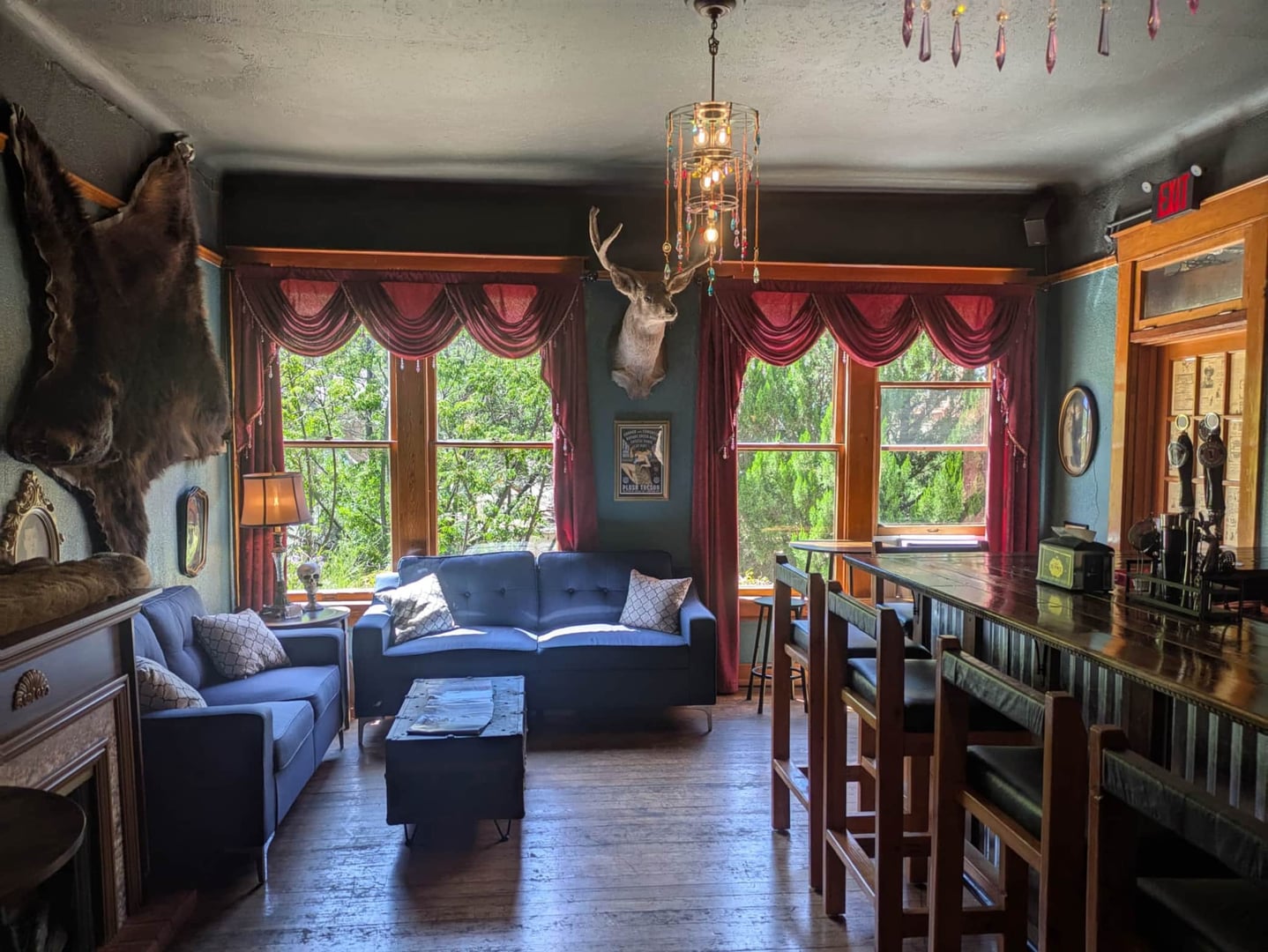
In Pub 1910, the bar on the ground floor, staff report the jukebox changing songs without human input and the television switching on independently, tuned to crime dramas — an account that investigators Kerriann Flanagan Brosky and Joe Giaquinto documented in their investigation of the property. Brosky characterized the presence as 'someone that loves the house' — benign rather than threatening.
The most physically anomalous detail is the window in Mrs. Pratt's former study: a persistent fog or condensation pattern appears on one pane that staff have not been able to eliminate despite replacing the window multiple times. Orb photographs and EVP recordings have been captured at the location.
Notable Entities
Ruth Baker Pratt (1877–1965; first woman elected to Congress from New York; died at The Manor)John Teele Pratt (1873–1927; oil heir; original owner)
Where this legend is told