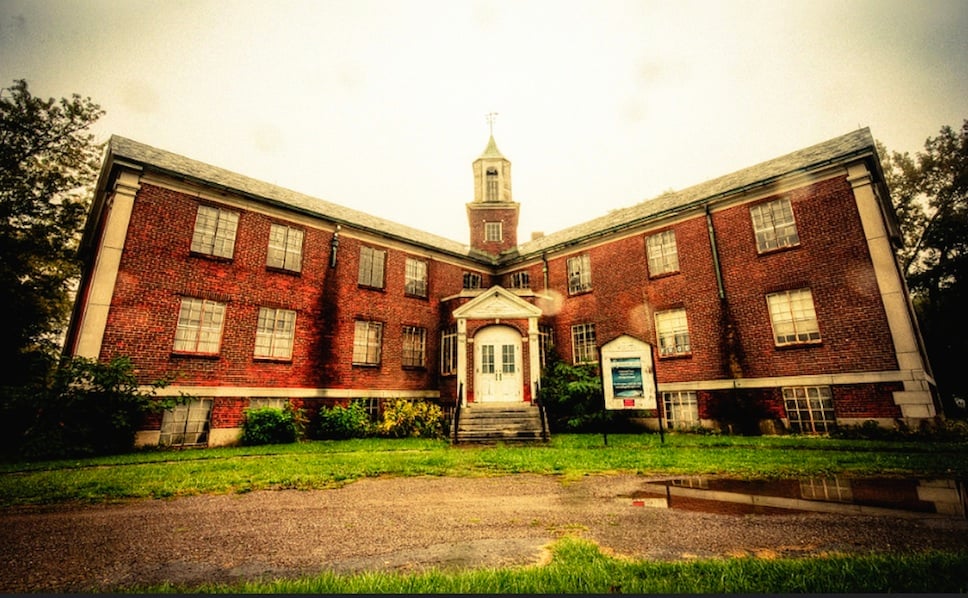
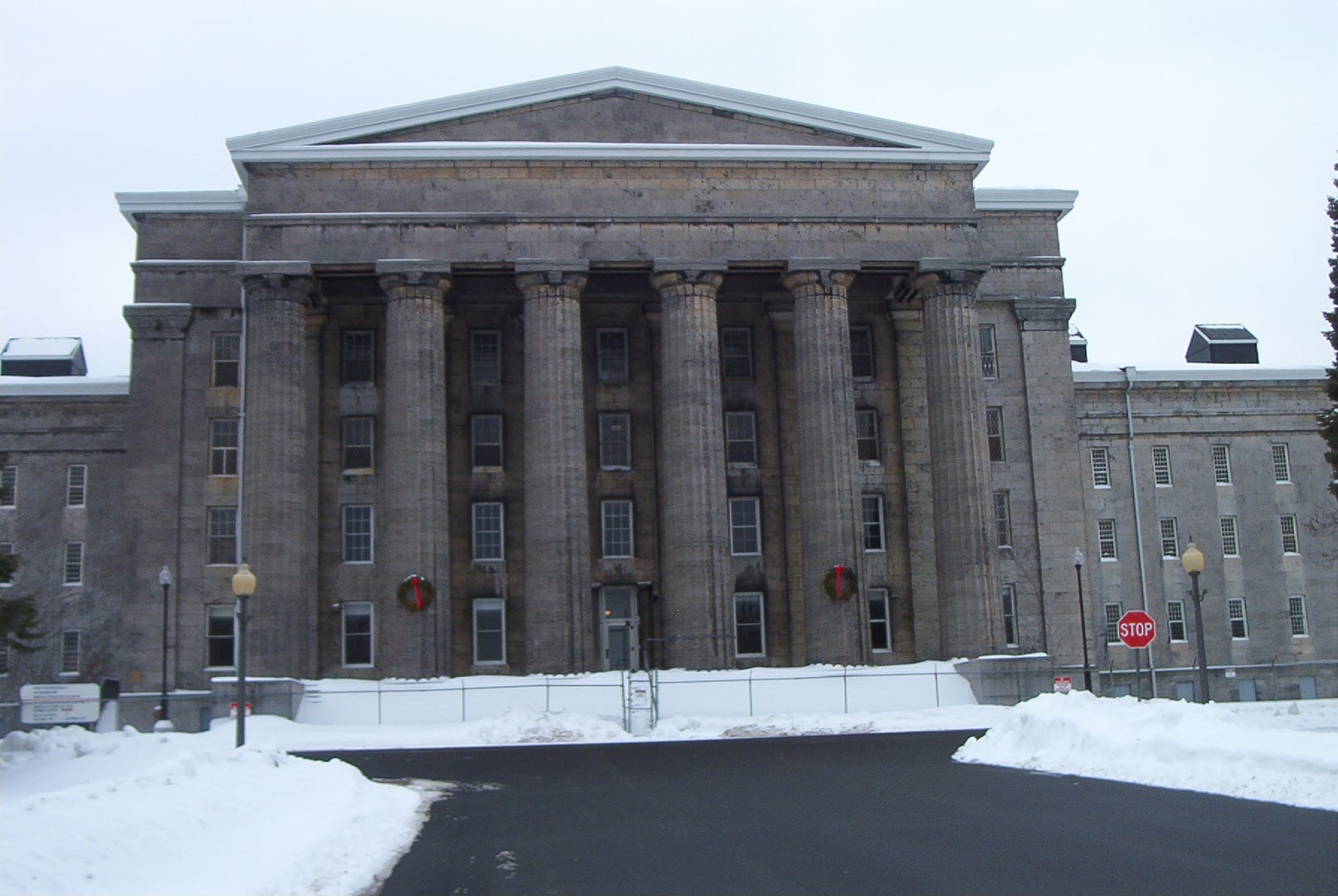
Est. 1931 · Psychiatric building constructed 1931; original 1736 hospital is America's oldest public hospital · O. Henry, Eugene O'Neill, Norman Mailer, Stephen Foster, and Allen Ginsberg among documented patients · Nellie Bly went undercover at Bellevue in 1887 for her muckraking report Ten Days in a Madhouse · Mark David Chapman held here following John Lennon's murder, 1980 · Original iron spiked fence still intact around the 1931 building
Bellevue's origins are in a two-story almshouse built in 1736 on what is now City Hall Park. In 1798 the city purchased a parcel of land along the East River at what was then called Belle Vue farm, and formal hospital operations moved there. The institution received its current name in 1824. For most of the 19th century it served as New York's last resort — the place where the city's poor, homeless, intoxicated, and mentally ill were brought when no other institution would take them.
Journalist Nellie Bly went undercover in 1887, was committed as a patient, and spent time at Bellevue before being transferred to a state asylum on Blackwell's Island. Her account, published as Ten Days in a Madhouse, documented conditions including overcrowding, cold baths, spoiled food, and staff indifference. Charles Dickens reported 'deep disgust and measureless contempt' after touring the facility in the 1840s.
The current psychiatric building was erected in 1931 in the Italian Renaissance style, designed by architects C.B. Meyers and Thompson, Holmes, and Converse. It occupies the full block on First Avenue between 29th and 30th Streets and is still surrounded by its original iron spiked fence. Writers and artists held in the psychiatric ward over the decades include O. Henry, Eugene O'Neill (multiple admissions for alcohol), composer Stephen Foster, and Norman Mailer, who was committed after stabbing his wife in 1960. Mark David Chapman was held at Bellevue following the 1980 murder of John Lennon before transfer. Allen Ginsberg referenced the hospital by name in his 1955 poem Howl.
The psychiatric hospital ceased hospital operations in the mid-1980s. The building currently operates as a men's homeless shelter. The main Bellevue hospital complex remains an active Level I trauma center with 898 beds.
Sources
- https://en.wikipedia.org/wiki/Bellevue_Hospital
- https://www.archives.nyc/blog/2021/4/16/building-histories-the-bellevue-psychopathic-hospital-and-the-rivington-street-bath
- https://www.boweryboyshistory.com/2013/05/the-startling-history-of-bellevue.html
Atmospheric sense of presence reported by visitors to the exteriorDark-history site documented by Atlas Obscura and multiple ghost tour operators
The Bellevue psychiatric building is less a site of named ghost legends than a place whose documented history carries its own dark weight. The 1931 structure — red brick, surrounded by a rusting iron spiked fence, still covered in ivy — has served as a template for fictional asylums in films, comic books, and novels including the Batman universe's Arkham Asylum, which multiple sources connect visually and thematically to the Bellevue building.
Pulitzer Prize-winning historian David Oshinsky, whose book Bellevue: An Illustrated History covers the hospital's full arc, has noted that 'the ghosts are everywhere' — referring not to paranormal entities but to the accumulated suffering of the patients who passed through. The psychiatric ward treated thousands of New York's most marginalized residents using methods now considered cruel: insulin shock therapy, hydrotherapy, and electroconvulsive treatment administered in conditions of severe overcrowding.
Atlas Obscura has documented the building as a dark tourism site, noting its architectural drama and institutional history. Ghost tour operators working the Kips Bay area have included it on walking routes, though specific paranormal accounts are thin compared to the building's historical documentation. The building's conversion to a men's homeless shelter — one form of institutional warehousing replacing another — adds a layer of continuity that guides sometimes note.
The most honest accounting of what haunts the building is the public record: Nellie Bly's 1887 undercover report, the treatment histories of its literary patients, and the architectural fact that the iron fence is still there.
Notable Entities
O. Henry (1862–1910; writer; treated for alcoholism)Eugene O'Neill (1888–1953; playwright; multiple admissions for alcohol)Norman Mailer (1923–2007; writer; committed 1960 following assault on his wife)Stephen Foster (1826–1864; composer; died following a period of destitution)