Est. 1886 · Archbishop Jean Baptiste Lamy · French Romanesque Revival Architecture · Seat of the Archdiocese of Santa Fe · 1980 Penitentiary Riot Crucifix
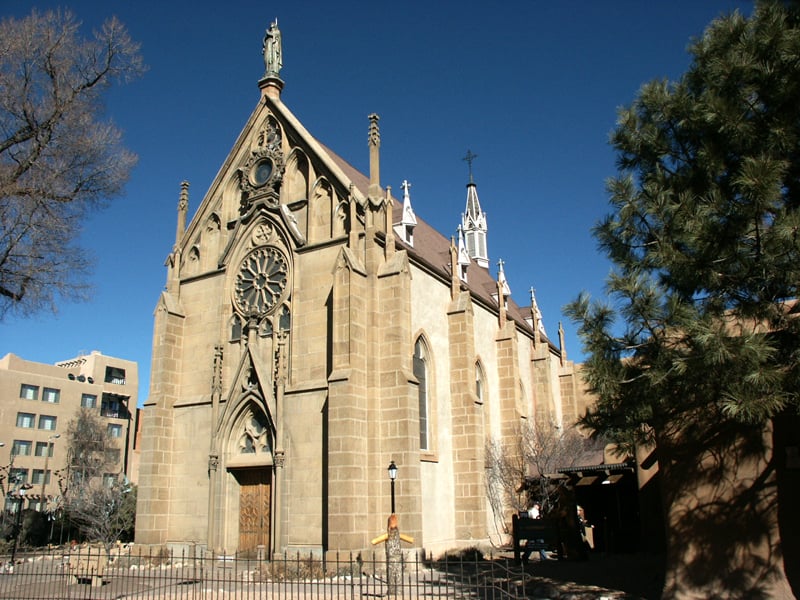
Archbishop Jean Baptiste Lamy, the first Catholic bishop of the New Mexico Territory, began construction of the cathedral in 1869 on the site of an earlier adobe church, La Parroquia, which dated to 1714-1717. The new French Romanesque Revival building, made of local stone, was raised around the standing adobe church; when the new walls were complete, the older church was dismantled and removed through the front doors. The main structure was largely finished by 1886.
The cathedral anchors the east end of Santa Fe's plaza district and was elevated to the rank of basilica in 2005. It remains the seat of the Archdiocese of Santa Fe and an active parish.
A later piece of New Mexico history is tied to the building. During the New Mexico State Penitentiary riot of February 2-3, 1980 -- one of the most violent prison riots in United States history, in which 33 inmates died -- fire swept the penitentiary south of Santa Fe. A crucifix that had hung in the prison's Catholic chapel was scorched by the flames but survived. In 2011 the singed crucifix was moved to St. Joseph's Chapel inside the cathedral, where it is displayed today.
The cathedral's age, prominence and connection to the riot have made it a fixture on Santa Fe's ghost-tour circuit, where guides fold it into the city's older legends.
Sources
- https://en.wikipedia.org/wiki/Cathedral_Basilica_of_St._Francis_of_Assisi_(Santa_Fe)
- https://www.cbsfa.org/our-parish-history
- https://en.wikipedia.org/wiki/New_Mexico_State_Penitentiary_riot
Apparition of a robed figureVanishing figure on the grounds
Compared with Santa Fe's famous haunted hotels, the cathedral's paranormal reputation is thin and rests mostly on the ghost-tour circuit rather than on any documented account. The story most often attached to it is of a robed, monk-like figure reported on or near the grounds at night that disappears when approached.
Guides on Santa Fe's evening ghost walks also weave in older threads of city lore: tales of priests who went missing in the territorial era and references to the Penitentes, the lay Catholic brotherhood whose Holy Week practices were long the subject of outside rumor and exaggeration in New Mexico. These elements are presented as atmosphere for visitors walking the plaza after dark.
The singed crucifix from the 1980 penitentiary riot, displayed in St. Joseph's Chapel, gives the building a genuinely somber object with a documented history, and tour narratives tend to pair it with the vanishing-figure story. Because the supernatural claims are not tied to named witnesses or investigation records, they are best treated as part of Santa Fe's well-developed ghost-tourism storytelling, with the cathedral serving as one stop among many.
Notable Entities
The robed monk