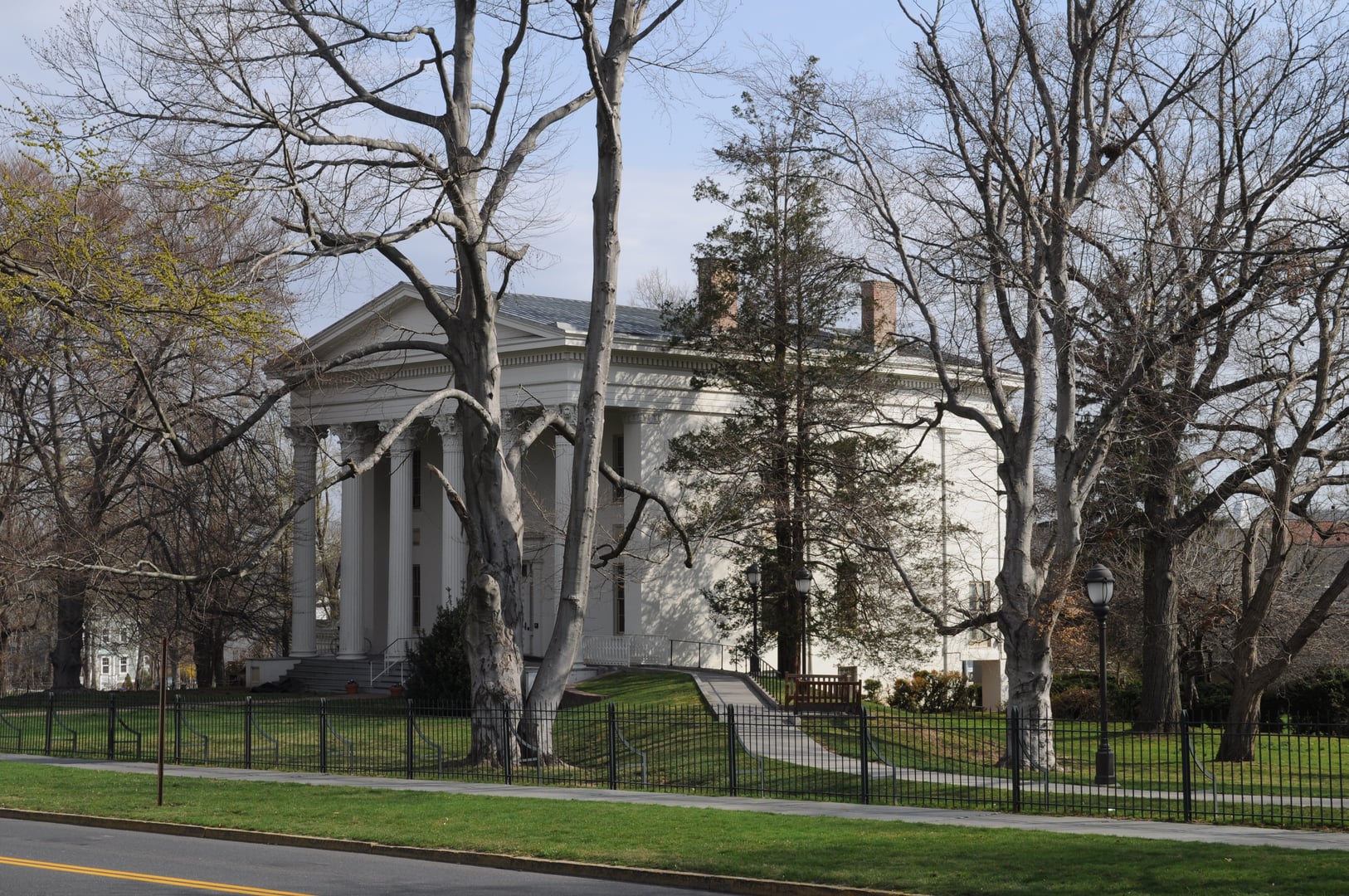
Est. 1809 · National Historic Landmark (1967) · Oldest building on Rutgers University campus · Designed by John McComb Jr., co-architect of New York City Hall · Administrative center of one of America's nine colonial colleges
Old Queens was completed in 1809 as the primary building of Queen's College, which had been founded in 1766 under a royal charter from King George III. The college — renamed Rutgers College in 1825 to honor a benefactor, Colonel Henry Rutgers — needed a permanent home after operating for decades without one. The brownstone Federal-style structure was designed by John McComb Jr., who also co-designed New York City Hall, and its bell tower became the defining architectural symbol of the institution.
The building sits at the center of what is now the College Avenue campus in New Brunswick. During the nineteenth century it housed virtually all university functions — classrooms, library, administration, and faculty offices — before the campus expanded. Today it serves as the main administrative building for Rutgers University–New Brunswick, housing the offices of the chancellor and other senior administrators.
The Revolutionary War context is inseparable from the building's identity. Queen's College was active during the conflict, though it suspended formal operations for several years. New Brunswick was a significant staging ground and supply point for both armies at different times. Alexander Hamilton, who served as Washington's aide-de-camp, was stationed in the area in 1777 and is documented to have corresponded with Catherine Livingston during that period, though the romantic nature of those letters is disputed by historians.
Old Queens was designated a National Historic Landmark in 1967 and is a centerpiece of the Rutgers College Avenue Historic District on the National Register of Historic Places.
Sources
- https://en.wikipedia.org/wiki/Old_Queens
- https://www.rutgers.edu/news/haunted-rutgers
- https://finance.yahoo.com/blogs/yahoo--on-the-road/ghost-stories-rutgers-university-grey-lady-152133932.html
Gray-clad female figure seen in the bell towerSense of being watched from upper floorsFigure observed watching toward the Raritan River
The Lady Gray legend is one of Rutgers University's most documented campus ghost stories, unusual in that the university itself has published accounts of it. Official Rutgers news materials identify the ghost as Catherine Livingston (c. 1747–1827), daughter of New Jersey's first governor under the Constitution, William Livingston. According to the tradition, Catherine exchanged letters with Alexander Hamilton while he was stationed near New Brunswick as Washington's aide-de-camp in 1777, and the emotional weight of that correspondence — and whatever became of it — left her spirit tethered to the tower.
Historians have confirmed that Alexander Hamilton did correspond with Catherine Livingston during the Revolutionary period, though the nature of those letters is subject to interpretation. Catherine Livingston later married John Jay's brother Peter Jay Munro's associate, but the popular legend focuses on the Hamilton connection and the image of a woman in gray watching the Raritan River from the tower window.
Reported phenomena include a gray-clad female figure visible in the bell tower, particularly at dusk or in early morning. Students and staff have described the sense of being watched from the upper floors. The legend has been stable enough that Rutgers uses it in campus-published Halloween content, lending it a degree of institutional acknowledgment rare among university ghost stories (Rutgers University official news; Yahoo Travel).
Notable Entities
Catherine Livingston — daughter of Governor William Livingston, identified as Lady Gray
Where this legend is told