Est. 1930 · Two-time Tony Award winner for Outstanding Regional Theatre · Built for Princeton University Triangle Club with McCarter's $250,000 gift · Designed by D.K. Este Fisher Jr. in New Jersey shale and red brick · One of New Jersey's oldest surviving professional theater buildings
Thomas N. McCarter graduated from Princeton in 1888 and went on to become one of the most powerful businessmen in New Jersey — president of Public Service Corporation of New Jersey for 35 years, a role that gave him influence over the state's electricity, gas, and transit systems. In 1927 he contributed $250,000 toward a permanent home for the Princeton University Triangle Club, the undergraduate musical-comedy organization he had supported for decades.
Architect D.K. Este Fisher Jr., Princeton class of 1913, designed the building in what was described at its opening as Georgian lines with Gothic accents. The construction material was New Jersey shale — indigenous stone from the local geology — relieved by red brick. The theater opened February 21, 1930.
For its first decades, McCarter served primarily as the Triangle Club's performing space and as a touring house for productions en route to or returning from Broadway. The theater hosted major productions and stars across those years, building a programming reputation that eventually led to its independence from Princeton University and its reorganization as a professional not-for-profit company.
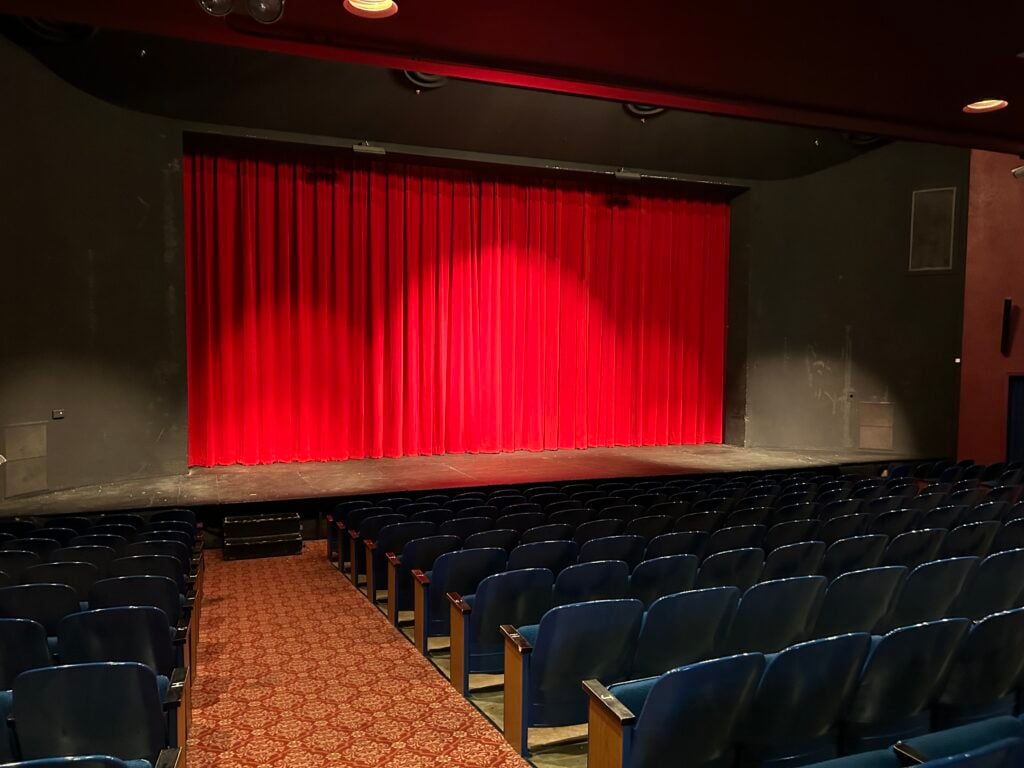
McCarter Theatre Center received Tony Awards for Outstanding Regional Theatre in 1994. Its main house seats approximately 1,077 patrons; a studio theater, the Matthews, provides a smaller performance space. The theater presents plays, musicals, dance, and family programming year-round and has maintained a role as one of New Jersey's leading regional theater institutions for nearly a century.
Sources
- https://en.wikipedia.org/wiki/McCarter_Theatre
- https://www.mccarter.org/
- https://www.princetonianamuseum.org/artifact/9b154e23-ff9a-4c86-9268-1d1f4e464003
Phantom performance sounds (voices, movement) in empty theaterUnexplained applause from empty houseGhost light tradition maintained on stage
The ghost light at McCarter is the most concrete expression of its paranormal reputation. The theater maintains the tradition found in performance houses across the country: a bare bulb on a stand, left burning on the stage when the theater is dark and empty between productions. The theater tradition holds that a ghost light keeps spirits — specifically the spirits of performers who worked the stage — from taking over the space when humans are absent.
The Princeton ghost tour circuit, as documented by US Ghost Adventures and Princeton Magazine, describes McCarter as a location where unexplained sounds of performance have been reported after hours: the sounds of actors delivering lines or moving on stage, and the sound of applause coming from an empty house. These accounts follow a pattern common to historic theater buildings and are consistent with the kind of residual-haunting theory that paranormal investigators typically apply to venues with dense performance histories.
McCarter's 1930 opening came during a period of significant theatrical activity in Princeton, and the building has housed performances continuously for nearly a century. The density of emotional experience embedded in a theater used for 95-plus years provides the contextual substrate that ghost tour guides point to when explaining the reported phenomena.
Where this legend is told