Est. 1835 · Greek Revival Architecture · New Jersey Governor's Residence · National Register of Historic Places
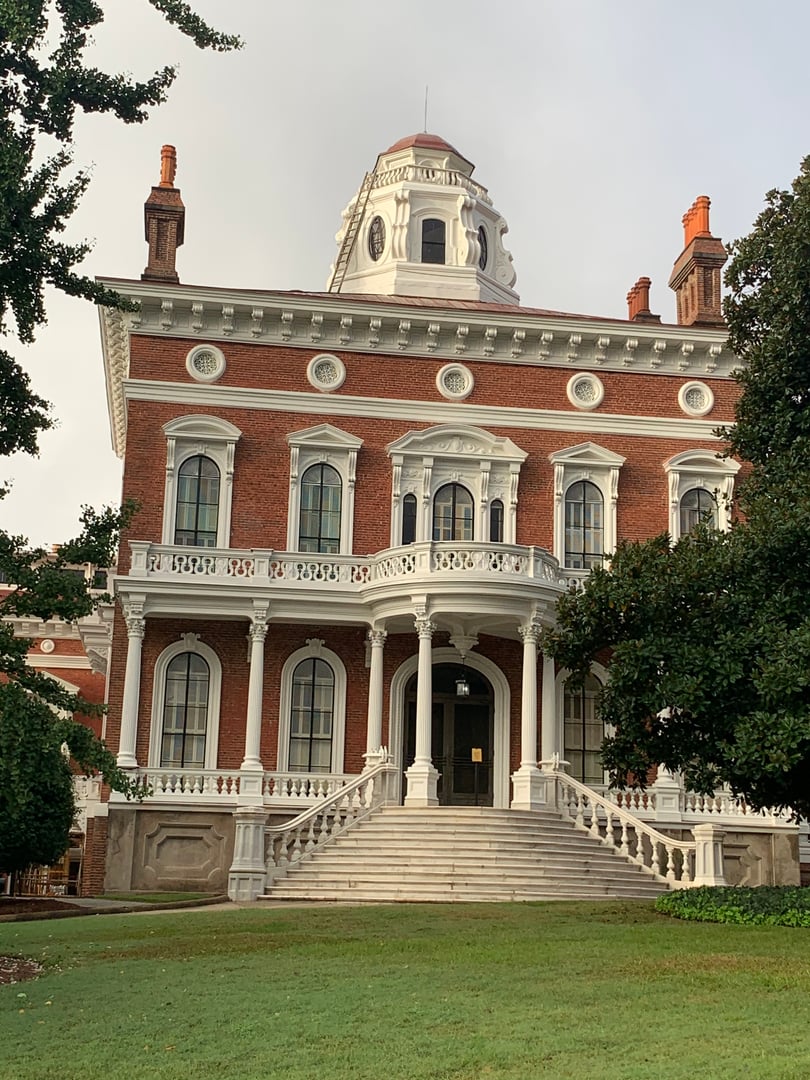
Charles Smith Olden began construction of Drumthwacket in 1835 in Princeton, New Jersey, on land originally part of William Penn's seventeenth-century grants in West Jersey. Olden had built his fortune as a young man working for mercantile firms in Philadelphia and New Orleans before returning to Princeton to establish himself as a gentleman farmer, businessman, and political figure. He served as treasurer and trustee of the College of New Jersey (now Princeton University), as a state senator, and was elected governor of New Jersey in 1859, taking office in January 1860 during the secession crisis and serving through the early years of the American Civil War. He was the first occupant of the new house.
In 1893, financier, industrialist, and Princeton University benefactor Moses Taylor Pyne purchased Drumthwacket from Olden's widow. Pyne added wings on each side of the house around the turn of the twentieth century, designed by architect Raleigh C. Gildersleeve and including a paneled library that remains one of the most striking interior spaces. The Pyne family occupied the property through the early twentieth century.
The inventor and industrialist Abram Spanel acquired the property in the mid-twentieth century and, in 1966, sold the estate to the State of New Jersey with the intent that it serve as the governor's official residence, replacing the smaller Morven on Stockton Street. Drumthwacket has served as the official residence in this capacity since the early 1980s, with the Drumthwacket Foundation managing tours, fine-art collections, and public programming. Guided tours are offered most Wednesdays except August, are approximately one hour in length, and are free of charge.
Sources
- https://drumthwacket.org/
- https://en.wikipedia.org/wiki/Drumthwacket
- https://visitnj.org/nj-historic-sites-memorials/drumthwacket
- https://drumthwacket.org/visit/public-tours/
Phantom footstepsApparitionsCold spots
Drumthwacket is included on regional Princeton ghost-walk itineraries and on the Wikipedia list of reportedly haunted locations in the United States, but the property's interpretive programming centers on architecture, fine art, and political history rather than on paranormal claims.
Visitor accounts collected by regional ghost compendia describe footsteps in the library wing added by Moses Taylor Pyne, the impression of company in the music room, and occasional reports of figures glimpsed in the upper-floor windows from the front lawn. The accounts are restrained and consistent with the broader pattern of large Princeton-area nineteenth-century houses.
The Drumthwacket Foundation runs the residence as an interpretive site for New Jersey political and architectural history. Tours are scheduled and free; visitors interested in the ghost-lore strand should check independent walking-tour operators in Princeton rather than the residence itself.