Est. 1811 · National Historic Landmark · Robert Mills Architecture · Early American Penal Reform · Fireproof Masonry Construction
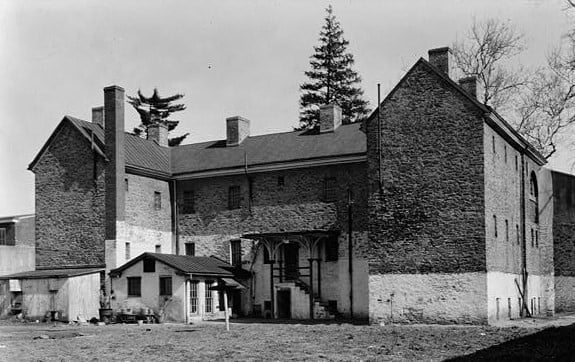
Burlington County contracted Robert Mills to design a new county jail in 1808. Mills, then 27 years old and recently apprenticed under Benjamin Latrobe, accepted the commission as one of his first independent projects. The building was completed in 1811. It was among the earliest American structures designed explicitly as fireproof: poured-concrete and brick vaulted ceilings, masonry interior walls, and minimal exposed timber, all arranged to deny fire the fuel to spread between floors.
Mills's design reflected the latest thinking in penal philosophy imported from Britain and the Quaker reform movement centered in Philadelphia. The third-floor maximum-security wing held prisoners awaiting execution in single cells with a small Franklin stove and a barred window. Lower floors held debtors, women, and short-term prisoners in larger common rooms. A separate yard accommodated the gallows. The building's compact masonry form, the symmetrical front elevation, and the heavy brick cornice reflect Mills's training under Latrobe and his later affinity for clean Federal-period proportion. The Washington Monument, designed by Mills four decades later, shows the same restraint.
The prison operated continuously for 154 years. Inmates included men awaiting execution by hanging, women convicted of property crimes, debtors held until family settled their accounts, and a steady flow of short-term prisoners. The hanging yard saw multiple judicial executions over the prison's operating life, the last in 1906. The facility closed in 1965 when Burlington County opened a new correctional facility. At the time of closure, it was the oldest operating prison in the United States.
The property was added to the National Register of Historic Places in 1973 and designated a National Historic Landmark in 1987. It now operates as a museum administered by the County of Burlington, with the support of the Mount Holly historical community.
Sources
- https://www.prisonmuseum.net/
- https://en.wikipedia.org/wiki/Burlington_County_Prison
- https://www.co.burlington.nj.us/956/Prison-Museum
- https://weirdnj.com/stories/garden-state-ghosts/burlington-prison/
- https://www.thescarefactor.com/ghost-directory/new-jersey/burlington-county-prison-museum/
Phantom footstepsPhantom voicesEVPCold spotsPhantom smellsEquipment malfunctionTouching/pushingApparitions
Paranormal accounts at the Burlington County Prison reach back into the prison's operating period. Newspaper articles and inmate testimony from as early as the 1880s describe phantom footsteps and disembodied voices in the third-floor maximum-security wing. The cells on that floor held men awaiting execution; the small windows look down onto the gallows yard.
Modern paranormal investigation has clustered most consistently around three specific spaces. Cell five on the maximum-security floor, the last cell occupied by inmate Joel Clough before his 1833 hanging, draws repeated reports of cold spots, EVP captures, and the sensation of pressure on the chest of investigators sitting on the cell's stone bench. Clough was convicted of murder after stabbing Mary W. Hamilton in a Bordentown boarding house; he attempted to escape the prison shortly before his execution.
The basement and women's wing produce a different category of reports. Visitors describe the sound of a woman crying, the smell of perfume in spaces that have not been domestically occupied in decades, and disembodied footsteps in the basement corridor near the original kitchen. The dungeon — a small reinforced cell used for punishment isolation — generates equipment malfunction during paranormal investigation sessions.
The museum has been the subject of multiple televised paranormal investigations and operates regular Friday and Saturday evening investigation sessions with rentable spirit boxes. Staff position the property as one of the most consistently active sites in New Jersey while presenting the underlying penal history with archival neutrality.
Notable Entities
Joel Clough (cell five, executed 1833)
Media Appearances
- Multiple televised paranormal investigation series