Est. 1885 · Kirkbride Plan · Northern Michigan Asylum · National Register of Historic Places · Adaptive Reuse
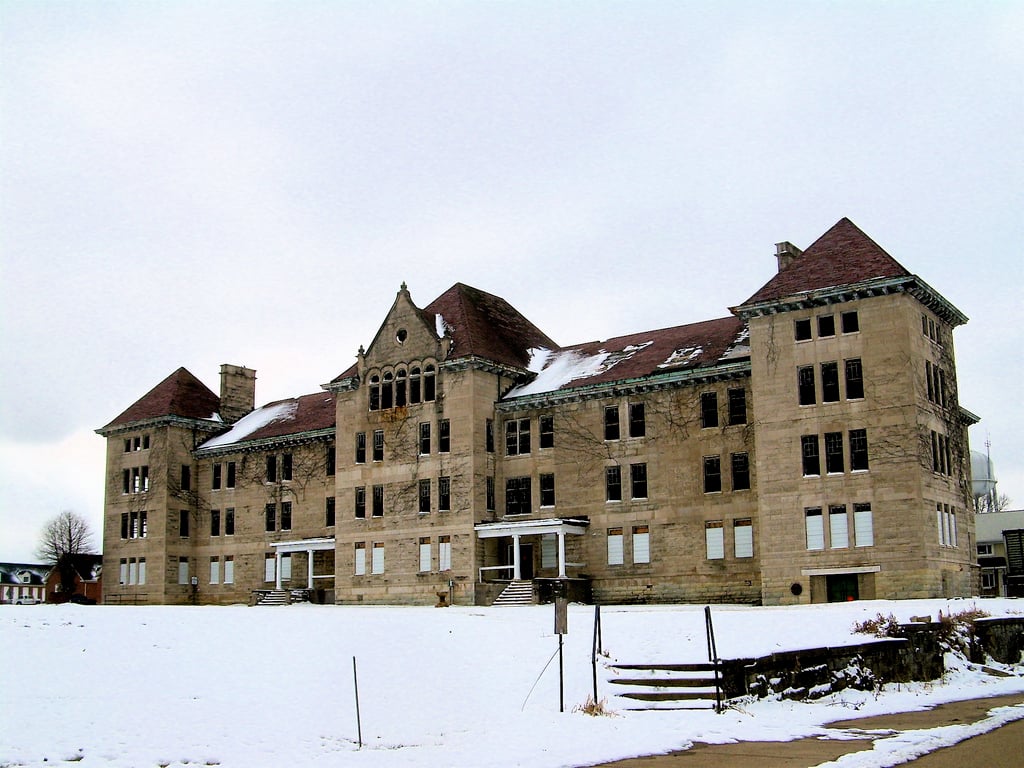
The Northern Michigan Asylum was authorized by the Michigan Legislature in 1881 and opened in 1885 with 43 patients on a 339-acre campus southwest of downtown Traverse City. Established by superintendent James Decker Munson and lumber baron Perry Hannah, the institution became the third state asylum in Michigan, after Kalamazoo and Pontiac.
The site's central structure, Building 50, was designed by architect Gordon W. Lloyd in a Victorian-Italianate adaptation of the Kirkbride Plan. The plan, developed by Philadelphia psychiatrist Thomas Story Kirkbride, called for long, staggered wings that allowed sunlight and cross-ventilation to reach every patient room. At Traverse City, Building 50 stretched nearly a quarter mile, rose more than 70 feet at the roof ridge, and enclosed over 300,000 square feet. The campus included an extensive farm, dairy operation, library, and chapel; Munson's articulated belief that 'beauty is therapy' shaped both the architecture and the daily routines of the patient community.
At its peak, the hospital housed several thousand patients and was one of the largest employers in northern Michigan. Treatment philosophies evolved from moral therapy and farming work to mid-20th-century psychiatric medicine, including drug therapy and electroshock. The hospital began consolidating in the 1970s as state psychiatric care decentralized, and it formally closed in 1989.
For more than a decade, the campus stood largely empty. In 1993 the property was transferred from the state to the Grand Traverse Commons Redevelopment Corporation. Development partner The Minervini Group began a phased restoration that reopened the first occupied spaces in 2002 as the Village at Grand Traverse Commons. The redevelopment, one of the largest historic preservation projects in the United States, has transformed the wards and corridors of Building 50 and the surrounding cottages into bakeries, restaurants, residences, retail, and offices while retaining the original architecture.
The Village remains an active commercial district. Self-guided exploration of the public spaces is free; ticketed historic and steam-tunnel tours are run by Grand Traverse Commons partners.
Sources
- https://en.wikipedia.org/wiki/Traverse_City_State_Hospital
- https://www.thevillagetc.com/about
- https://northernmichiganhistory.com/traverse-city-state-hospital/
- https://www.awesomemitten.com/traverse-city-state-hospital/
- https://mysteriousmichigan.com/haunted-traverse-city-state-hospital
Shadow figuresPhantom footstepsCold spotsApparitions
The Traverse City State Hospital occupies an unusual position in Michigan paranormal lore: most of its folklore now belongs to the woods behind the campus rather than to the buildings themselves.
The Hippie Tree is a beech in the wooded preserve southwest of the former hospital, layered with decades of psychedelic graffiti and folded limbs that brush the ground. The most repeated story warns that anyone who circles the tree completely, without crossing under or over a limb, opens a gate to hell. Many visitors fail the loop unintentionally because of the tangled limbs, which is part of why the legend has lasted. A second strand, attributed by Michigan media outlets to undocumented mid-20th-century retellings, describes a child reportedly murdered by an escapee from the hospital and buried near the tree. No primary source confirms this account; it functions as folklore rather than recorded history.
The Village's official tours acknowledge a paranormal reputation without leaning into it. Reports collected from tunnel-tour participants and adaptive-reuse residents tend toward small, ambient experiences: footsteps in unoccupied corridors, shadow figures glimpsed at the end of long Kirkbride wings, cold spots in stairwells, and the occasional sense of being watched in the older sections of Building 50. Many of the wards have been gutted and rebuilt for retail and residential use, and the architecture itself, with its long sightlines and high ceilings, encourages the kind of visual ambiguity that produces such reports.
The trails behind the hospital are patrolled. The Shadowlands entry that anchors this listing closes with an explicit warning that trespassers will be escorted off; visitors interested in the Hippie Tree should stay on public preserve trails and respect posted boundaries.
Notable Entities
The Hippie Tree
Media Appearances
- Angels in the Architecture: A Photographic Elegy to an American Asylum — Heidi Johnson (2001)