Drive-By
Exterior Drive-By
The former Riverside Osteopathic Hospital site can only be viewed from public roads in Trenton. The building has been undergoing demolition and is not accessible; interior exploration is trespassing.
- Duration:
- 15 min
HauntBound archive · catalog record
Reported phenomena — as catalogued
A Trenton, Michigan hospital built around the late-1800s riverside mansion of Arm & Hammer magnate Austin Church, long rumored to be haunted by a singing girl before its closure and demolition.
150 Truax Street, Trenton, MI 48183
Research updated May 2026
Age
All Ages
Cost
Free
Site is closed and undergoing demolition; no public access
Access
Limited Access
Former hospital site undergoing demolition; not open to the public
Equipment
No Photos
Est. 1944 · Downriver Michigan Healthcare History · Austin Church / Arm & Hammer Connection · Adaptive Reuse of a Historic Mansion
Riverside Osteopathic Hospital in Trenton, Michigan, began as a private riverside mansion built in the late nineteenth century by businessman Austin Church, a one-time owner of the Sibley Quarry who was associated with the Arm & Hammer brand. The home was built for his wife and overlooked the Detroit River in the Downriver community of Trenton, in Wayne County.
In 1943 the Church family donated the property so it could serve a medical purpose, and the conversion of the mansion into a functioning hospital was completed in 1944 at a cost of roughly $100,000. Over the following decades the institution grew, with modern hospital wings added around the original mansion structure, becoming a fixture of Downriver healthcare as Riverside Osteopathic Hospital.
The hospital faced mounting financial difficulty in its final years, reportedly losing some $21 million between 1998 and 2002. In July 2002 it was merged into the Henry Ford Health System through Henry Ford Wyandotte Hospital, and in October 2002 Henry Ford announced the facility would close. The hospital shut its doors on November 15, 2002.
The vacant complex sat for years and became a frequent subject of urban-exploration photography. Following a December 2021 agreement among the City of Trenton, property owner Dr. Iqbal Nasir, and NABA Management, demolition of the building began, and as of August 2023 the structure was being torn down. Note that the popular ghost-story version of the building's origins — claiming the entire Church family died and that Henry Ford personally bought the house in 1944 — is not accurate; the family donated the property, and the Henry Ford connection came only through the 2002 merger.
Sources
The haunting tradition associated with Riverside Osteopathic Hospital centers on the building's nineteenth-century origins as the Church family mansion. According to the popular legend, recounted on Michigan haunted-place sites such as MichiganHauntedHouses.com and Haunts.us, one of the family's daughters fell from her horse and broke her arm, prompting her father to kill the animal and bury it near the house. The grieving girl is said to have withdrawn to her bedroom, where she spent her days singing and rocking in a chair. After her death, her spirit is reportedly seen in an upper window, dressed in white and still singing.
Staff and visitors during the building's hospital years and its later abandonment described disembodied singing, footsteps, and a sense of presence concentrated in the older portions of the structure built into the original mansion. These accounts are documented across regional haunted-location collections rather than in newspaper or historical-society records, and the specific family details in the legend should be treated as folklore rather than verified biography.
With the building now demolished, the legend persists primarily through urban-exploration photography and Downriver ghost-story tradition. The story is presented here as the local paranormal narrative attached to the site, not as a documented historical event.
Notable Entities
Media Appearances
The former Riverside Osteopathic Hospital site can only be viewed from public roads in Trenton. The building has been undergoing demolition and is not accessible; interior exploration is trespassing.
Some links on this page may earn HauntBound a small commission when you book, at no extra cost to you. Our editorial picks are independent. Full disclosure
Every HauntBound history is researched from documented sources. We clearly separate verified historical fact from paranormal folklore.
Free Guide
10 verified stops, rated for families, mapped in order. Free.
One email to confirm, then the guide link. Unsubscribe anytime.
Pontiac, MI
Opened in 1878 as the Eastern Michigan Asylum, the Pontiac institution was designed by Michigan State Capitol architect Elijah Myers. Renamed Pontiac State Hospital in 1911 and Clinton Valley Center in 1973, it peaked at about 3,100 patients in the 1950s. Listed on the National Register of Historic Places, it was closed in 1997 and demolished in 2000; a subdivision now occupies the site.
Los Angeles, CA
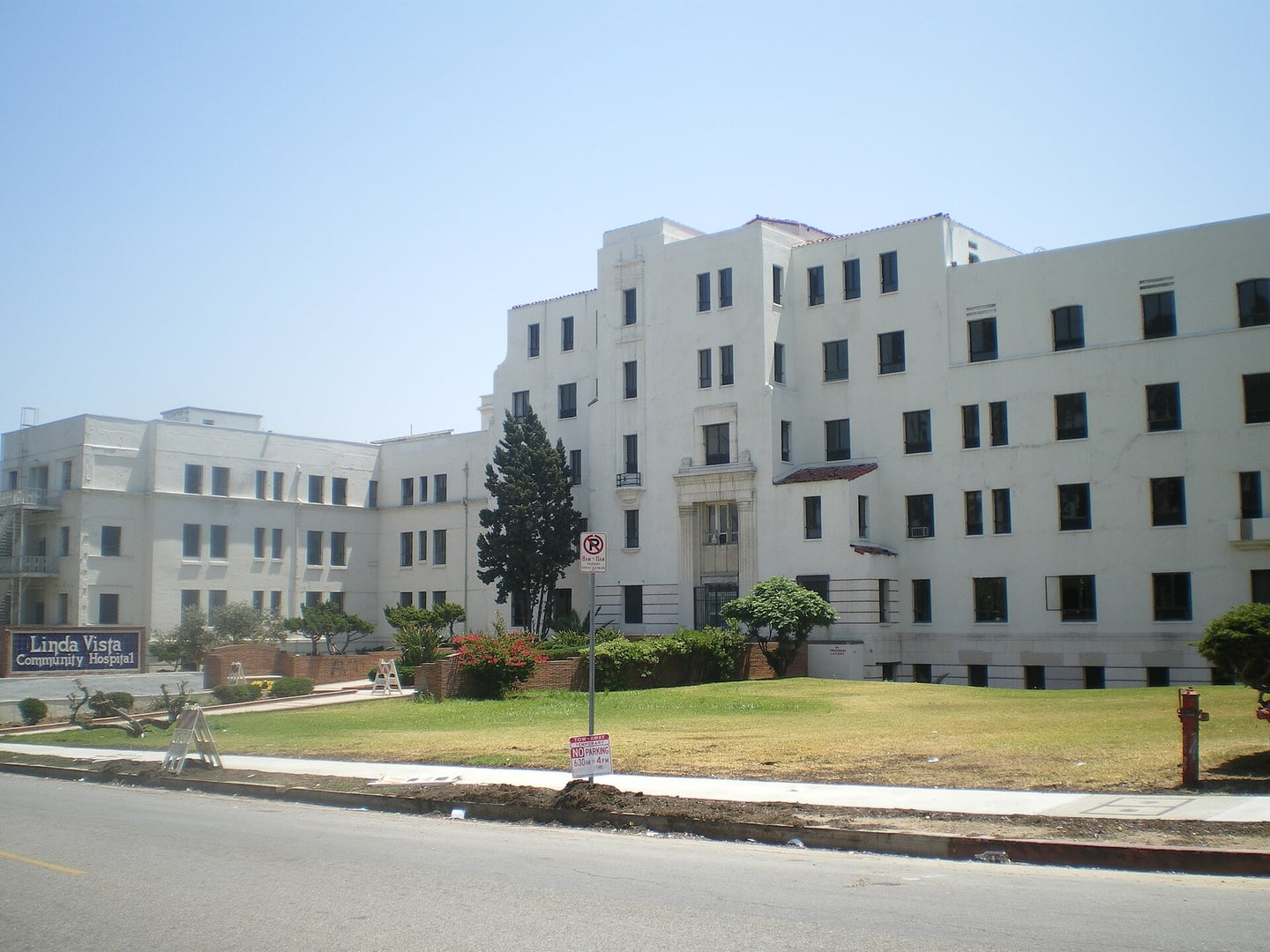
The Linda Vista Community Hospital opened in 1904 in Boyle Heights, Los Angeles, originally as the Santa Fe Coast Lines Hospital serving railroad employees. The Mission Revival building operated as a community hospital through the late twentieth century, sat vacant from 1991 to 2011 while serving as a frequent horror-film location, and was converted to senior affordable housing in 2012.
North Muskegon, MI
Northshore Hospital in North Muskegon, Michigan, was built in the 1920s as a tuberculosis sanatorium and later housed mental patients. After funding shortfalls forced its closure, the building stood abandoned for years before being demolished in the early 2000s. The site on Holton Road is now a vacant, fenced lot.