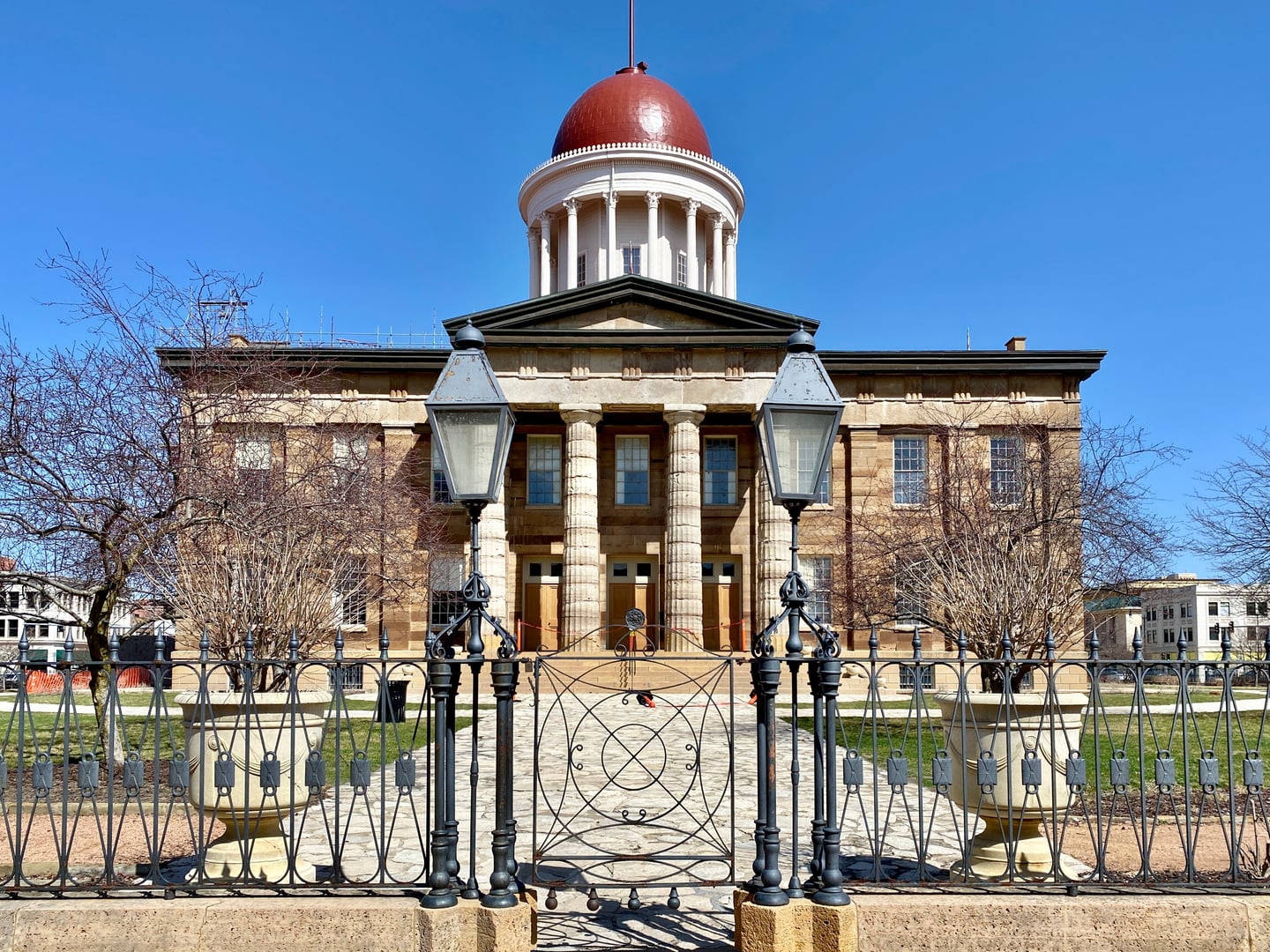
Est. 1879 · Designed by Elijah Myers — completed 1879 · Italian Renaissance with cast-iron dome; Myers later designed Texas and Colorado capitols · Comprehensive restoration 1989–1995 restored original interior appearance · Four documented workplace deaths: pageboy (1880s), restoration painter (1990s), roofer, elevator operator · Active seat of Michigan state government
The Michigan State Capitol was the design of Elijah Myers, whose competition entry carried the name Tuebor, 'I will defend.' The cornerstone was laid on October 2, 1873, before a crowd contemporary accounts put between 30,000 and 50,000, and the finished building was dedicated on January 1, 1879: 139 rooms, an iron dome, a final cost of $1,427,738.78 raised by a six-year state income tax. The commission made Myers's career. Texas and Colorado both hired him afterward to design their statehouses on similar plans, the most capitols credited to any single American architect.
The building rewards close looking. The rotunda floor is a vault light of 976 blocks of translucent glass, sized so that seen from the upper galleries the floor reads as a bowl mirroring the dome overhead. The eight muses painted below the oculus in 1886 went unattributed for more than a century; they are now known to be the work of Tommaso Juglaris, an Italian artist who painted them in his Boston studio and never visited Michigan. The apparent walnut woodwork throughout is Michigan white pine, hand-grained by painters to imitate the costlier wood. The Capitol was also built as a fireproof repository for the state's Civil War artifacts, and its battle flags hung in the building until their 1990 transfer to the state museum.
A comprehensive restoration from 1989 to 1992 removed the office half-floors inserted in 1969, returned the dome to its original creamy white, and restored the interior to its 1879 appearance; the building was designated a National Historic Landmark in 1992. Restoration has continued in cycles since: the inner dome was cleaned and conserved in 2023-24, and a restoration of the glass floor began in 2025.
Four deaths on the Capitol grounds are documented in the course of ordinary work across the building's history, and they anchor its paranormal reputation. A pageboy, a young employee who carried messages between legislative offices, fell from the Grand Staircase in the 1880s and died of his injuries. A painter working in the rotunda during the early-1990s restoration fell from his lift to the Capitol floor. A roofer fell from the exterior roofline. An elevator operator was electrocuted in the building's mechanical systems.
The Capitol has operated as Michigan's seat of government without interruption since 1879. The Capitol Tours office coordinates free public visits Monday through Saturday.
Sources
- https://capitol.michigan.gov
- https://99wfmk.com/hauntedlansingcapitol2018/
- https://en.wikipedia.org/wiki/Michigan_State_Capitol
Apparition of pageboy on Grand StaircaseApparition of painter near rotunda scaffolding areaRooftop figurePresence near elevator shaftCold spots in staircase areas
Capitol employees who stay past closing describe four figures, each keeping to its own part of the building, and each matching a workplace death documented across the Capitol's century and a half of ordinary labor: a teenage pageboy who fell from the Grand Staircase in the 1880s, a painter who fell from a lift in the rotunda during the early-1990s restoration, a roofer who fell from the exterior, and an elevator operator electrocuted in the building's machinery. In every account the figures appear alone. No report places two of them together.
The pageboy is the one most often described: a young male in period clothing who pauses on the Grand Staircase and is gone by the second look. The painter is reported from the rotunda floor during off-hours, a stationary form in work clothes near the upper dome where the scaffolding once stood, described in more than one account as still wearing his painter's pants. The roof-level figure and the disturbance near the elevator shaft surface less often; both belong to restricted sections off the public tour route, so the reports come from the employees whose badges reach them.
A quieter strand of lore points somewhere else entirely. The Capitol was built partly as a repository for Michigan's Civil War artifacts, including the battle flags that hung in the building until 1990, and one local tradition attributes the unclaimed noises and cold spots to the flags rather than to any of the four workers. The flags now reside at the Michigan History Museum. The stories stayed behind.
The direct correspondence between the reported figures and verifiable deaths, rather than general atmosphere, is what draws regional investigators, and the Capitol anchors the US Ghost Adventures Lansing walking tour. Daytime tour guides, by reputation, will either share the stories when asked or decline with a smile.
Where this legend is told