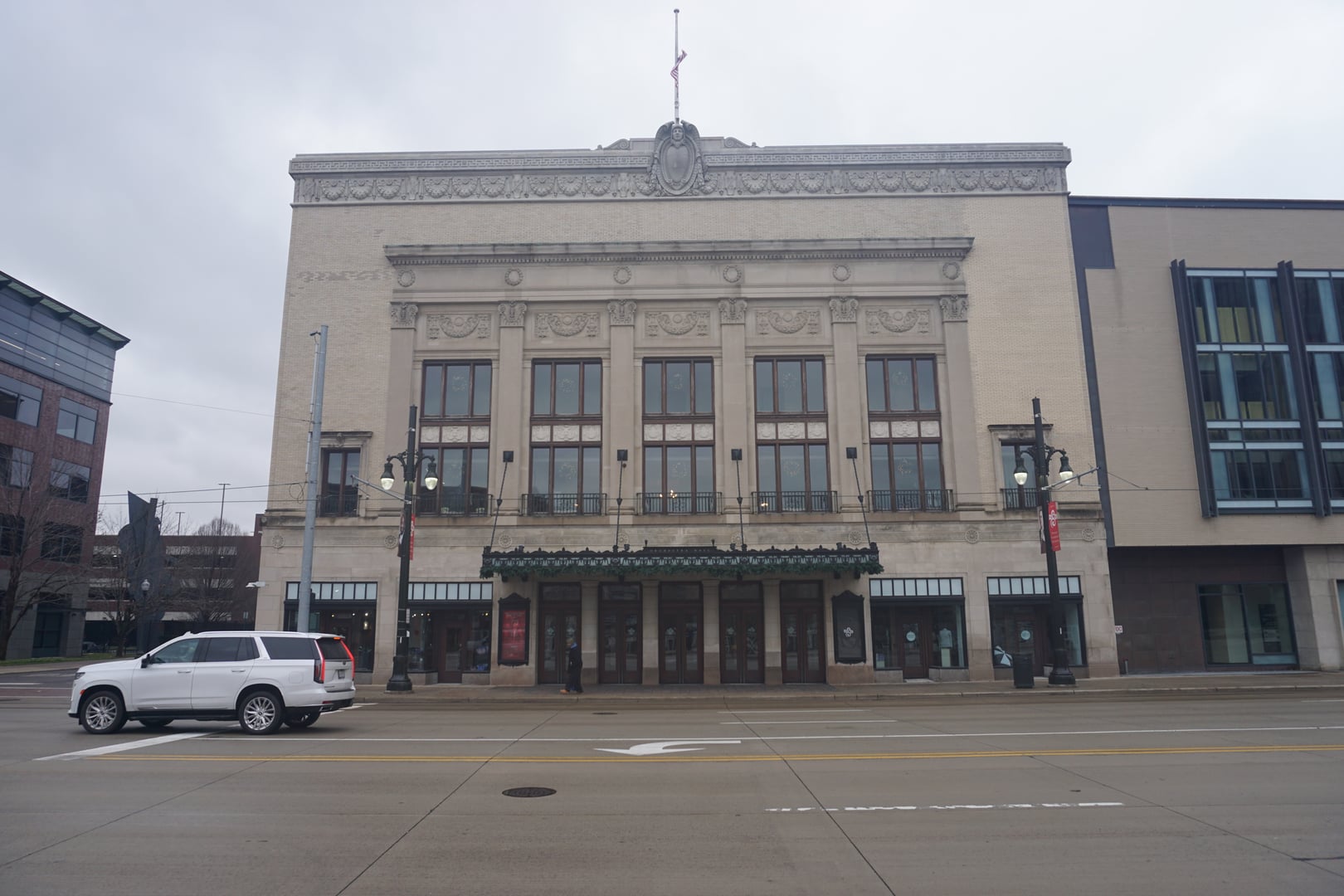
Est. 1902 · Only surviving Albert Kahn-designed religious building in Detroit · Pantheon-inspired domed exterior · Converted 1925 by C. Howard Crane to one of America's first civic theaters · Continuously operated by Wayne State University drama since 1951
The Bonstelle Theatre stands at 3424 Woodward Avenue in Detroit's Midtown Woodward Historic District. The building was completed in 1902 as Temple Beth-El, a Reform Jewish congregation building designed by Albert Kahn — who was himself a member of the congregation. Kahn's exterior, marked by a prominent dome over the main worship space and gabled north and south wings, has been compared closely to the Pantheon in Rome. When Detroit's Central High School burned in January 1893, Temple Beth-El temporarily lent its building to the Detroit Board of Education; that earlier connection foreshadows the building's later civic life.
In late 1924 the building was purchased for $500,000 by Eugene Sloman as a gift for actress-manager Jessie Bonstelle, who had been running stock companies in Detroit and was looking to establish a permanent home. Architect C. Howard Crane — the same architect responsible for Orchestra Hall and many of Detroit's great theaters — reconfigured Kahn's temple interior into a 1,400-seat playhouse, opening as the Bonstelle Playhouse in 1925. In 1928 it was reorganized as the Detroit Civic Theatre, one of America's first civic-theater experiments.
Jessie Bonstelle (1871-1932), dubbed the 'Maker of Stars' for her role in launching the careers of actors including Katharine Cornell and Frank Morgan, died of a heart attack at the home of relatives in Detroit on October 14, 1932. After her death the theater operated under multiple names through the 1930s-40s before becoming the Mayfair Theatre and showing first-run films. Wayne State University acquired the building in 1951 for its drama department; in 1963 the university renamed it the Bonstelle Theatre in her memory.
The building remains in active use by Wayne State University's Department of Theatre and Dance as a 1,000-1,200-seat performance space and is the only surviving Albert Kahn-designed religious building in Detroit.
Sources
- https://en.wikipedia.org/wiki/Bonstelle_Theatre
- https://historicdetroit.org/buildings/bonstelle-theatre
- https://en.wikipedia.org/wiki/Jessie_Bonstelle
- https://www.thejewishnews.com/community/built-in-1902-as-temple-beth-el-iconic-albert-kahn-structure-to-get-a-50/article_93cf2211-b6aa-5a18-b496-fbad6a53742a.html
- https://www.encyclopedia.com/women/encyclopedias-almanacs-transcripts-and-maps/bonstelle-jessie-1871-1932
- https://www.clickondetroit.com/live-in-the-d/2019/10/31/hunting-for-ghosts-at-detroits-bonstelle-theatre/
- https://www.theoaklandpress.com/2009/10/26/discover-the-spooky-history-of-detroits-bonstelle-theatre/
- http://www.detroitentourtainment.com/3--theatre.html
- http://thetalesofeloise.com/urban-legends-and-ghost-stories-of-michigan/
Footsteps in empty aislesFull-bodied apparition (2009 investigation)Dressing-room door movementsLights dimming during late-night rehearsalsSense of being watched from empty seatsAudio anomalies on the balcony
Lore around the Bonstelle centers on its namesake. Jessie Bonstelle died of a heart attack on October 14, 1932, at the home of relatives in Detroit — not at the theater itself — but Wayne State drama students, faculty, and visiting investigators describe her continuing attachment to the building she built and managed during the final seven years of her life. According to the Hilberry Theatre blog (October 2009) and ClickOnDetroit's 2019 coverage, reported phenomena include footsteps in empty aisles, dressing-room door movements, lights dimming and brightening during late-night rehearsals, and the sense of being watched from the empty house during solo work sessions.
In August 2009 the Wayne State University Department of Theatre formally hosted the Mad Anthony Paranormal Society (MAPS) for a documented overnight investigation. According to the published account, the investigation produced reports of full-bodied apparitions and audio anomalies attributed to Bonstelle, with most concentrated activity in the dressing rooms and the balcony. The 2009 event remains the most-cited paranormal investigation at the venue.
WXYZ and ClickOnDetroit both featured live broadcasts from the Bonstelle during October 2019, with Wayne State students and faculty recounting their own experiences working in the building after hours. Unlike many haunted-theater traditions, the Bonstelle's lore is grounded in a verified historical owner with a documented and dramatically appropriate death date — October 14, 1932 — and a clear personal investment in the property.
Notable Entities
Jessie Bonstelle (1871-1932, theater operator 1925-1932)
Media Appearances
- Mad Anthony Paranormal Society investigation (Aug 2009)
- ClickOnDetroit Hunting for Ghosts feature (Oct 2019)
- Hilberry Theatre blog 'Jessie is still at the Bonstelle' (Oct 2009)