Est. 1855 · First Screwpile Lighthouse in Maryland · Congressional Silver Lifesaving Medal Site · Chesapeake Bay Maritime Heritage
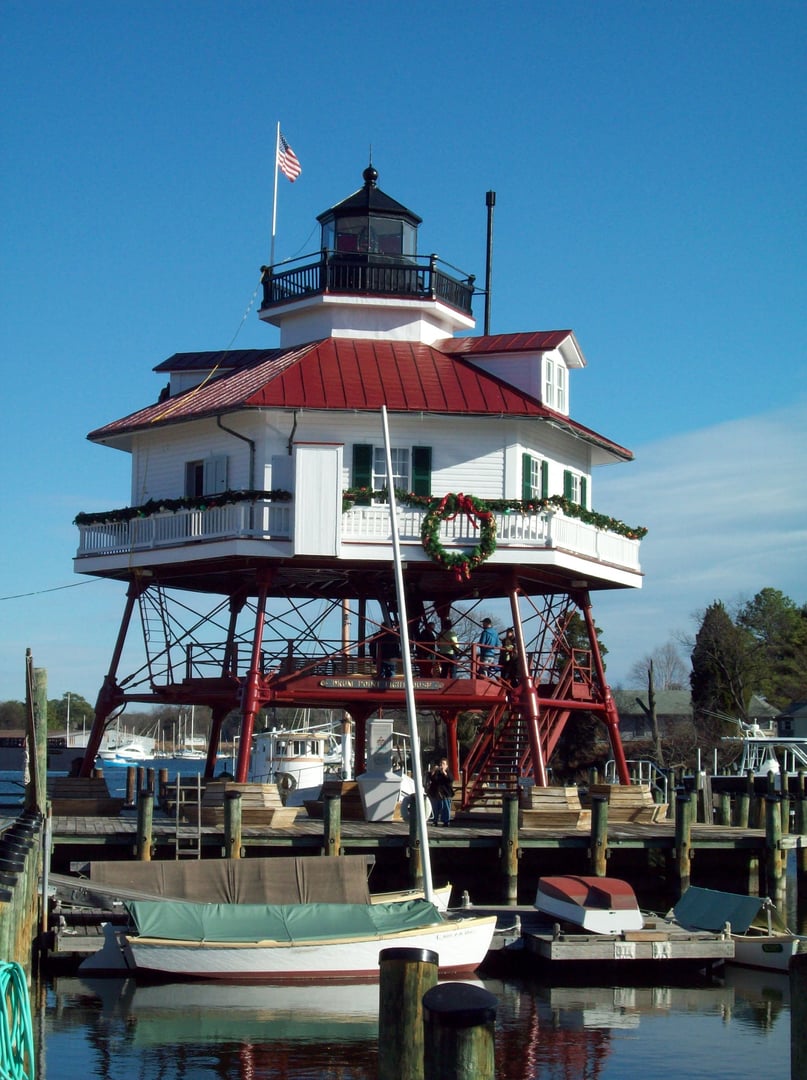
Seven Foot Knoll Light was constructed in 1855 on a shoal at the mouth of the Patapsco River where the river meets the Chesapeake Bay. The seven-foot water depth at the shoal gave the station its name. It is the oldest screwpile lighthouse in Maryland and the second screwpile design ever built on the Chesapeake.
The structure is unusual among Bay screwpiles for its circular cast-iron design and its distinctive barn-red color. The original optic was a fourth-order Fresnel lens. The U.S. Coast Guard automated the light in 1949, after which the station deteriorated and a skeleton tower replaced it as the active aid to navigation.
In 1988 the lighthouse was lifted from its original shoal by a thousand-ton derrick and barged to Baltimore's Inner Harbor. The City of Baltimore accepted the donation, and the lighthouse was set on the eastern end of Pier 5, where it now anchors the Historic Ships in Baltimore museum complex alongside the USCG Cutter Taney and other historic vessels.
The lighthouse's best-documented chapter is the 1933 hurricane. On the night of August 20, 1933, Keeper Thomas Steinhise heard a distress whistle and launched the station's small motorboat into fifteen-foot waves and ninety-mile-per-hour winds. He and his son Thomas Earl pulled six crewmen from the foundering tugboat Point Breeze aboard; one had died, but five survived. In 1936 Steinhise received the Congressional Silver Lifesaving Medal for the action, one of the highest civilian maritime decorations.
Today the interior houses exhibits on Chesapeake Bay screwpile design, keeper life, and the Steinhise rescue. The museum is operated by Historic Ships in Baltimore.
Sources
- https://historicships.org/explore/sevenfootknoll-lighthouse
- https://en.wikipedia.org/wiki/Seven_Foot_Knoll_Light
- https://www.lighthousefriends.com/light.asp?ID=419
- https://cheslights.org/seven-foot-knoll-lighthouse/
Cold spotsLights flickering
The paranormal lore associated with Seven Foot Knoll Lighthouse is modest compared to active Chesapeake light stations still on their original foundations. Regional folklore accounts circulate of keeper Thomas Steinhise's son experiencing an unexplained cold hand on his shoulder during the August 1933 hurricane that destroyed the Point Breeze tugboat, which preceded the call for help that drew Steinhise into the storm.
The story appears in Chesapeake maritime-folklore compilations and ghost-tour walking routes through Fells Point. It is not heavily documented in primary newspaper coverage of the rescue itself, which focused on the Congressional Silver Lifesaving Medal awarded to Steinhise.
At the museum's current Pier 5 location, reports of phenomena inside the relocated structure are uncommon. Some visitors describe a sense of unease in the small upper-deck room where the lens and lantern equipment are displayed, and seasonal staff have noted occasional flickering in the modern interpretive lighting. The lighthouse's interpretive emphasis remains the documented 1933 rescue rather than the paranormal lore.