Est. 1852 · Incorporated 1852 as Frederick's garden cemetery · Burial place of Francis Scott Key (author of 'The Star-Spangled Banner'), with monument dedicated 1898 · Holds 408 unknown Confederate soldiers; Confederate monument unveiled June 2, 1881 · Also the burial place of Barbara Fritchie and Maryland's first governor Thomas Johnson
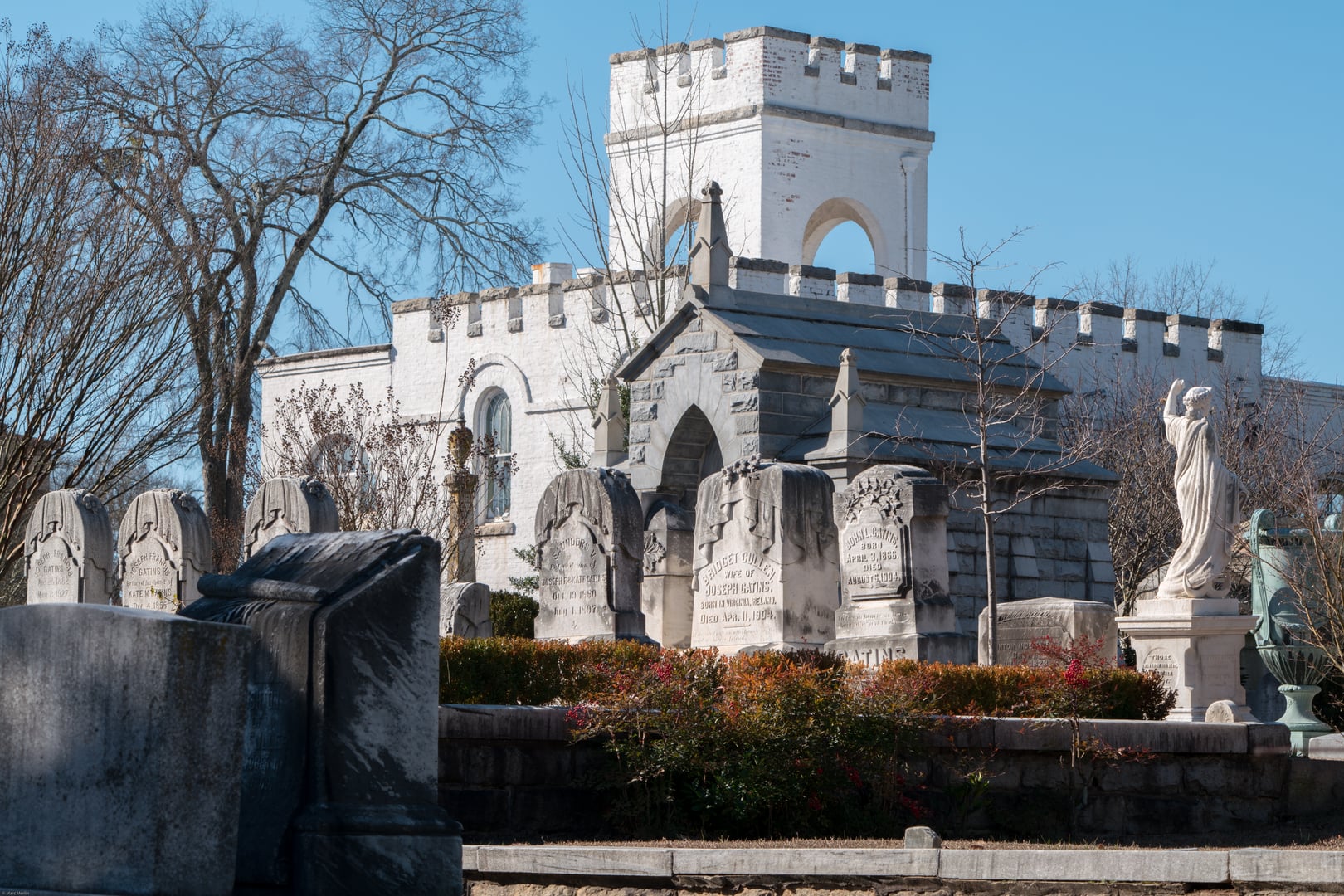
Mount Olivet Cemetery was incorporated in 1852 to address the rapid filling of small churchyard burial grounds inside the city of Frederick. The site was developed in the garden-cemetery style popular in mid-nineteenth-century America, with curving drives, planted plots, and a hilltop setting visible from much of southern Frederick.
The cemetery's most famous burial is Francis Scott Key (1779-1843), the Frederick-born lawyer who wrote the lyrics to 'The Star-Spangled Banner' in September 1814 while watching the bombardment of Fort McHenry. Key and his wife Mary Tayloe Lloyd Key are interred near the main gate, marked by an imposing monument dedicated on August 9, 1898. The Key monument has become one of Frederick's most-visited heritage sites.
Following the Civil War, the Ladies Monumental Association of Frederick County organized in 1879 to raise funds for a monument to the Confederate soldiers buried at Mount Olivet. According to American Battlefield Trust and Wikipedia documentation, the cemetery holds the remains of 408 'unknown' Confederate soldiers reinterred from area battlefields including South Mountain and Antietam. The monument was unveiled on June 2, 1881 and stands at the heart of the Confederate section.
Other notable Mount Olivet interments include Barbara Fritchie (1766-1862), the Union folk-heroine of Whittier's 1864 ballad, and Thomas Johnson (1732-1819), Maryland's first elected governor. The cemetery remains an active burial ground and serves as a regular stop on Frederick heritage tours, the Journey Through Hallowed Ground driving route, and Maryland Ghost Tours' candlelight cemetery program.
Sources
- https://en.wikipedia.org/wiki/Mount_Olivet_Cemetery_(Frederick,_Maryland)
- https://www.battlefields.org/visit/heritage-sites/mount-olivet-cemetery
- https://www.hallowedground.org/site-locations/mount-olivet-cemetery-francis-scott-key-monument/
Localized pipe tobacco or incense scents near Confederate gravesSweet floral scents near other graves that vanish when one walks away
According to Maryland Ghost Tours' cemetery-tour overview and Our Haunted Travels' detailed visit account, the most consistently reported phenomenon at Mount Olivet is unexplained, localized strong scents experienced by visitors near specific graves. Witnesses describe smelling pipe tobacco or incense in the immediate area of certain Confederate-soldier graves and sweet floral or perfume scents near other plots, with the smell vanishing within a few paces as the visitor moves away.
Maryland Ghost Tours operates a 90-minute candlelight cemetery tour that incorporates these visitor reports alongside the documented history of the Key, Fritchie, and Confederate burials. The tour's framing is explicitly atmospheric rather than scare-based; the operator emphasizes that Mount Olivet's lore is grounded in cemetery experience rather than apparitional sightings.
Visit Frederick's haunted-Frederick coverage similarly catalogs the scent reports and frames Mount Olivet as a contemplative rather than confrontational paranormal site. No named entity or specific apparition is associated with the cemetery's lore; the reports cluster around the Confederate section, the Key memorial, and a small number of other plots.
Notable Entities
Unnamed presences associated with Confederate burials