Est. 1847 · Only surviving church steeple in Provincetown · 1847 Greek Revival meeting house by Benjamin Hallett · National Register of Historic Places (1972) · Provincetown Historic District (1989)
The Unitarian Universalist Meeting House of Provincetown traces its origin to 1820, when, according to congregational history, two girls found a waterlogged copy of a biography of the Universalist preacher John Murray on a Provincetown beach. The book is credited with introducing Universalism to a town then dominated by hellfire-and-judgment Calvinist preaching. The congregation organized formally in 1829 as the Church of the Redeemer (Universalist), renaming to the Universalist Church in 1863 and later to the Universalist Meeting House.
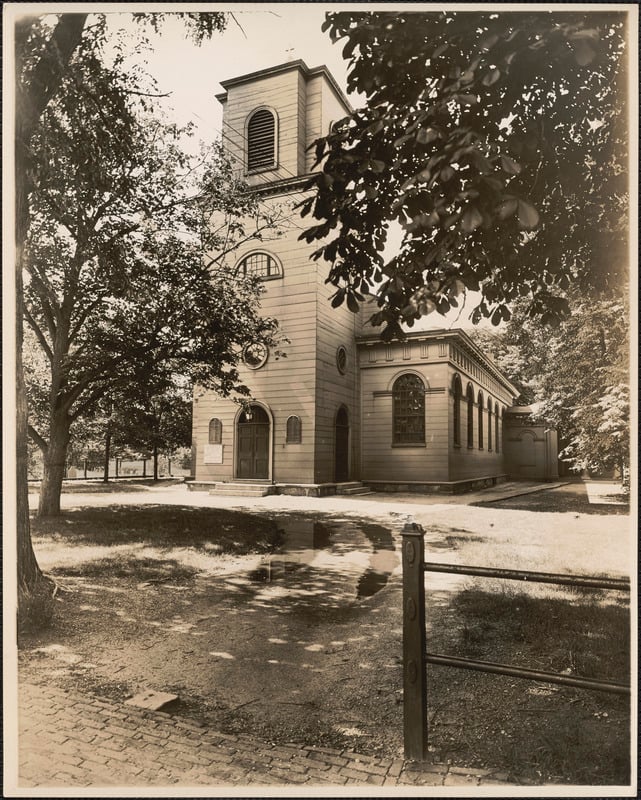
The current building was constructed in 1847 in the Greek Revival style to a design by Benjamin Hallett. Off-duty Provincetown seamen and fishermen built the massive post-and-beam timber frame, and the building's distinctive telescopic steeple with Greek ornamentation is the only surviving church steeple in Provincetown, serving historically as a landmark for seafarers approaching the harbor.
The church was listed on the National Register of Historic Places in 1972 and was included in the Provincetown Historic District in 1989. The congregation operates today as a Unitarian Universalist meeting house and is profiled in Tablet Magazine as a notable LGBTQ-affirming progressive congregation on Cape Cod.
Sources
- https://en.wikipedia.org/wiki/First_Universalist_Church_(Provincetown,_Massachusetts)
- https://uumh.org/our-meeting-house
- https://www.hmdb.org/m.asp?m=141940
- https://www.tabletmag.com/sections/community/articles/church-beach-provincetown-unitarian-universalist-meeting-house
Faint hymn-singing in an empty sanctuaryCold spots on the steeple stairsSense of presence near the pews
Folklore associated with the Unitarian Universalist Meeting House is comparatively gentle and centers on its deep Provincetown maritime history. Visitors over the years have, in regional ghost-story compilations, described faint sounds of hymn-singing in an empty sanctuary, the impression of a presence near the pews, and a slight chill on the staircase to the steeple. The building's congregants in the 19th century included Provincetown's seafaring families, who built the structure with their own hands; the lore frames any reported presence as a quiet residual echo of that community rather than a haunting in any conventional sense.
The current congregation does not market the building as a paranormal site. Visitors interested in the historical and architectural significance of the meeting house should attend a service, view the steeple from Commercial Street, or contact the church for visiting hours.