Est. 1892 · Gilded Age Philanthropy · Henry Huttleston Rogers · Bristol County History · Victorian Memorial Architecture
Henry Huttleston Rogers (1840–1909) grew up in Fairhaven, Massachusetts, before becoming a major figure in the Standard Oil trust and one of the principal financiers of his generation. His investments extended to railroads, copper, coal, and natural gas; his friendship with Mark Twain produced some of the most documented correspondence in American literary history.
Rogers's third child, Millicent Gifford Rogers, was born in 1873. An avid reader, particularly of poetry, she died of a heart ailment at age 17 — before she could see the building her father would construct in her memory. Rogers funded the library's construction in 1892. His siblings deeded the land and building to the Town of Fairhaven. The deed was executed in 1892; the formal dedication took place January 30, 1893, which would have been Millicent's 20th birthday.
Rogers also donated the Fairhaven Water Company — which he had founded in 1888 — to the library as an endowment, its dividend payments funding operations for 70 years until the town acquired the utility in 1966.
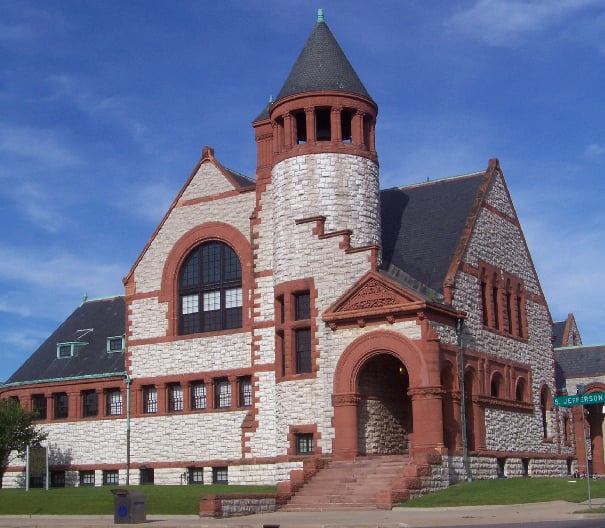
The building stands at 45 Center Street and operates today as a 501(c)3 nonprofit library serving Fairhaven and the surrounding South Coast communities. The Rogers Room contains family portraits and archival materials related to the Rogers family. A separate Rogers family mausoleum at Riverside Cemetery on Main Street holds the family's actual interments.
Sources
- https://millicentlibrary.org/about-library
- https://en.wikipedia.org/wiki/Millicent_Library
- https://fun107.com/fairhaven-millicent-library-rogers-buried-legend/
- https://www.atlasobscura.com/places/millicent-library
ApparitionsShadow figures
The foundation-burial legend has circulated in Fairhaven for generations: that Millicent Rogers, who died before the library dedicated in her memory was completed, was interred beneath the building's foundation — sealed into her memorial by a grief-stricken father. This is not documented in any historical record, and Millicent's actual burial location is identified in the Rogers family mausoleum at Riverside Cemetery on Main Street. Library staff have consistently denied any evidence supporting the legend.
The ghost accounts begin with the figure of a girl outlined in bright blue light, walking the upper floors of the three-story building. This is locally attributed to Millicent, though the description has no period parallel — no documented cases of blue light associated with Millicent Rogers in any historical account.
A second report involves passersby on Center Street, both on foot and in vehicles, who describe seeing a girl's figure standing motionless in the turret window of the library's front facade at night. The building is dark at these hours.
A third figure, distinct from the blue-light apparition, is described as a woman in black moving through the stacks on the upper floors — specifically running her fingers along the spines of the books — before disappearing too quickly for observers to identify her. No one in local accounts or archival sources has identified who this figure might be.
A fourth legend concerns the Rogers Room portrait collection, where some visitors report the sensation that the eyes of the family portraits follow them across the room.
Library employees, when asked, have consistently declined to confirm any of these accounts.