Est. 1762 · Home of Boston Tea Party participant John Hicks (1773) · Hicks killed at Lexington and Concord (April 19, 1775) · Relocated to Kirkland House in 1928 · One of few pre-Revolutionary Harvard structures still in use
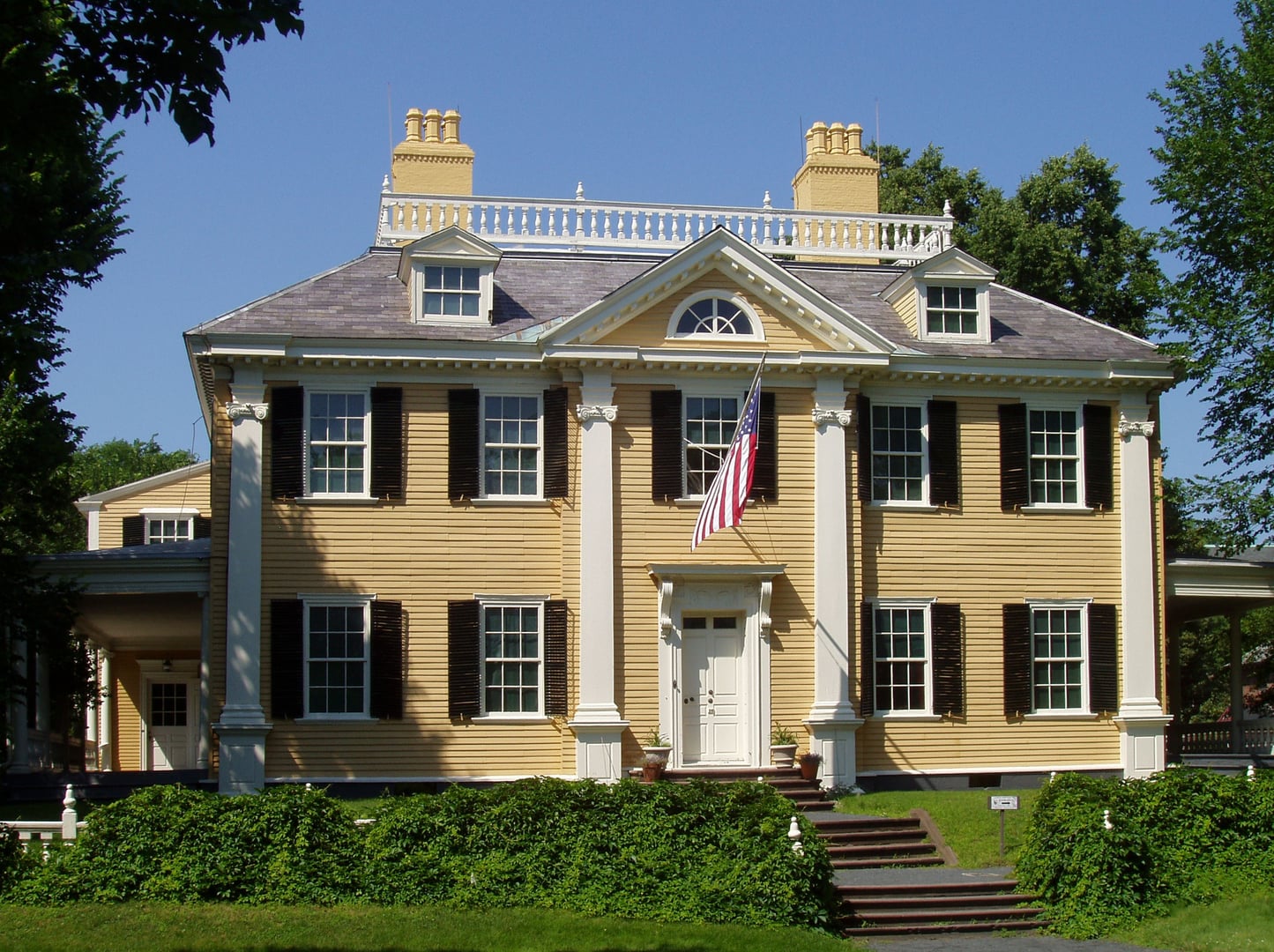
Hicks House was built in 1762 for John Hicks (1725–1775), a Cambridge carpenter who became active in the Patriot cause in the 1770s. Hicks is documented as one of two Cambridge participants in the Boston Tea Party of December 16, 1773. Local tradition holds that he returned home that night with tea spilled in his boots, which his wife discovered the next morning.
On April 19, 1775 — the day of the Battles of Lexington and Concord — Hicks joined Cambridge minutemen pursuing the British column withdrawing from Concord through Menotomy (modern Arlington). He was killed in the fighting along with two other Cambridge men, Moses Richardson and William Marcy. The three are buried together in the Old Burying Ground at Cambridge Common.
The Hicks House remained in private ownership through the 19th and early 20th centuries. In 1928 Harvard physically relocated the building approximately one block from its original site on Dunster Street to its current location at 64 John F. Kennedy Street, where it was incorporated as the library of the newly constructed Kirkland House — one of Harvard's seven original residential 'Houses' for upperclassmen.
The building today serves as the Kirkland House library and is one of the few pre-Revolutionary structures still in active use on the Harvard campus.
Sources
- https://www.thecrimson.com/article/2021/11/4/kirkland-is-haunted/
- https://www.thecrimson.com/article/2017/11/16/retrospective-hicks-house-kirkland/
- https://www.kirkland.harvard.edu/hicks-house-library
- https://www.bostonteapartyship.com/john-hicks
- https://historycambridge.org/Cambridge-Revolution/John%20Hicks%20House.html
- https://www.youtube.com/watch?v=C77xwjj3hvM
Apparition of soldier in Revolutionary War uniformSmell of tea near the entrance
The signature Hicks House ghost story is told in the Harvard Crimson's 2021 'Kirkland is Haunted' feature. The story holds that John Hicks's spirit roams the building in his Revolutionary War-era uniform. The Crimson's 2017 'Retrospective' history of the building documents the well-attested fact of Hicks's Boston Tea Party participation and the local tradition that he returned home that night with tea spilled in his boots, which his wife discovered the next morning. Modern occupants of the library report that the smell of tea can sometimes be detected near the entry where the tea-stained boots were reportedly left to dry.
During a 2021 student investigation in the library, the Crimson reports that participants used a candle-flicker communication method and concluded that a 'soldier ghost' was present — described as 'not older than us' and 'not buried around here.' Hicks was 50 when killed, so the 'not older than us' detail does not unambiguously identify the ghost as Hicks himself; the soldier identification is more general.
The building's relocation in 1928 — a physical move of roughly one block from the original 18th-century site — is itself unusual and is sometimes invoked in paranormal lore as a possible 'displacement' explanation for the activity. The recurring elements are a sensed Revolutionary-era presence and the recurring olfactory detail of tea.
Notable Entities
John Hicks (1725–1775, Boston Tea Party participant killed at Lexington)