Est. 1899 · Indiana Poor-Relief History · County Asylum Institutional History
Indiana became a state in 1816 and by the early 1820s its government was confronting a persistent problem: hundreds of indigent people without homes or means of support were settling across the state. The initial response — paying established families to house and employ these individuals — created arrangements that often exploited the people it was supposed to help. By the late 1840s, the state shifted to a formal township-funded asylum system.
Randolph County's first asylum opened in 1851 as a wooden structure on 350 acres, housing 19 residents. The building burned to the ground in 1857 — no casualties — and was immediately replaced with a hastily constructed brick structure that deteriorated badly. By the 1880s, residents were stuffing bedclothes into holes in the walls to block weather. An 1895 toilet installation was symptomatic: by 1897, sewage had accumulated to eighteen inches deep in parts of the structure.
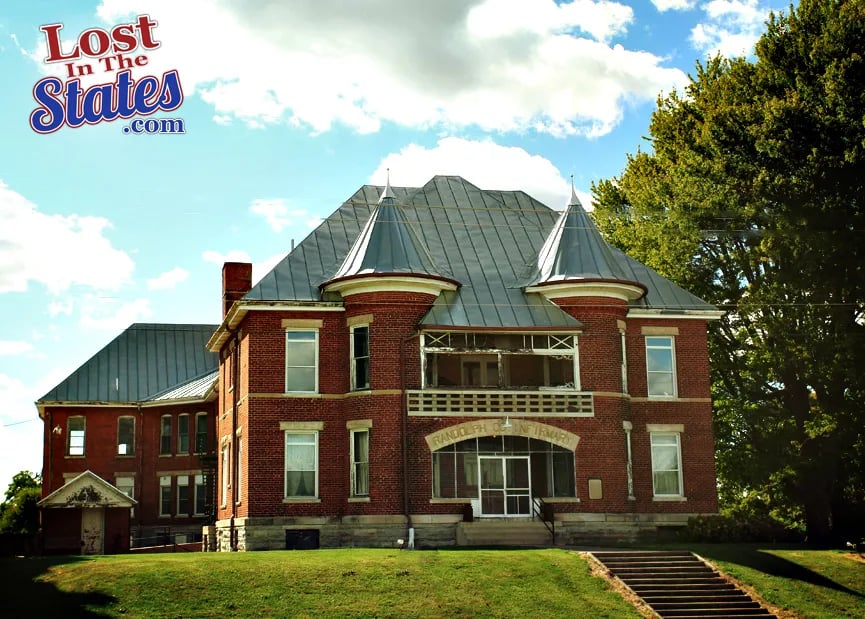
The current building opened in December 1899 — a 58,000-square-foot, four-story asylum built partially over the original foundation. Constructed from locally fired brick on-site, the structure represented a genuine institutional upgrade. The facility housed orphaned children, the physically and mentally disabled, elderly individuals without family support, unwed mothers, and whole families too poor to live independently. Residents who were physically able worked the facility's farm, raising livestock and cultivating crops.
The institution operated under multiple names across its century of use: county poor farm, county infirmary, county asylum, and eventually the Countryside Care Center, which closed in 2006 with only five remaining patients. Approximately 500 residents died there over the years, from causes including age, disease and suicide; only those not claimed by family were buried in the on-site unmarked cemetery.
The building has been operated as a paranormal investigation venue since its closure, and has been featured on Paranormal Lockdown and Destination Fear.
Sources
- https://hauntedrandolphcounty.com/history/
- https://hauntedrandolphcounty.com/paranormal-investigations/
- https://www.ghostresearch.org/Investigations/randolph.html
- https://hauntedus.com/indiana/randolph-county-asylum/
- https://myfamilytravels.com/this-chilling-indiana-poor-farm-invites-you-to-spend-a-night-in-the-asylum-made-famous-by-paranormal-lockdown
ApparitionsShadow figuresEVPIntelligent hauntingCold spotsPhantom voicesPhantom footsteps
The claim that appears most frequently in accounts of the Randolph County Infirmary is not atmospheric or ambiguous: investigators have reportedly become so frightened that they left the building mid-session, abandoning their equipment where it was set up. This detail circulates in paranormal investigation communities as a marker of intensity rather than theater, and it has contributed to the infirmary's reputation as a genuinely challenging location.
The Ghost Research Society investigated the building on June 12, 2016, and published a specific finding in their report: they encountered what they characterized as an intelligent spirit — one that gave direct responses to questions through EVP recording, a Ghost Box, and an Ovilus X device. The responses were described as coherent and contextually relevant to the questions asked, rather than ambient audio. This kind of documented interactive response is what investigators distinguish from residual or atmospheric phenomena.
Multiple investigation groups have documented full-body apparitions and shadow figures throughout the four floors. White misty figures and dark apparitions have been recorded on night-vision and thermal imaging cameras by multiple independent teams.
The site's cemetery, with unmarked graves for residents not claimed by family, is part of the active investigation area; the facility recorded roughly 500 deaths over the years from causes including tuberculosis, accidents, and suicide. Investigators describe the outdoor grounds as producing distinct phenomena from the interior.
The facility was featured on Paranormal Lockdown and Destination Fear, two productions with strong investigation credentials, reinforcing its standing in the paranormal investigation community.
Media Appearances
- Paranormal Lockdown
- Destination Fear