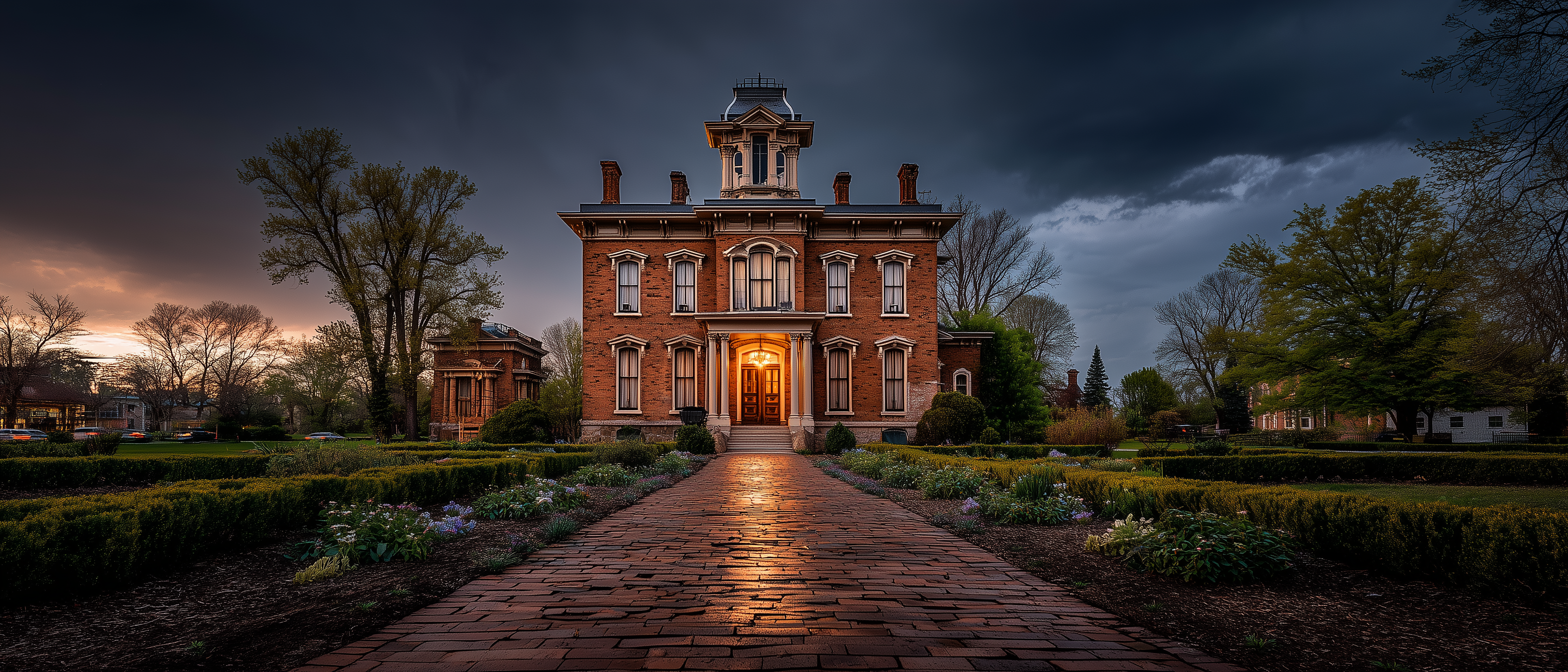
Est. 1901 · Benedictine Heritage · Orphanage Site · Monastic Tradition
Benedictine University's origins trace to 1887, when Benedictine monks established an educational institution on Chicago's West Side dedicated to serving men of Czech and Slovak heritage. The college expanded and relocated to Lisle, Illinois, in 1901, selecting a rural 108-acre site approximately 25 miles southwest of downtown Chicago. The move reflected the institution's desire for expanded physical space and a more conducive environment for monastic and academic life.
The Lisle campus was constructed on property that had previously hosted St. Joseph's Bohemian Orphanage (1898-1956), an institutional facility that served as both a home and place of education for orphaned and vulnerable children. During the orphanage's operation, twenty-three children died on the grounds and were interred in graves marked by uniform headstones.
The original campus building, Benedictine Hall, was dedicated in September 1901. This Romanesque Revival structure of limestone and brick became the institutional centerpiece. Over subsequent decades, the university added multiple residence halls and academic buildings, including Jaeger Hall, Neuzil Hall, and Ondrak Hall, each of which has generated reports of paranormal phenomena.
In 1968, Benedictine became coeducational, marking a significant shift in institutional identity. The college adopted the name Illinois Benedictine College in 1971 and became Benedictine University in 1996. Throughout the late 20th and early 21st centuries, the institution continued to serve approximately 2,500 students across multiple programs and satellite locations.
Sources
- https://ben.edu/about/history/
- https://en.wikipedia.org/wiki/Benedictine_University
- https://thecandor.wordpress.com/2019/10/16/benedictine-university-might-be-haunted-not-clickbait-real-story-people-died/
ApparitionsShadow figuresSensed presencePhantom sounds
Student accounts and campus folklore describe persistent paranormal phenomena across the Benedictine University grounds. A recurring sighting involves a small child wearing a blue t-shirt and shorts, observed running across campus in various seasons and weather conditions before inexplicably vanishing. This apparition is often attributed to children who died at the orphanage that previously occupied the property.
Benedictine Hall, the original 1901 structure, has emerged as a focal point for reported hauntings. Maintenance staff refuse to access the fourth floor due to a documented presence described as that of a priest. This avoidance behavior has persisted across multiple generations of campus workers, suggesting a longstanding institutional awareness of something unusual occurring in that space.
Additional reports describe a heavy paranormal presence concentrated in at least one dormitory building, sufficiently pronounced that the institution has closed affected structures to residents. Underground tunnel systems connecting campus buildings have also been incorporated into paranormal folklore, with students and staff reporting eerie atmospheres and unexplained phenomena within these subterranean passages.
The convergence of orphanage history, monastic presence, and reported paranormal activity has created a rich folklore ecology that persists among the campus population. The combination of documented institutional changes (building closures, staff avoidance patterns) alongside traditional paranormal reports creates a distinctive haunting narrative.
Notable Entities
The Blue-Shirted ChildThe Priestly PresenceThe Dorm Hauntings