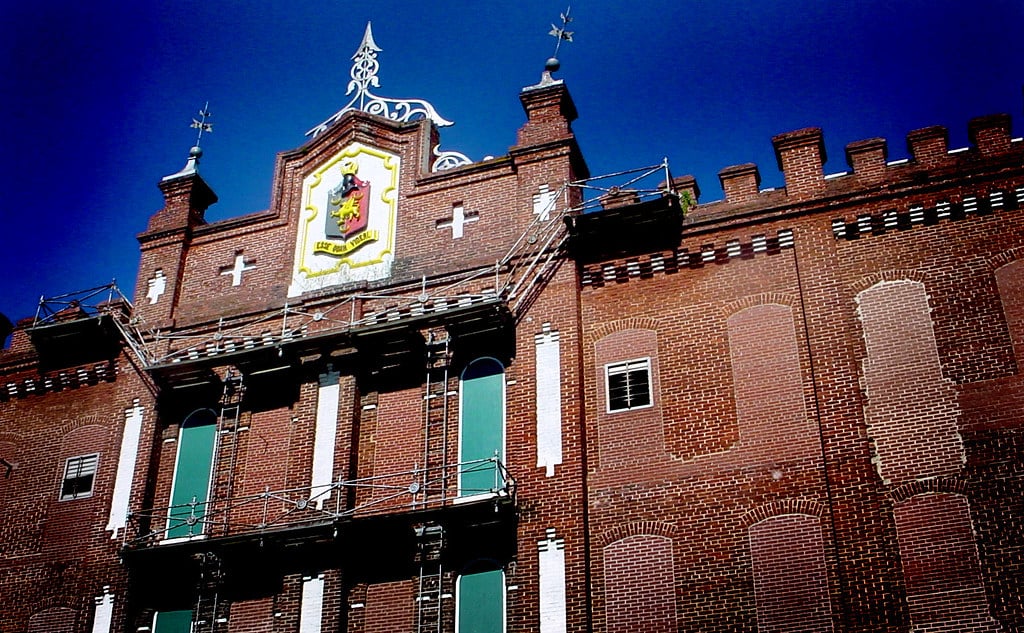
Est. 1839 · Site of Sherman's 1864 arrest and deportation of approximately 400 mill workers · Surviving 1839 machine shop (only structure to escape burning) · Part of Chattahoochee River National Recreation Area · Memorial column dedicated 2000 to deported workers
The Roswell Manufacturing Company was established in the late 1830s by a group of investors from coastal Georgia who laid out the town of Roswell as a planned industrial and residential community. Mills were constructed along Vickery Creek, which provided waterpower, and operations expanded to include both cotton and woolen production. By the Civil War, the mills had converted to manufacturing Confederate military supplies: uniform cloth, rope, canvas, and tent material.
In July 1864, during the Atlanta campaign, General Sherman's forces moved through Roswell. On July 5–6, 1864, Union troops burned the mill buildings. Sherman had already ordered the arrest of anyone connected to the Confederate manufacturing operation, writing that owners and employees should be charged with treason and sent north by railroad. The workers—records and later scholarship suggest approximately 400 people, the majority women and their children, along with some older men—were taken by wagon to Marietta, held at the Georgia Military Institute, then loaded into boxcars.
The destinations included Louisville, Kentucky, and cities in Indiana. Most had no money, no connections in the North, and no clear path back to Georgia. The New Georgia Encyclopedia, drawing on contemporary records and subsequent research, concludes that there is little evidence more than a handful of these women ever returned home. The displacement was effectively permanent for most of them.
The only structure from the original mill complex to survive the burning was the 1839 machine shop, a two-story brick building in late Georgian style that still stands along the creek. In July 2000, the City of Roswell dedicated a 10-foot Corinthian memorial column to the deported workers. The site is now Old Mill Park, connected to the Chattahoochee River National Recreation Area trail network.
Sources
- https://www.georgiaencyclopedia.org/articles/history-archaeology/deportation-of-roswell-mill-women/
- https://roswellpulse.com/the-real-history-of-the-roswell-mill-cotton-courage-and-the-ghosts-that-remain/
- https://en.wikipedia.org/wiki/Roswell_Mill
Apparitions (woman in white near covered bridge)Unexplained footsteps in ruinsAuditory phenomena (voices, crying)Residual haunting patterns
The paranormal reputation of the Roswell Mill site is inseparable from the historical event that defines it: the mass arrest and northward deportation of the mill workers in July 1864. Most of those women never came back. That specific, documented loss—hundreds of people forcibly removed from a place they had lived their entire lives, most disappearing into an unfamiliar region—has generated a sustained haunting tradition.
The most frequently described apparition is a woman in white near the covered bridge or along the creek bank, most often reported at dusk. Investigators from multiple groups have documented unexplained sounds in the ruins: footsteps in areas where no one is present, faint voices, and what some describe as soft crying near the waterfall. The covered bridge and the creek crossing are consistently cited as the most active areas.
Paranormal investigators have characterized the site as one of residual haunting—the phenomena repeating without apparent awareness of observers, which fits the pattern of a traumatic historical event rather than an individual named haunting. The Roswell Ghost Tour includes the mill ruins as a primary stop.
Where this legend is told