Est. 1819 · National Historic Landmark (1976) · Preeminent English Regency residential architecture in North America · Designed by William Jay (1792-1837) · Marquis de Lafayette addressed Savannah from the south veranda on March 19, 1825 · Intact urban slave quarters with original haint-blue ceiling paint · Savannah's first historic-house museum (opened 1954)
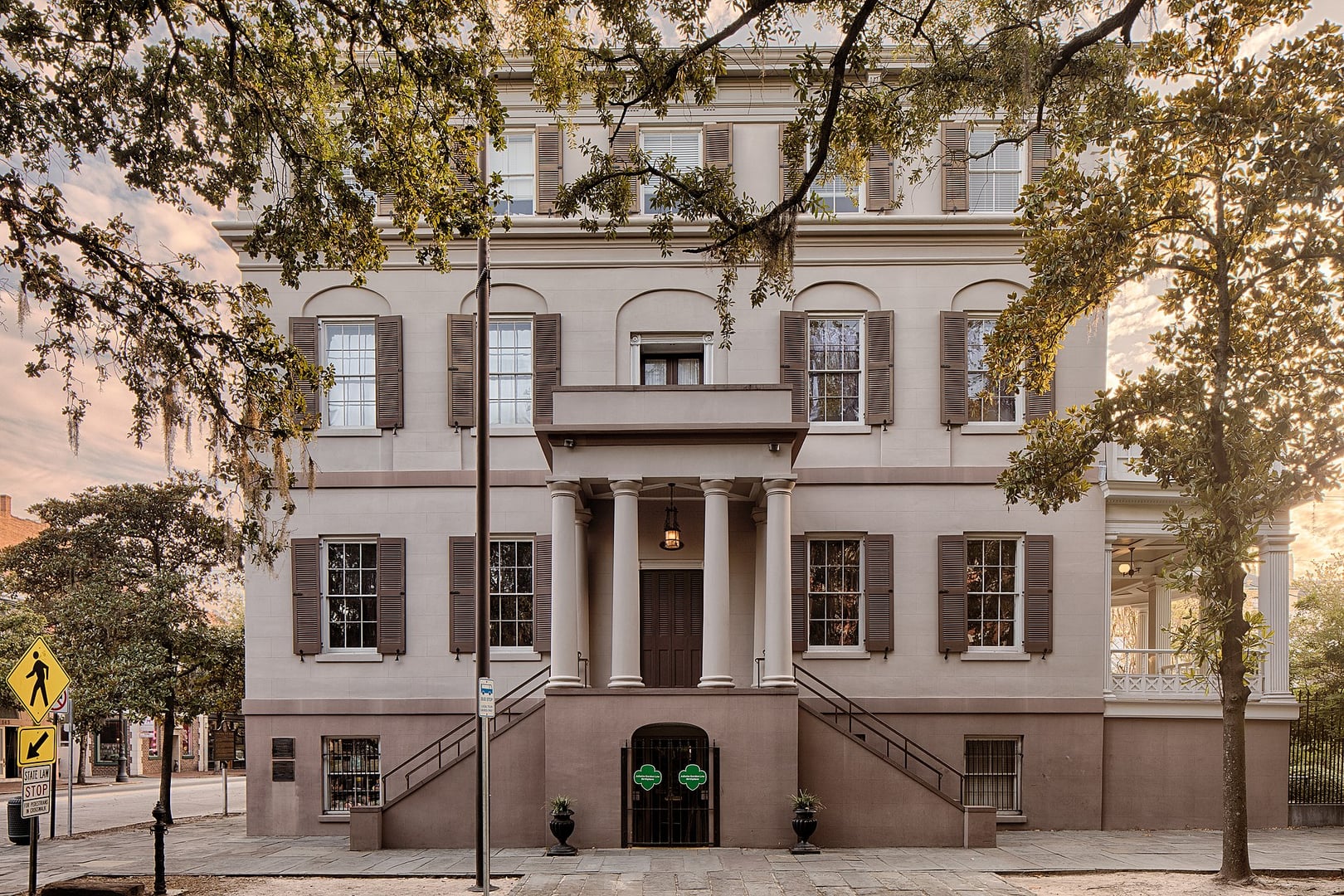
Cotton merchant Richard Richardson and his wife Francis Bolton commissioned a residence in 1816 from English-born architect William Jay (1792-1837), who had relocated to Savannah from Bath, England. Jay completed his designs before his twenty-first birthday, and the resulting mansion — known initially as the Richardson House — is widely recognized as North America's preeminent example of English Regency residential architecture. The building features Greek Revival detailing, a curved cast-iron veranda on the south facade, and an early American example of indoor plumbing.
Richardson suffered severe financial losses three years after the home's completion and lost the property. The Bank of the United States held the building for several years; subsequently, Mrs. Mary Maxwell ran a lodging house in the structure for approximately eight years. On March 19, 1825, the Marquis de Lafayette, then on his triumphal U.S. tour, stayed at the lodging house and addressed an enthusiastic crowd from the cast-iron veranda on the south facade.
In 1830, attorney, congressman, lawyer, and Savannah mayor George Welshman Owens purchased the property for $10,000. The home remained in the Owens family for the next 121 years. In 1951, Margaret Thomas — George Owens's granddaughter and the last private owner — bequeathed the mansion to the Telfair Academy of Arts and Sciences (today's Telfair Museums), making it Savannah's first historic-house museum.
The property includes an intact urban slave quarters building behind the main house — a rare survival in American historic preservation. The quarters retain original haint-blue ceiling paint applied by enslaved workers, and the museum's interpretive program gives substantial attention to documented enslaved residents including Hagar, Marshall, and other named individuals who labored at the Owens household. The Owens-Thomas House was designated a National Historic Landmark in 1976 (Library of Congress HABS reference number HABS GA-272).
Sources
- https://en.wikipedia.org/wiki/Owens%E2%80%93Thomas_House
- https://www.telfair.org/article/the-history-of-the-owens-thomas-house/
- https://www.loc.gov/item/ga0091/
- https://exploregeorgia.org/savannah/history-heritage/historic-homes/owens-thomas-house
- https://www.georgiahistory.com/ghmi_marker_updated/owens-thomas-house-2/
'Lady in Grey' apparition in the garden and lower hallBlack-haired male apparition in 1830s dress in the front parlorPhantom pipe tobacco smoke in unoccupied roomsCold spots upstairs
The Owens-Thomas House is one of the few Savannah museums that explicitly does not market itself as a haunted attraction; the Telfair Museums' interpretive program centers on William Jay's architecture, the documented lives of the Owens family, and the enslaved laborers who worked the urban estate. Paranormal reports come through Savannah ghost-tour operators and visitor anecdote.
The most commonly reported apparition is the 'Lady in Grey,' a female figure in nineteenth-century mourning dress described walking the garden behind the main house and occasionally on the ground floor of the mansion. Tour-operator lore identifies the figure as Margaret Thomas (the last private owner, who lived in the home into the 1950s), though no source provides physical descriptions or photographs that would corroborate the identification. Hauntbound notes the figure is described in clothing consistent with the nineteenth century, which would be inconsistent with Margaret Thomas's actual lifetime — flagging the identification as ghost-tour tradition rather than documented fact.
A second figure, described as a black-haired man in 1830s formal dress, is reported in the front parlor. Tour-operator lore associates the figure with the George Welshman Owens era (1830-1856), but no specific named individual is identified.
A third recurring report describes the smell of pipe tobacco accompanied by visible smoke appearing briefly in unoccupied rooms, particularly upstairs. The Owens household is documented to have included pipe smokers, but no specific connection is drawn in the sources.
Hauntbound treats the property primarily as a National Historic Landmark of major architectural and social-history significance, with paranormal lore secondary to its documented role in interpreting urban slavery and English Regency architecture. The narrative of enslaved residents — Hagar, Marshall, and others identified in surviving Owens family records — is presented in the museum's interpretive program as historical fact, not as a haunted attraction; Hauntbound follows that editorial framing.
Notable Entities
'Lady in Grey' (identified by ghost-tour lore as Margaret Thomas; identification disputed)Unnamed male figure in 1830s dress
Media Appearances
- Featured on multiple Savannah ghost-tour itineraries
- Telfair Museums historic-architecture programming