Est. 1807 · One of oldest Gothic Revival civic buildings in the United States · Georgia Secession Convention January 19, 1861 · Sherman's 1864 Union occupation and mock repeal of secession · Lafayette visit 1825 · National Register of Historic Places
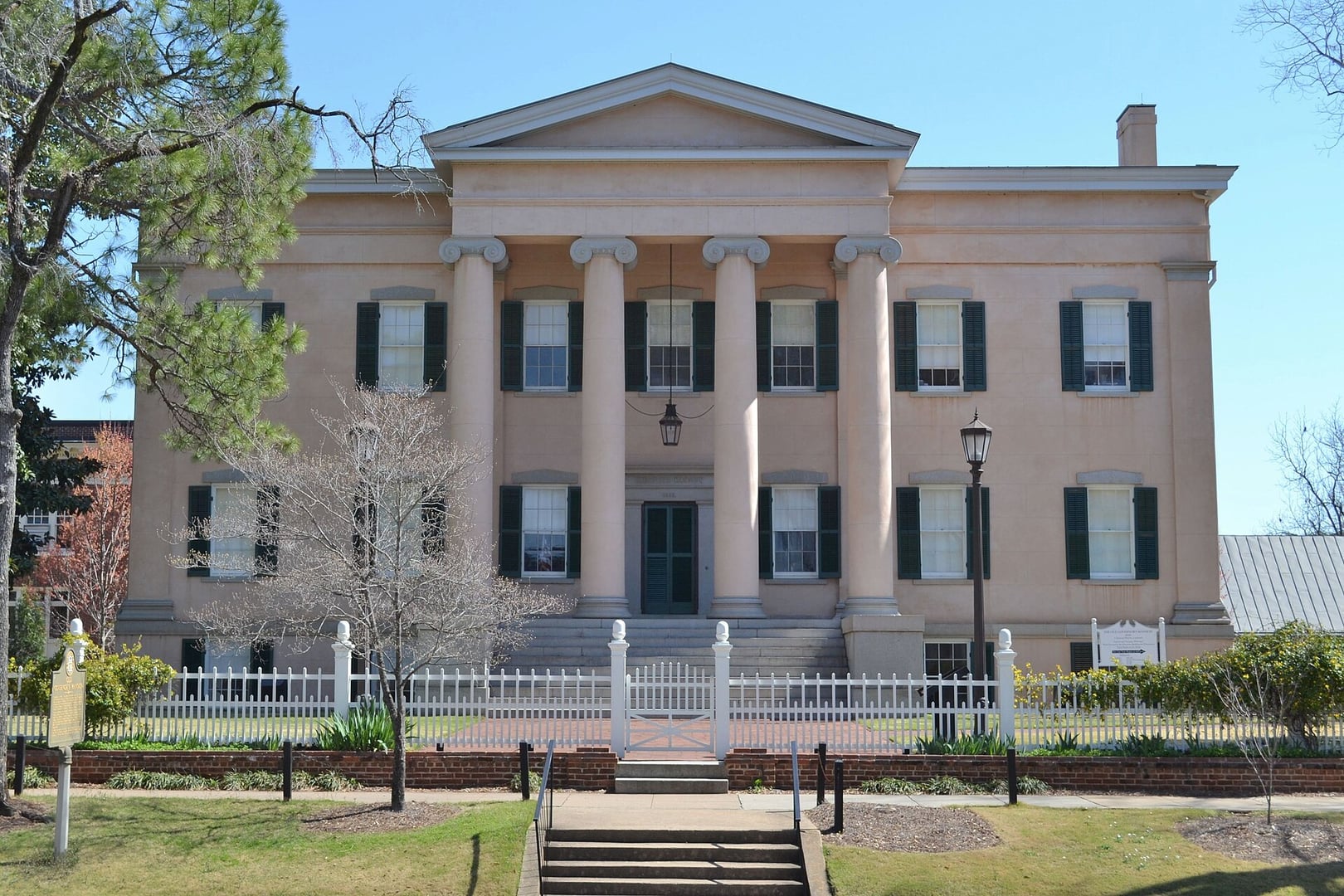
The Old State Capitol was completed in 1807 after Georgia's legislature voted in 1804 to relocate the capital from Louisville to Milledgeville. Designed in the Gothic Revival style — an unusually early American use of the form for civic architecture — it was expanded with a north wing in 1828, a south wing in 1834, and granite portico steps in 1835. The Marquis de Lafayette visited during his 1825 American tour.
On January 19, 1861, Georgia's Secession Convention convened in the building and voted to withdraw from the Union — one of the pivotal legislative actions leading to the Civil War. When Union General William Tecumseh Sherman's forces arrived on November 23, 1864, state officials had already fled. The building was damaged during the occupation, and armories and magazines on the Statehouse Square were destroyed. Union troops then staged a mock legislative session in the chamber, theatrically 'repealing' Georgia's secession.
After the Civil War, the building served as a courthouse from 1871 to 1879 before Georgia Military College took over the campus. The building remains the center of the college to this day and is listed on the National Register of Historic Places.
Sources
- https://en.wikipedia.org/wiki/Old_State_Capitol_(Milledgeville,_Georgia)
- https://georgia.gov/blog/2014-10-28/spooks-and-scares-around-georgia
- https://www.visitmilledgeville.org/things-to-do/history-heritage/haunted-milledgeville/
Phantom marching sounds on parade groundsApparition of Confederate sentry at building perimeterUnexplained auditory phenomena on campus
The lingering paranormal tradition at the Old State Capitol centers on sound rather than apparition. Witnesses on the adjacent parade grounds have reported the sound of massed troop movement — boots on ground, a cadence — with no corresponding physical presence. The phenomenon has been documented in Georgia.gov's own coverage of the site, giving it a degree of official acknowledgment unusual for paranormal claims.
A Confederate sentry apparition has also been reported, described as a uniformed figure that appears briefly at the building's perimeter before disappearing. Given the building's documented history as a site of Civil War-era legislative drama — secession voted here in January 1861, Union occupation in November 1864 — the campus has accumulated enough historical weight to anchor persistent folk accounts of residual presence.
The mock legislative session staged by Sherman's troops in 1864 adds an additional layer of symbolic intensity: the building that formalized Georgia's departure from the Union was also the stage for a theatricalized federal reassertion of authority.
Notable Entities
Confederate sentry apparition