Est. 1874 · Active First-Order Fresnel Lens · National Register of Historic Places · Florida Maritime Archaeology Center
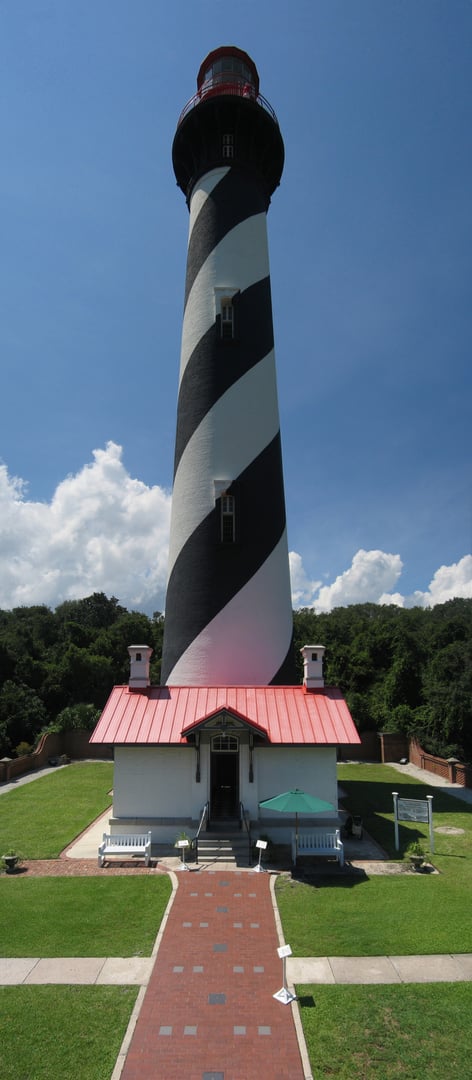
Spanish colonial authorities established a watchtower on Anastasia Island in the late 16th century to mark the entrance to Matanzas Bay and protect the supply route to St. Augustine. A coquina-stone tower stood at the site through the early 19th century. The U.S. Lighthouse Service designed a permanent replacement following coastal erosion that threatened the older structure, and construction of the present 165-foot brick tower began in 1871.
During construction, on July 10, 1873, four young people working or playing on the supply tramway at the building site died in a drowning accident. The construction railway carried materials from supply ships docked at Salt Run up to the building pad. The wooden timber that normally stopped the cart at the water's edge had been removed. Mary Pittee (15), Eliza Pittee (13), and an unnamed African-American girl (10) were trapped under the overturned cart and drowned. The youngest Pittee daughter, four-year-old Carrie, was pulled to safety by Dan Sessions, a young African-American worker on the construction crew. The girls were the daughters of construction superintendent Hezekiah H. Pittee.
The tower was lit on October 15, 1874, with a first-order Fresnel lens still in operation today. The black-and-white spiral daymark is the station's distinguishing feature on charts of the Florida coast.
The U.S. Coast Guard automated the light in 1955 and transferred the keeper's house and grounds to the Junior Service League of St. Augustine in 1980 for restoration. The non-profit St. Augustine Lighthouse and Maritime Museum opened the restored complex in 1994. The Lighthouse Archaeological Maritime Program (LAMP), housed at the museum, conducts shipwreck and underwater-archaeology research along the First Coast.
The property is listed on the National Register of Historic Places and serves as an active aid to navigation.
Sources
- https://www.staugustinelighthouse.org/2020/03/02/ghost-stories-the-pittee-girls/
- https://www.staugustinelighthouse.org/
- https://floridatrust.org/haunted-in-st-augustine/
- https://ghostaugustine.com/blog/haunted-st-augustine-lighthouse/
- https://www.visitstaugustine.com/article/haunting-tour-lighthouse
- https://believingthebizarre.com/is-st-augustine-light-house-haunted/
- https://believingthebizarre.com/the-haunted-st-augustine-lighthouse/
- https://americanghoststories.com/the-haunting-tale-of-the-st-augustine-lighthouse-st-augustine-fl/
- https://coffeehousewriters.com/ghosts-of-st-augustines-lighthouse/
Disembodied laughterApparitionsPhantom footstepsPhantom smellsObject movementEquipment malfunction
The lighthouse's most prominent paranormal narrative centers on the 1873 drowning of the three Pittee daughters and their friend during construction. The venue's interpretive program acknowledges the lore with archival care: the deaths are documented in the Pittee family record and in contemporary press coverage, but the paranormal reports are presented as visitor and staff accounts rather than as confirmed supernatural events.
Reported phenomena include the sound of children laughing on the upper gallery and the tower stairs, a young girl in 19th-century dress photographed on the grounds and in the keeper's house, and ribbons of blue light that have been captured on infrared photography. Staff arriving early to open the museum have reported hearing footsteps on the stairs above them.
The keeper's house produces a distinct second cluster of reports tied to former keepers and their families. Smell of cigar smoke has been documented in the parlor; the rocking chair in the upstairs bedroom has been reported as moving when no one is present. The basement, which houses LAMP archaeological equipment, has produced equipment-malfunction reports during paranormal investigations.
The lighthouse appeared on Syfy's Ghost Hunters in 2006, on Travel Channel's Ghost Adventures, and on several other paranormal programs. The site has been ranked among the most-haunted places in Florida and the world by various commercial and editorial outlets.
Notable Entities
Mary PitteeEliza Pittee
Media Appearances
- Ghost Hunters (Syfy, 2006)
- Ghost Adventures (Travel Channel)
- BuzzFeed Unsolved: Supernatural: The Haunting Shadows of the St. Augustine Lighthouse (S6E2) (2019)
- Ghost Hunters: Return to St. Augustine (2019, A&E)
- Ghost Hunters: Return to St. Augustine Lighthouse (2008)