Self-Guided Visit
Self-Guided Daytime Visit
Walk the Colonial-era grounds, read headstones dating to the 1790s, and explore the historic Gunn family section and Revolutionary War veterans' graves during daylight hours.
- Duration:
- 45 min
HauntBound archive · catalog record
Reported phenomena, as catalogued
+ 3 further entries on record
A Colonial-era Naugatuck burial ground established in 1790, cited by Ed and Lorraine Warren as haunted and renowned for phantom children's laughter, ragtime music, and spectral figures among Revolutionary War graves.
Gunntown Rd, Naugatuck, CT 06770
Research updated September 2026
Age
All Ages
Cost
Free
Free public access during daylight hours. Private guided ghost investigations available through Veil Walker Paranormal (fee applies).
Access
Limited Access
Grassy hillside cemetery with uneven ground and stone walls; not paved.
Equipment
Photos OK
Est. 1790 · One of the oldest continuously used cemeteries in New Haven County · Final resting place for Revolutionary War, War of 1812, and Civil War veterans · Named for the Gunn family, among the founding settlers of the Naugatuck Valley · Documented in the Charles R. Hale Collection at the Connecticut State Library
Gunntown Cemetery was established in 1790 on a modest hill above the Naugatuck River in Naugatuck's Millville section. The site takes its name from the Gunn family, early settlers of the Naugatuck region whose patriarch Jasper Gunn emigrated from Britain to New England around 1635 and helped found the town of Milford, Connecticut. By the mid-1700s, descendants of the family had spread into the Naugatuck valley, operating an 800-acre parcel that included a sawmill, blacksmith shop, general store, and distillery — a community known as Gunntown. Numerous Gunn family members are interred here, as are veterans from every major American conflict of the 18th and 19th centuries: the Revolutionary War, the War of 1812, and the Civil War.
Headstones in the old section display family names typical of early New England settlement — the cemetery represents a cross-section of the farming and mill-working community that built Naugatuck before its industrial expansion in the 19th century. The site is enclosed by a stone wall and an iron gate and maintained by the Grove Cemetery Association of Naugatuck. It is listed in genealogical databases including FindAGrave and BillionGraves, and is documented in the Oxford Past Cemetery Project maintained by local researchers.
The cemetery's reputation as one of Connecticut's most notable historic burial grounds is reinforced by its continuous use from 1790 and the survival of legible Colonial-era markers. It sits within the broader Gunntown Passive Park and Nature Preserve, managed by the Borough of Naugatuck.
Sources
Gunntown Cemetery has carried a haunted reputation for decades, drawing paranormal investigators and curious visitors alike. The most celebrated endorsement came from Ed and Lorraine Warren, founders of the New England Society for Psychic Research and Connecticut's most famous paranormal researchers. After visiting the cemetery, Lorraine Warren reportedly stated the location harbored dark energy — not because of the souls buried there, she cautioned, but because of the intentions of some of those who visit for negative purposes.
The most consistently reported phenomenon is the laughter of children. Witnesses describe the sound originating in the field beyond the back stone wall and growing closer with each passing minute, until it seems to arise from within the cemetery itself. Some visitors also report hearing old ragtime-style music, described as sounding as though it were being played from deep within the surrounding woods. Paranormal investigators have captured alleged Electronic Voice Phenomena (EVPs) and photographed what they describe as spirit orbs and ectoplasmic mist among the headstones.
Several apparitional figures have been described over the years: a man carrying a lantern while leading a horse across the cemetery grounds; a young boy playing near the rear stone wall who vanishes when approached; and a large black dog that disappears suddenly. These accounts are documented in Cheri Revai's *Haunted Connecticut* (Stackpole Books, 2006), one of the region's most widely referenced paranormal reference books, as well as in multiple local and regional paranormal publications. According to Damned Connecticut, unlike many haunted cemeteries, Gunntown lacks a single well-known founding tragedy — the paranormal reputation has accumulated through visitor accounts across many decades rather than a specific documented event.
Notable Entities
Media Appearances
Walk the Colonial-era grounds, read headstones dating to the 1790s, and explore the historic Gunn family section and Revolutionary War veterans' graves during daylight hours.
Small-group private paranormal investigations offered by Veil Walker Paranormal, a local CT operator, for parties of 1-2 during daytime hours.
Some links on this page may earn HauntBound a small commission when you book, at no extra cost to you. Our editorial picks are independent. Full disclosure
Every HauntBound history is researched from documented sources. We clearly separate verified historical fact from paranormal folklore.
Free Guide
10 verified stops, rated for families, mapped in order. Free.
One email to confirm, then the guide link. Unsubscribe anytime.
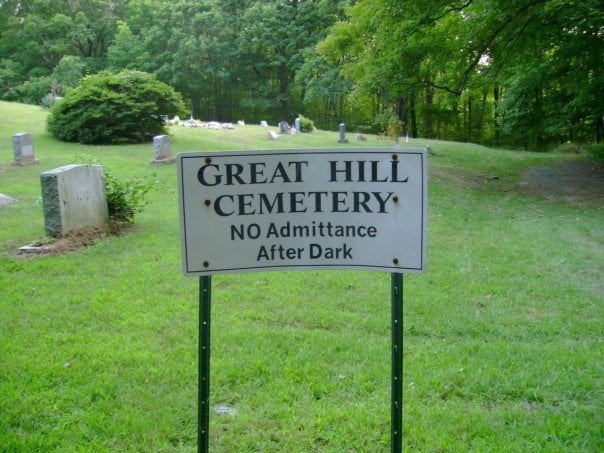
Seymour, CT
Great Hill Cemetery in Seymour, Connecticut was established in 1798 and contains graves dating to the late 18th century. It is a privately maintained rural burial ground with family names typical of early Naugatuck Valley settlers, including Holbrook, Smith, Lum, and Tomlinson. Cemetery records are held in the Charles R. Hale Collection at the Connecticut State Library.
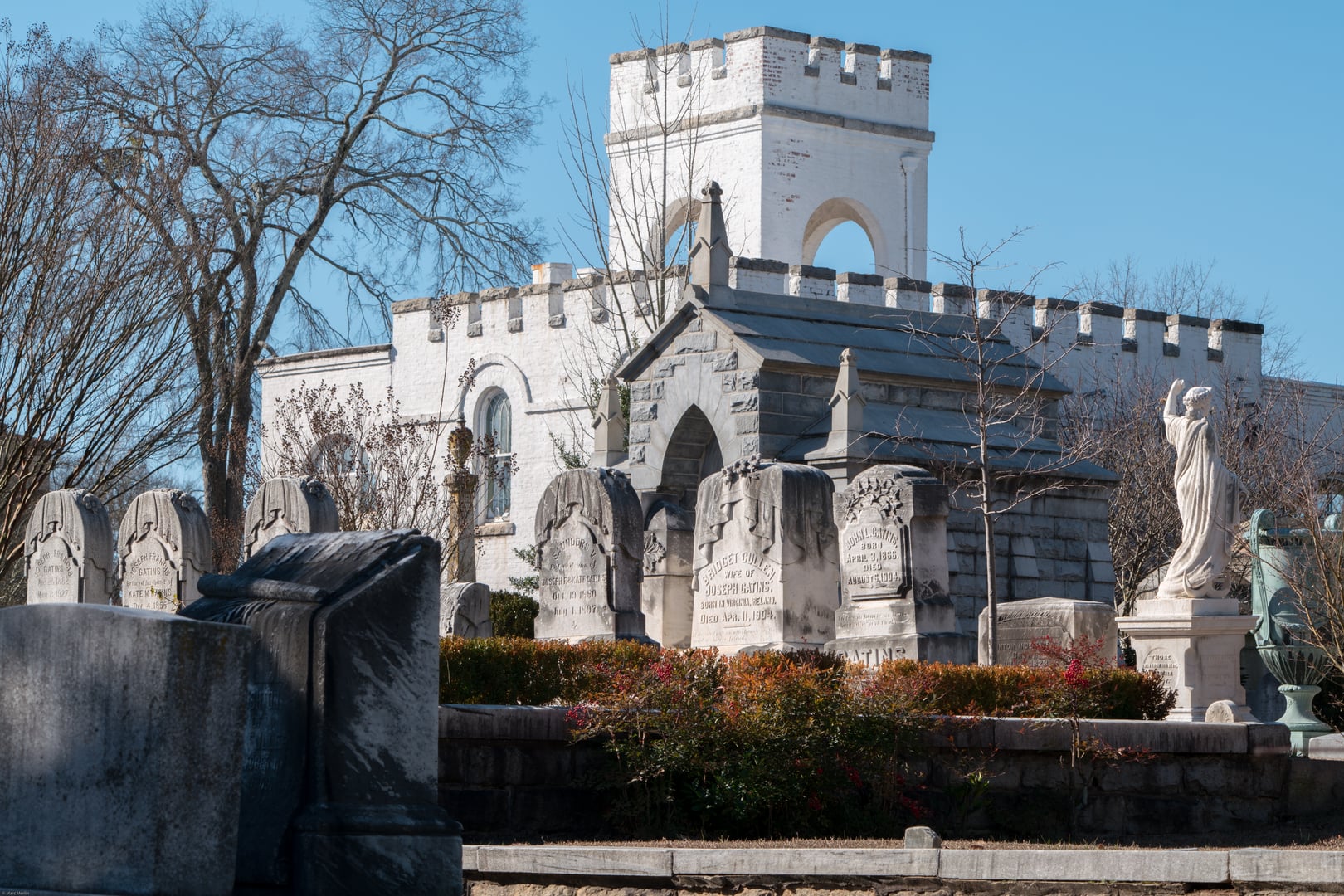
Atlanta, GA
Historic Oakland Cemetery was chartered in 1850 as the six-acre 'Atlanta Cemetery,' renamed Oakland in 1872, and expanded to 48 acres. Approximately 70,000 people are interred, including roughly 6,900 Confederate soldiers (3,000 unidentified), four Confederate generals, six Georgia governors, 27 Atlanta mayors, Margaret Mitchell, golfer Bobby Jones, and Maynard Jackson, Atlanta's first African American mayor. The cemetery was listed on the National Register of Historic Places on April 28, 1976.

San Diego, CA
El Campo Santo was established in 1849 as the Catholic cemetery for San Diego's Mexican-California community in Old Town, with approximately 477 burials through its 1880 closure. In 1889 a horse-drawn streetcar line was cut through part of the cemetery, and in 1942 that path was paved as San Diego Avenue, entombing more than 20 graves under the modern street. The San Diego Historical Society restored the visible cemetery in 1933, and in 1993 ground-penetrating radar located the buried graves — their positions are now marked by small bronze discs in the sidewalk and pavement.